Allision - Nautical Word of the Day

Published: November 8th, 2007 by John | Comments |


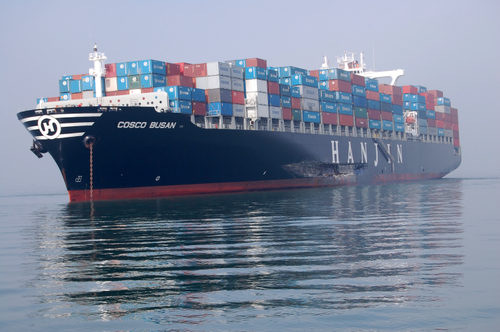
Cosco Busan Allision

In covering the recent San Francisco Bay Bridge incident I have noticed most (but not all) of the news articles have made a small error in terminology. In describing the incident where the Cosco Busan hit the Bay Bridge many prominent news organizations referred to event as a collision when in fact it was an allision.

For clarification: A vessel collides with another moving vessel…. A vessel allides with a fixed object (unless it is submerged) and is presumed at fault.

Marine Dictionary - Allision

For those interested in learning more about the allision here are some good links;

For future articles stay tuned with our Maritime News Discoverer’s Upcoming Links

Here is a photo of the environmental damage;

Oil Spill around alcatraz

Kurt Rogers / San Francisco Chronicle

Update:

We received an excellent email on the subject from fellow SUNY Maritime alumni John A. Tylawsky;

Allision is a violent striking (such as in a collision) with a fixed object.
This is in contrast with “vessel contact” with a fixed object such as would
be made with bridge fenders in the ordinary course of say a tug and barge
passing under a bridge.

Bridge owners would prefer to classify all vessel/bridge interactions as
“allisions” when fender systems have not been maintained and simply fall
apart upon incidental contact, or were never properly designed.

The right of navigation generally supercedes the right of the bridge to
obstruct the waterway. Bridge fenders are intended to protect the vessel,
not the bridge. Congress allowed the bridge to be constructed with the
provision that navigation would not be interfered with.

Under the “Oregon Rule” the burden of proof is on the moving vessel to prove
that the allision was the stationary object’s fault. This might be shown,
for example, if the fender was encroaching upon the navigation channel
either from damage, or in some cases because it was not built or repaired
according to the permit.

John A. Tylawsky, P.E.
Consulting Marine Engineer
Board Certified Forensic Engineer
www.marinesafetycenter.com

Thanks John for the clear explanation.

Related Articles

Related Link: USCG Talk - Chat with other Guardians on our forum!

Related Link: Marine Incident Forum - Share photos, videos and marine incident reports online.

Related Link: Marine Incident Forum - Share photos, videos and marine incident reports online.

Categories: Container Ship · Incidents · MARPOL Incidents · San Francisco · marpol

Tags: · , , , , , , , , , , , , , ,


-

  • Jerry Mendes
    I'm not a mariner, nor am I familiar with "rules of the road" for ships, boats, and other seagoing craft. Nor am I familiar with the responsibility of the ship's Master or the authorities who build bridge piers in the midst of navigable waters.

    I am but a simple, but well-informed, citizen of the San Francisco Bay Area.

    While Mr. Tylawski may well be correct in stating Maritime Law as it relates to a ship hitting a bridge pier (or it's fendering system) -- his words strike me as classroom theory, not reality in the present instance of a 900 foot ship hitting the fendering system of the Bay Bridge.

    The bridge and it's piers have been in their present locations since 1936 (actually earlier, during the construction) and local Maritime rules-of-the-road have long since been established to guide mariners safely between the piers without hitting any fixed objects. And, the fendering system was recently upgraded and completely rebuilt by the State of California Department of Transportation and it's contractor. There's been no mention of the fendering system having been previously damaged and being in the well-defined shipping channel -- because it wasn't previously damaged, and wasn't in the channel.

    So, while Mr. Tylawski's words may be a correct statement of maritime law and common practice, it's misleading to me and members of the public to hear (read) his dissertation, without reference to the actual event of the Cosco Busan hitting the fixed object.

    It might have been more helpful to those of us in the public -- who could easily find this site through a search -- if he had said that he was describing a theoretical circumstance, and his words actually had no real relevance to the Cosco Busan incident. He leaves me with the impression that it is his opinion that there is some doubt about whether the bridge owner or the ship's owner is legally responsible for the allision.

    I'm sure he had no intention of leaving that impression. But I'm curious why he would describe this aspect of maritime law in a thread relating to the Cosco Busan, without being entirely clear that his statement wasn't meant to describe his views of what happened in this accident.

    Jerry Mendes
    San Francisco, California
  • Fergus, good catch but don't forget the temperature!
  • fergus moran
    Here is a thought to ponder on if you like :

    With regard to fuel, when refering to volumes - whether bunkering, daily consumption, heating, transfering or tank capacity of same - ship's officers normally and consistently speak in tonnes ... not gallons. Consider the spillage figure of 140 as provided to the USCG by one of the vessel's complement : had this been (correctly) interpreted as tonnes the approximate corresponding gallons would be the product of gallons per barrel times barrels per ton i.e. 56 x 7.2 x 140 resulting in a rough estimate of 56,000 gals.
  • Tim
    Allision is a good word, not used in it's correct context very often! Not to be confused with Allusion!
  • Thanks Mr. Rogers:

    Allision - that's a big word. Can you say that?
blog comments powered by Disqus


Search This Blog


Prefer Google? Click HERE


Subscribe Via Email

Daily Updates


Bi-Weekly Newsletter


Browse Categories


Authors


Recent Comments


Tags


Twitter License Plate