Don’t Miss Your Daily Briefing for the Maritime Industry
Join the leading maritime news network
— trusted by our 107,009 members
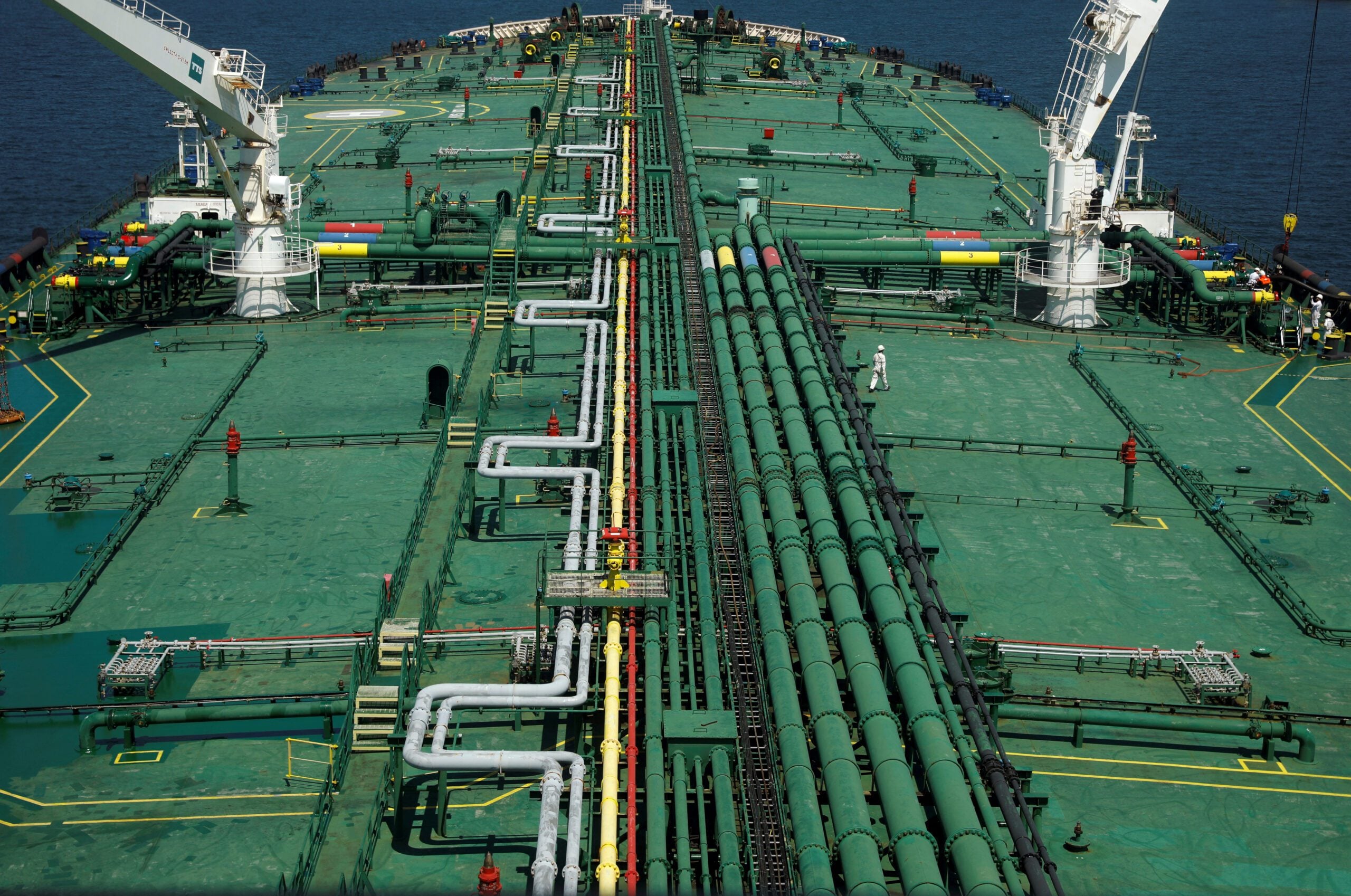
Pipelines run down the deck of Hin Leong's Pu Tuo San VLCC supertanker in the waters off Jurong Island in Singapore July 11, 2019. Picture taken July 11, 2019. REUTERS/Edgar Su
World Running Short Of Supertankers Threatens Long-Haul Oil Flow
By Yongchang Chin, Sherry Su, Nathan Risser and Alex Longley
Sep 19, 2026 (Bloomberg) –The soaring cost of moving oil around the world is making some long-distance crude trades uneconomical, threatening to disrupt flows at a time when fuel markets have never been tighter.
The jump is being driven by a shortage of available supertankers. In some parts of the world, there are barely any of the ships — each the length of three football fields — left for hire. The squeeze is making faraway barrels less attractive and encouraging refiners to snap up supplies closer to home if they can find them.
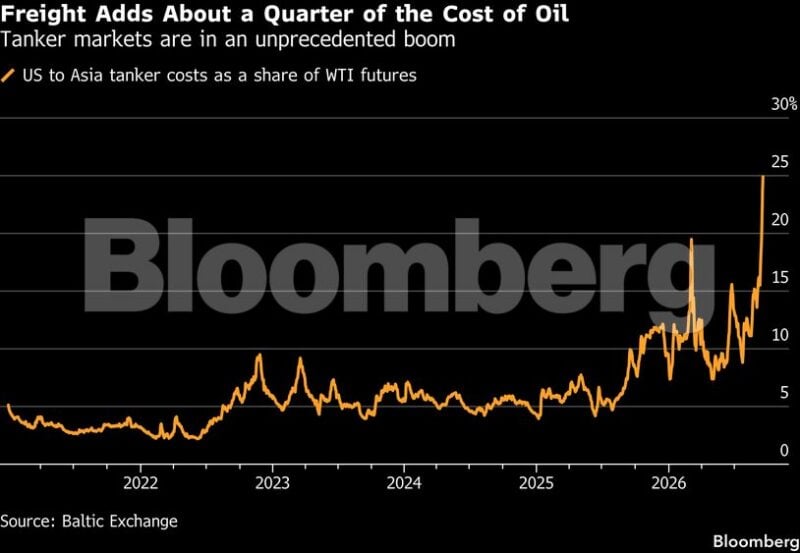
Moving a cargo from Houston to Asia now adds about $26 a barrel — $52 million a cargo — to the cost of supplying the world’s largest crude-importing region. That’s equal to roughly a quarter of the price of West Texas Intermediate futures. Before the war, shipping typically accounted for only a tiny fraction of the cost.
The rally is minting fortunes for the small group of shipowners that dominate the tanker market — several industry executives and brokers said the surge would previously have been unimaginable. The value of the world’s largest oil tanker equities soared to a record of almost $70 billion this week.
But for oil traders, the risk is that shipping becoming prohibitively expensive. They’re concerned that the higher costs make it unprofitable for some refiners to turn crude into fuels, deterring them from buying cargoes that have to sail over long distances, even when demand to make diesel and gasoline is strong.
On the industry’s main benchmark route, very large crude carriers hauling 2 million barrels of crude from the Persian Gulf to China are earning upward of $1.2 million a day. Similar pressures are now spreading across the freight market globally.
“It has never been this expensive to move oil around,” Saad Rahim, chief economist at trading giant Trafigura Group, said at the Bloomberg Commodity Investor Forum on Thursday. With freight becoming a larger portion of the value of the cargo, “it becomes a much bigger issue now when you start to think of that in terms of logistics.”
Some long-haul routes that became crucial after wars disrupted energy flows are now looking unattractive as a result of the surge.
Ship-tracking data from Vortexa show US-Asia flows have fallen in recent weeks, as freight costs roughly tripled. A Japanese refiner recently bought a cargo of Alaskan crude — a grade not typically well-suited for the country’s processors — because of the relatively short sailing distance, people familiar with the matter said.
In contrast, the clamor for nearby barrels shows up in Europe’s crude prices.
While Brent futures topped out close to $110 a barrel this week, the European Dated Brent physical crude price climbed above $131 as buyers hunted short-haul cargoes. The region’s processors are also scrambling to replace barrels from the Middle East after Saudi Arabia gave no cargoes to European buyers under their term contracts for next month.
Further afield, sales of Angolan oil, which usually sails thousands of miles to buyers in China, are sluggish.
“Current freight levels can become self-limiting over time — they eventually close arbitrage routes and reduce demand for the most expensive long-haul barrels,” said Sumit Ritolia, senior manager of modeling at analytics firm Kpler.
Shipbrokers with years of experience said they’ve never seen supertanker availability so tight, while multiple industry executives said they’ve never known a market like it. Many said there are few, if any, of the vessels available for hire in certain locations, depending on the timeframe in which they are required.
That’s rippling down to smaller ships.
Asian refiners are turning to 700,000-barrel Aframax tankers for some purchases from the US, rather than the supertankers typically used for those journeys. Shipments loading from ports in the Atlantic, including Brazil, are being booked on two 1 million-barrel Suezmax vessels rather one supertanker with twice that capacity, traders and shipbrokers said.
It’s dragged earnings for smaller vessels higher too. Earnings for Suezmaxes are on average north of $300,000 a day, rates typically associated with sailing in and out of war zones.
The biggest drivers of the surge are twofold: the knock-on effects of the US-Iran conflict, and a huge wager by a South Korean tycoon that was already sending shipping rates higher before the war began.
Vessels shuttling barrels through the Strait of Hormuz are sucking up more ships for longer as they switch cargoes near Oman. Other tankers are sailing thousands of miles around Africa to pick up cargoes in the Mediterranean, while until now, Asian buyers swapped lost Middle Eastern barrels for longer-haul supplies from the Americas. Those factors all help stretch out the tanker fleet and boost rates.
The key for oil traders is how long elevated freight rates can be sustained. Diesel futures in Europe are near $200 a barrel, a sign the region’s processors still need to get their hands on every cargo they can.
“Freight has never taken a big part of the delivered cost of oil, but it’s now playing a much bigger role in oil markets,” said Xavier Tang, senior market analyst at analytics firm Vortexa. “This is having a knock-on effect on end buyers.”
President Donald Trump said Friday that Russia has agreed to release millions of tons of diesel fuel into U.S. and global markets following a telephone call with Russian President Vladimir...
For a sign of just how extraordinary oil shipping costs have become, consider this: It’s now more expensive to hire a tanker from the US to China than to launch a rocket into space.
A commercial vessel was struck by a projectile in the Persian Gulf on Friday, sparking a fire onboard in the second reported attack on shipping inside the Gulf in just...
7 hours ago
Total Views: 360
Get The Industry’s Go-To News
Subscribe to gCaptain Daily and stay informed with the latest global maritime and offshore news
— just like 107,009 professionals
Secure Your Spot
on the gCaptain Crew
Stay informed with the latest maritime and offshore news, delivered daily straight to your inbox
— trusted by our 107,009 members
Your Gateway to the Maritime World!
Essential news coupled with the finest maritime content sourced from across the globe.

 Join The Club