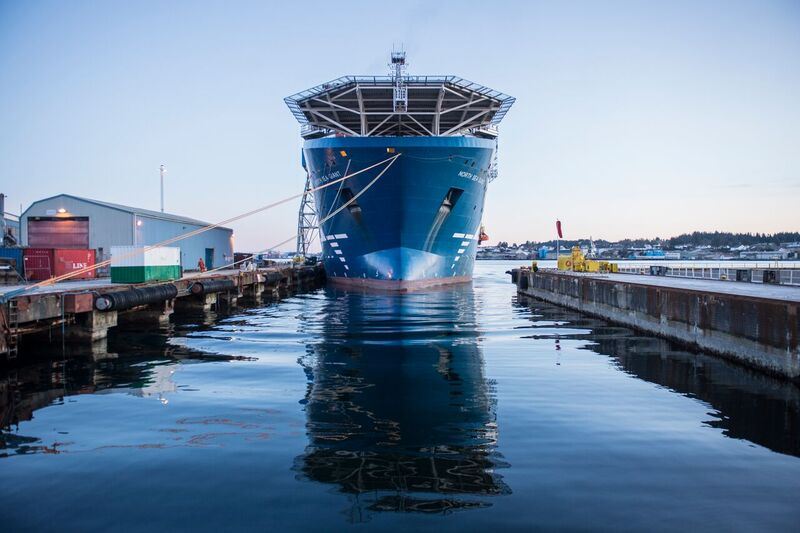
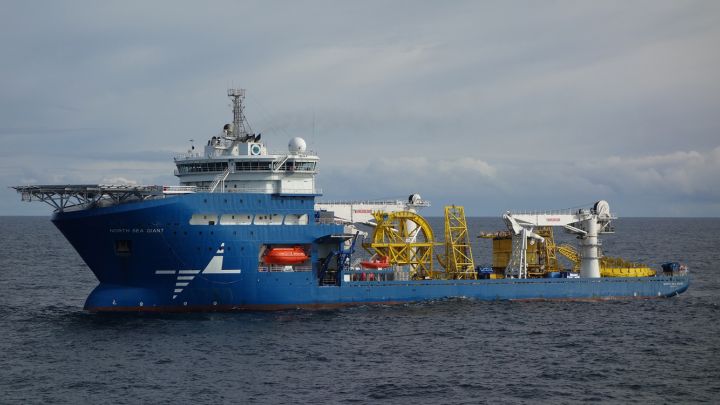
Finnish technology group Wärtsilä announced the installation of energy storage systems onboard the offshore construction vessel North Sea Giant which the group says could deliver impressive fuel savings of up to 50 percent.
Wärtsilä says the installation of three energy storage systems features, for the first time ever, energy and load sharing capability. The system combines a diesel-electric configuration with batteries.
The installation was carried out in February 2018 onboard the North Sea Shipping-owned ‘North Sea Giant’, one of the world’s largest and most advanced subsea construction vessels.
In a second phase of the project, Wärtsilä says it commissioned an electronic bus link, a newly developed module that allows the ship to share load and energy optimally between the three energy storage systems.
The company says the technology is expected to generate additional operating cost savings, and a total reduction in annual fuel consumption of two million liters, leading to an annual reduction in exhaust emissions of 5.5 million kg of CO2, 30 tons of nitrogen oxides (NOx), and 1200 kg of sulphur oxides (SOx).
Photo: North Sea Shipping
The three Wärtsilä energy storage systems reduce load fluctuations on the ship’s diesel generators. Typically, vessels utilizing dynamic positioning require two or more engines operating simultaneously at low load to secure back-up power. Wärtsilä explains, however, that by using a hybrid battery system to provide the needed reserve power, the operational engine can be run closer to its optimal load point.
“This is a forward looking solution that offers both cost and environmental benefits, including less maintenance, reduced fuel consumption, and fewer exhaust emissions. In addition, it promotes more efficient and safer operations for the ship. We are confident that the positive impact of this solution will eventually be felt throughout the industry,” says Sindre Utne, General Manager, Wärtsilä Project Centre, Norway.
“The project has been driven by our focus on reducing the environmental impact of offshore oil-related operations in the North Sea. The advanced Wärtsilä energy storage system is important, because of both the favourable fuel consumption as well as its sustainability. Seabed installations are increasingly moving further north into very sensitive environmental areas, which makes this system extremely relevant,” says Hallvard Klepsvik, CEO of North Sea Shipping AS.
HD Korea Shipbuilding & Offshore Engineering (HD KSOE) and HD Hyundai Heavy Industries (HD HHI) have received approval in principle (AIP) from ABS for their concept design of a 16,000...
Vigor Marine Seattle has completed a groundbreaking hybrid-electric conversion of the Washington State Ferry M/V Wenatchee, marking a significant advancement in maritime sustainability. The 202-vehicle ferry, one of the largest in...
The MF Ampere, the world’s first fully electric ferry, is celebrating 10 years of successful operations in Norway’s Sognefjord. Designed and built by Fjellstrand Shipyard in 2015, the vessel has...
February 19, 2025
Total Views: 1654
Get The Industry’s Go-To News
Subscribe to gCaptain Daily and stay informed with the latest global maritime and offshore news
— just like 107,412 professionals
Secure Your Spot
on the gCaptain Crew
Stay informed with the latest maritime and offshore news, delivered daily straight to your inbox
— trusted by our 107,412 members
Your Gateway to the Maritime World!
Essential news coupled with the finest maritime content sourced from across the globe.

 Join The Club