Sep 13, 2025 (Bloomberg) —Ukraine is increasingly targeting Russia’s oil refineries and export facilities with drones, taking the fight beyond the battlefield to strike at Moscow’s economy.
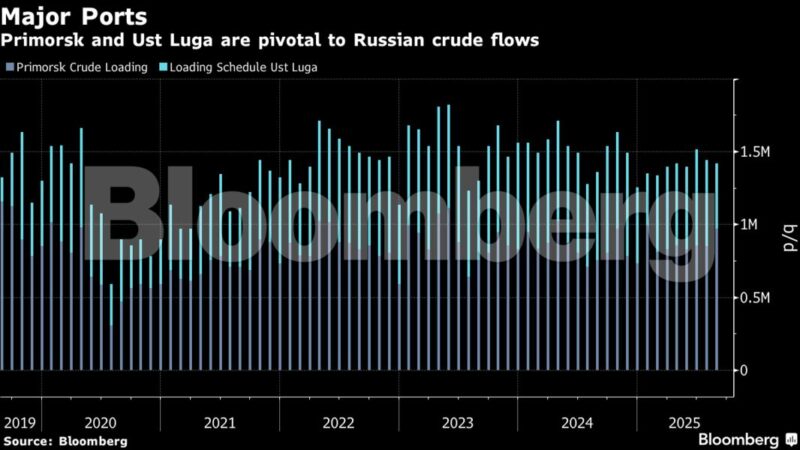
On Friday, Ukraine claimed to have struck facilities handling almost half of Russia’s seaborne crude exports. The attacks — part of a 200-plus drone raid centered on the Leningrad region bordering Finland and Estonia — came soon after strikes on several refineries crucial to domestic fuel supply.
Kyiv argues it’s trying to deprive Russia’s military of fuel, and the Kremlin of petroleum revenues. But Western allies have long expressed caution about any steps that could disrupt global oil and fuel supply.
Since the war began, the two Baltic Sea ports have sent the vast majority of their exports to China and India. Before the conflict, most flows went to Europe.
But even before Friday’s barrage, Ukraine had been pounding key plants that supply Russians with gasoline, diesel and other fuels — limiting how much Russia can make and highlighting Kyiv’s ability to affect the lives of ordinary citizens.
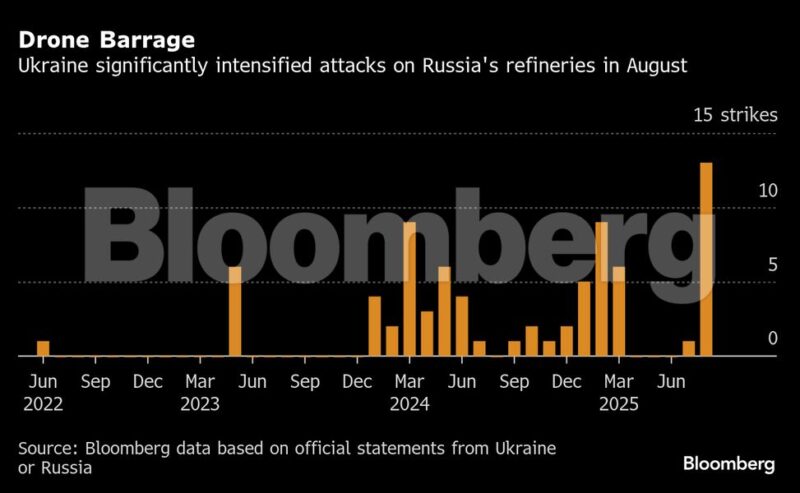
In August, the height of the summer driving season, Ukrainian drones carried out at least 13 attacks on major refineries, more than half the total for the previous seven months, data compiled by Bloomberg show. Within that, refineries in Russia’s most populous regions have been targeted more intensely than ever.
Gasoline shortages that first appeared in remote areas are now creeping closer to Moscow, with wholesale prices on the SPIMEX commodity exchange hitting successive records. Independent distributors that don’t produce their own fuel have been hardest hit, but major companies may also face supply strains if Kyiv continues its campaign.
“So far, shortages have been limited — it’s more of a matter of price and queues,” said Sergey Vakulenko, a former Russian oil executive and current senior fellow at the Carnegie Endowment for International Peace. “They do not hinder the economy yet, but rather create nuisances for the public.”
It’s nevertheless a concern for Russian authorities, and on the agenda of Deputy Prime Minister Alexander Novak and the Energy Ministry.
In response, Russia has banned gasoline exports and instructed refineries to ensure the domestic diesel supply, limiting outbound shipments. The targeted facilities are crucial for fuel supplies in the European part of the country, where over two-thirds of the population lives.
The frequency of strikes has forced some top refineries to halt operations for days to make emergency repairs, reducing Russia’s crude-processing rates in August to the weakest levels since May 2022.
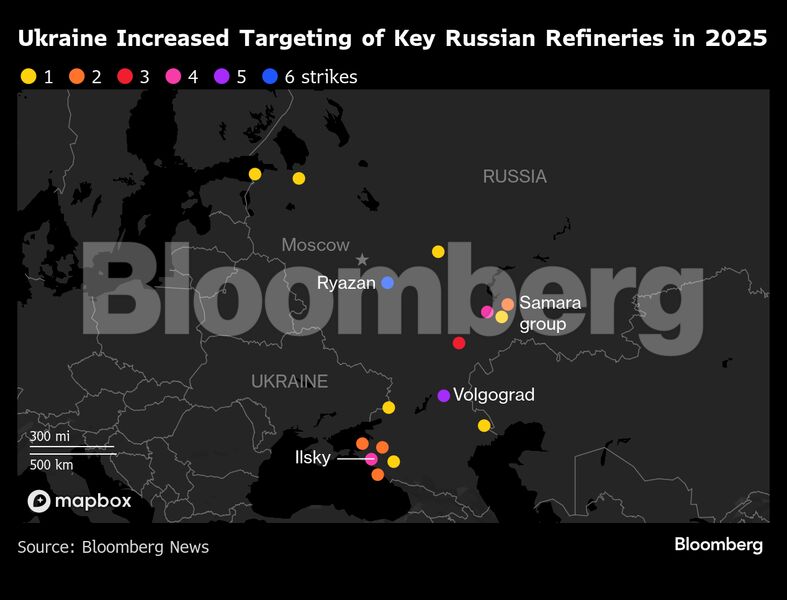
Lukoil PJSC’s Volgograd plant, with a capacity of 300,000 barrels a day, was attacked at least five times between January and August. Rosneft PJSC’s Ryazan refinery, designed to process as much as 340,000 barrels a day, was targeted at least four times. A group of plants known as the Samara refineries, with a combined capacity of 485,000 barrels a day, was hit at least seven times.
Those raids contrast with the first two years of the war, when drones struck mostly smaller independent refineries in southern Russia, causing little nationwide impact. In 2024, strikes widened to major facilities across the country, but damage was limited as drones rarely hit the same refinery repeatedly, allowing time for repairs.
The International Energy Agency in its most recent report estimated the August strikes put offline 250,000 barrels a day of Russia’s active crude-processing capacity. That’s around 5% of the nation’s refinery runs, although some estimates are higher still.
“If the temporary problems turn into more persistent ones, the Kremlin might start to worry or put some ideological spin on it,” Vakulenko said. “For now, it feels like they just expect it to pass.”
Western Support?
There’s no indication Ukraine’s campaign has Western backing. Allies have long avoided actions that could disrupt petroleum supply. A risk for Kyiv is that it pushes too far, driving up global fuel prices and straining relations with Europe and the US, where inflation and growth remain priorities.
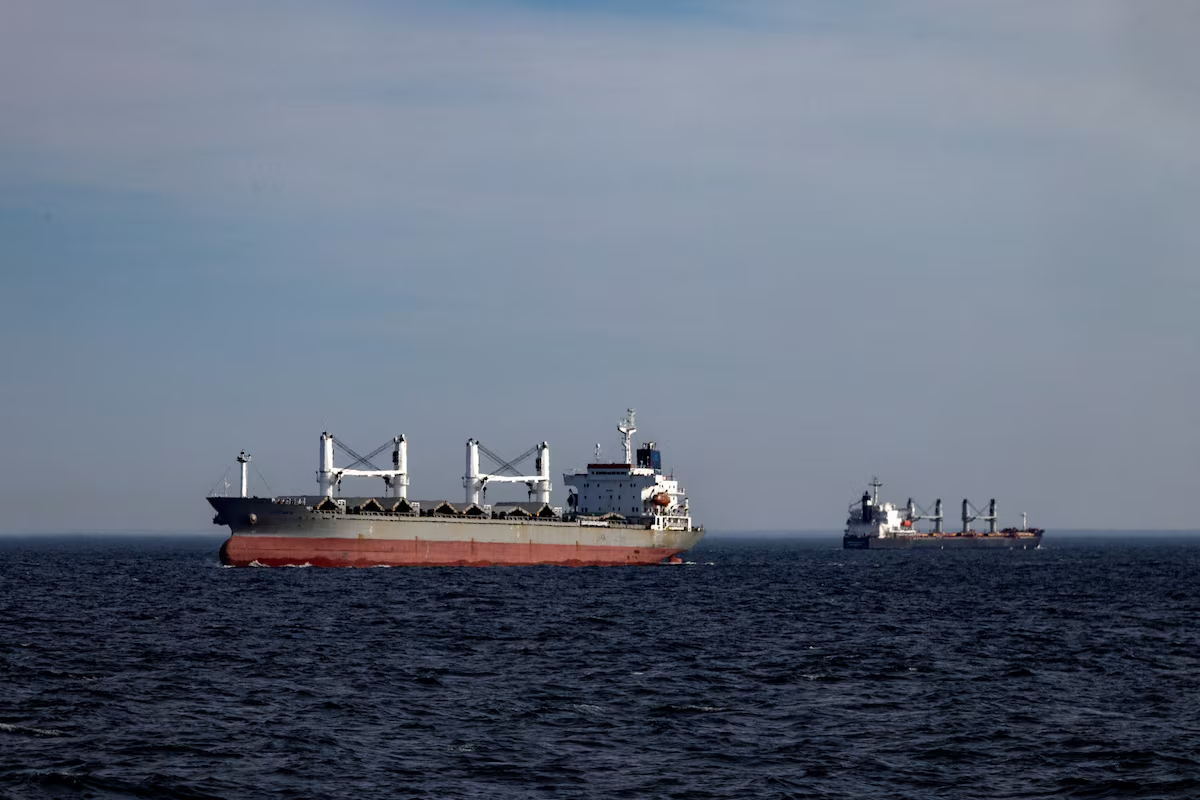
Ukraine says the latest attack in the Baltic Sea temporarily suspended crude operations at Primorsk, the region’s largest oil-loading port, according to a person familiar with the matter who asked not to be identified. Three pumping stations feeding Ust-Luga, another vital export facility, were also targeted, including one at Andreapol that was already struck earlier this year.
While located hundreds of miles inland, damage to those stations could disrupt shipments to the Baltic coast.
The Kremlin has not confirmed the Baltic strikes, and state pipeline operator Transneft didn’t respond to requests for comment.
A vessel moored in Primorsk caught fire after being hit by drones, but the blaze was extinguished, Aleksandr Drozdenko, governor of the Leningrad region, said in a Telegram post. He also mentioned an attack at an unnamed pumping station.
Primorsk is a key Baltic outlet for Russian crude and refined products. Last month, it loaded about 330,000 barrels a day of diesel-type fuel and 1.15 million barrels a day of crude, Bloomberg data show.
Ust-Luga is Russia’s second-largest Baltic oil hub. Its four-week average flows recently reached 626,000 barrels a day, though shipments had previously slumped after strikes on Unecha, another pumping station that supplies both Ust-Luga and the Druzhba export pipeline.
“The most effective sanctions are in fact the Ukrainian ‘sanctions,’ which are the drone attacks on Russian energy installations,” said Arne Lohmann Rasmussen, chief analyst at A/S Global Risk Management.
President Donald Trump said Friday that Russia has agreed to release millions of tons of diesel fuel into U.S. and global markets following a telephone call with Russian President Vladimir...
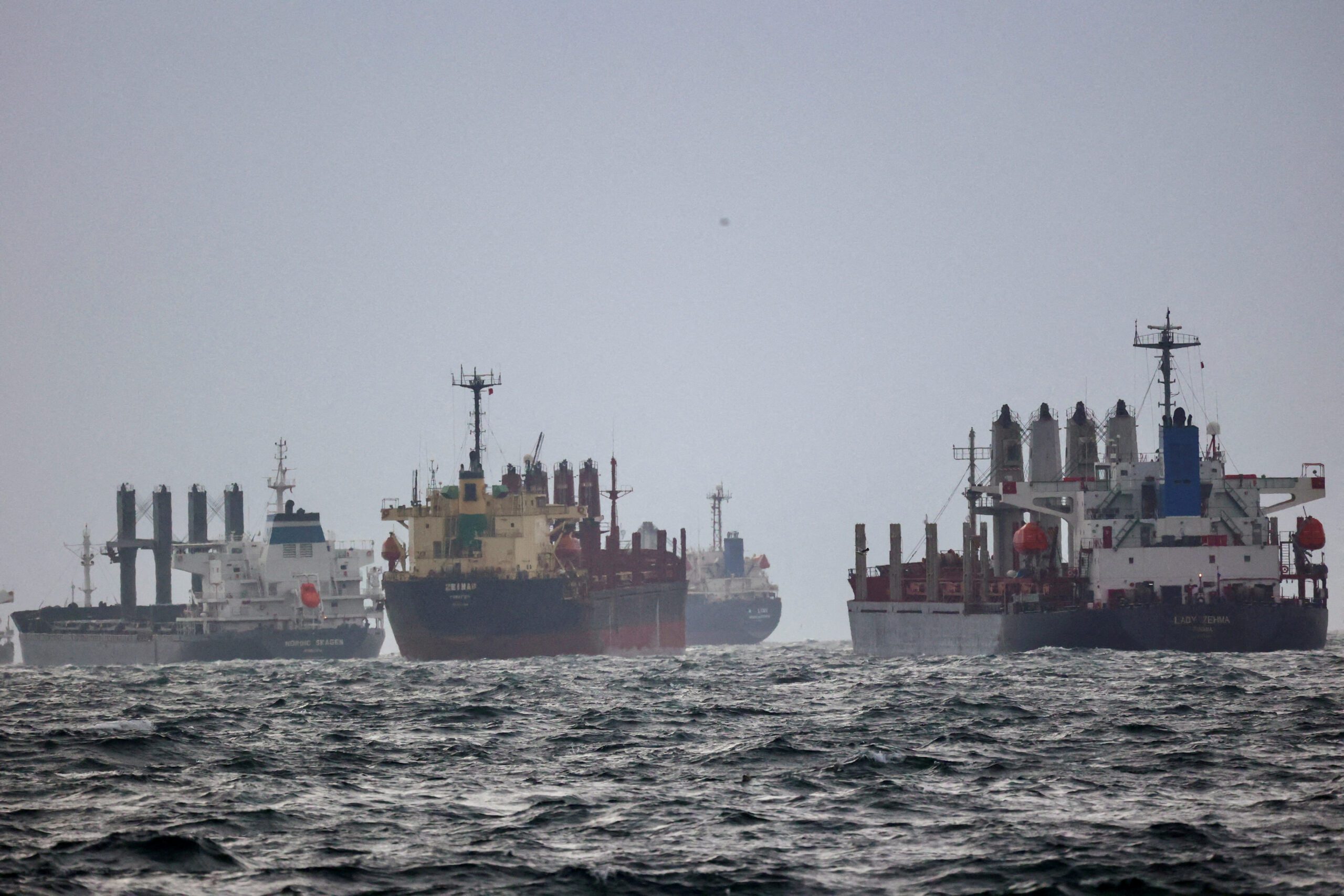
Attacks on commercial vessels off the Black Sea’s western coast are on the rise, threatening already-choked trade flows in the region while testing NATO’s readiness to react.
(Bloomberg) — Turkey and the United Nations have set up fresh talks in Russia and Ukraine to discuss a Black Sea ceasefire, trying to coalesce scattered efforts to protect grain...
October 1, 2026
Total Views: 567
Get The Industry’s Go-To News
Subscribe to gCaptain Daily and stay informed with the latest global maritime and offshore news
— just like 106,966 professionals
Secure Your Spot
on the gCaptain Crew
Stay informed with the latest maritime and offshore news, delivered daily straight to your inbox
— trusted by our 106,966 members
Your Gateway to the Maritime World!
Essential news coupled with the finest maritime content sourced from across the globe.

 Join The Club