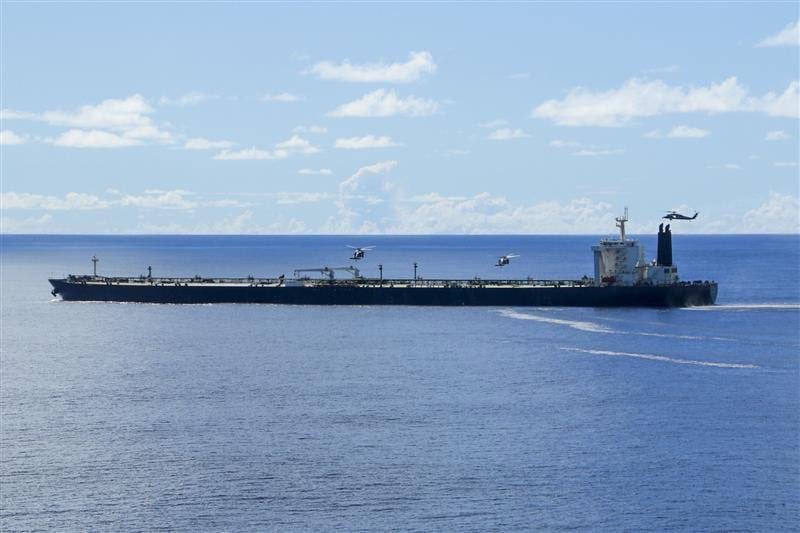
The U.S. military said overnight it carried out a maritime interdiction and “right-of-visit” boarding of the sanctioned stateless tanker Majestic X in the Indian Ocean, signaling U.S. enforcement against Iranian oil shipments is expanding far beyond the Strait of Hormuz.
The boarding, announced Thursday by the Department of War, targeted the tanker formerly known as Phonix—a vessel long associated with Iran’s shadow fleet and accused of helping move millions of barrels of sanctioned crude since 2023.
“International waters cannot be used as a shield by sanctioned actors,” the department said in a statement, adding U.S. forces would continue “global maritime enforcement” against vessels providing material support to Iran.
According to TankerTrackers.com, AIS data suggested the interdiction occurred at 0201 UTC in the Indian Ocean within the U.S. Indo-Pacific Command area of responsibility, near 5.72N, 86.94E. The tracking group said the vessel had helped transport roughly 20 million barrels of Iranian oil while operating under a false Guyanese flag without authorization.
The operation marks the latest in a string of increasingly aggressive U.S. interdictions tied to what Washington has framed as a broader maritime blockade and sanctions-enforcement campaign targeting Iran’s shipping network.
Majestic X, also identified as Eternity and widely known by its former name Phonix, was sanctioned by the U.S. Treasury in December 2024 as part of a sweeping crackdown on vessels transporting Iranian petroleum under Executive Order 13902.
At the time, Treasury linked the tanker to Vision Ship Management LLP and accused it of helping sustain oil revenues Washington says support Iran’s nuclear, missile and proxy activities.
Thursday’s boarding appears to be the first known direct U.S. interdiction involving the vessel.
The operation came hours after President Donald Trump posted a sharply worded warning ordering U.S. naval forces to destroy any boats allegedly laying mines in the Strait of Hormuz, while claiming U.S. mine countermeasure operations were being intensified.
The boarding also followed fresh U.S. assertions Wednesday that blockade enforcement now extends well beyond the Gulf.
U.S. Central Command moved to rebut reports Iranian-linked tankers were slipping through the blockade, saying 29 vessels had been directed to turn back or return to port and insisting widely cited examples such as Hero II, Hedy and Dorena did not evade enforcement.
Instead, CENTCOM said two of the tankers are now anchored at Chabahar in southeastern Iran after interception, while another remains under U.S. Navy escort in the Indian Ocean. TankerTrackers separately reported satellite imagery showed nine Iranian tankers gathered at Chabahar, up from five two days earlier, suggesting mounting congestion as enforcement pressure builds.
The boarding of Majestic X comes as maritime pressure appears increasingly two-sided.
Iran this week seized two MSC containerships attempting to exit the Persian Gulf, underscoring how contested the waterway remains despite President Trump’s declaration last week that the strait was “open.”
At the same time, Washington has stepped up interdictions involving Iranian-linked or sanctioned vessels, including the recent boarding of the tanker Tifani in the Indian Ocean and earlier operations targeting ships accused of challenging blockade restrictions—reinforcing what increasingly looks like pressure from both sides of the maritime corridor.
Together, the moves suggest maritime enforcement is evolving from localized interdictions into a distributed campaign stretching from Hormuz into the wider Indian Ocean. For shipowners, insurers and energy markets, that raises the stakes well beyond the chokepoint itself.

 Join The Club