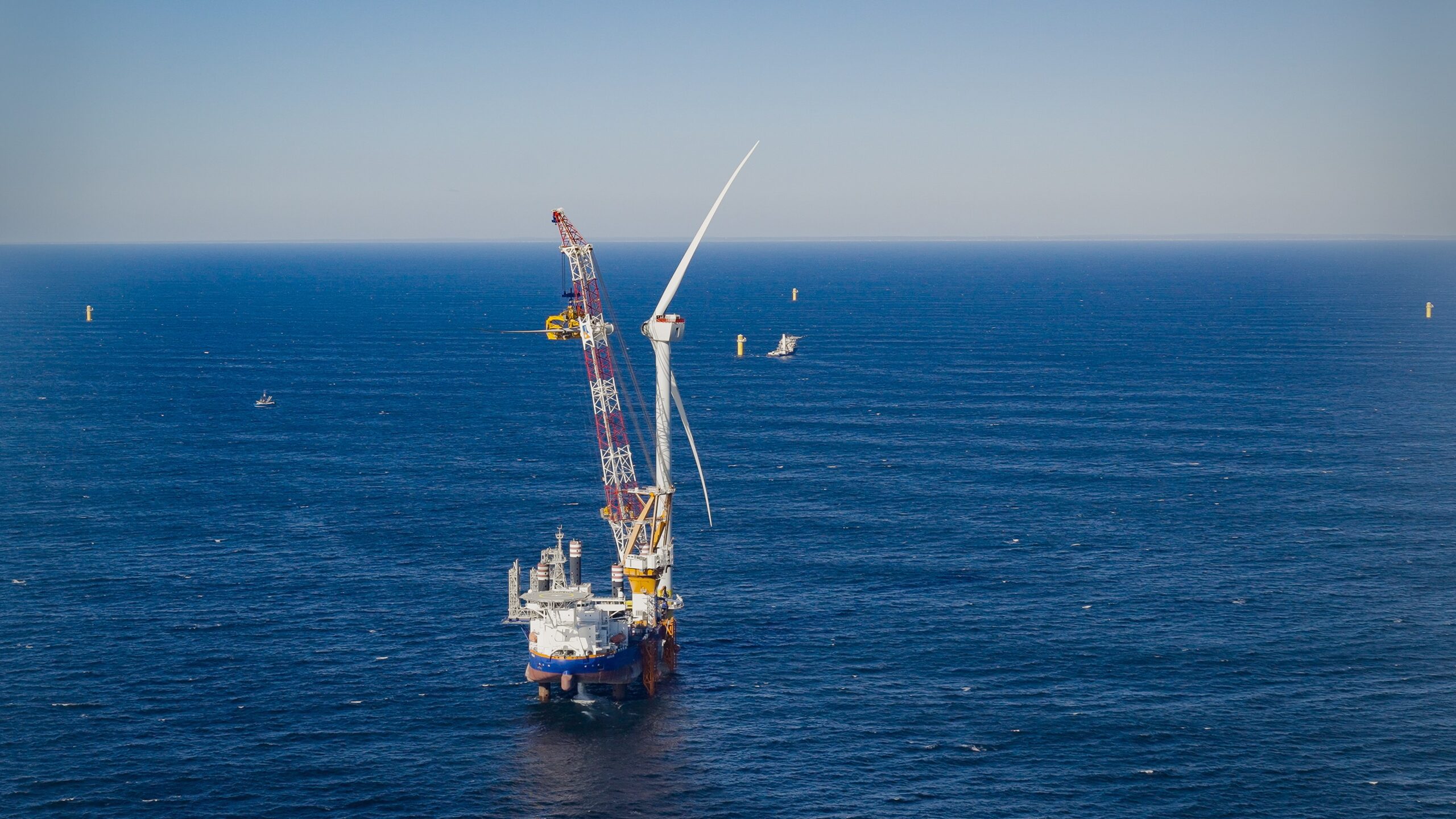
The Trump administration announced Monday an immediate pause on all large-scale offshore wind projects under construction in the United States, citing classified national security risks identified by the Department of Defense in recently completed reports.
The Department of Interior said the pause will allow federal agencies time to work with leaseholders and state partners to assess the possibility of mitigating national security risks posed by these projects. Five specific leases will be affected: Avangrid and Copenhagen Infrastructure Partners’ Vineyard Wind 1, Dominion Energy’s Coastal Virginia Offshore Wind (CVOW), Equinor’s Empire Wind, and Orsted’s Revolution Wind and Sunrise Wind.
Combined, the five projects have a capacity of around 5.9GW.
“The prime duty of the United States government is to protect the American people,” said Secretary of the Interior Doug Burgum in a press release. “Today’s action addresses emerging national security risks, including the rapid evolution of the relevant adversary technologies, and the vulnerabilities created by large-scale offshore wind projects with proximity near our east coast population centers. The Trump administration will always prioritize the security of the American people.”
The department highlighted unclassified government reports that have found massive turbine blades in large-scale offshore wind projects can create radar interference called “clutter” that can obscure legitimate moving targets and generate false targets. A 2024 Department of Energy report found that while the radar threshold for false alarm detection can be increased to reduce some of that clutter, the radar can “miss actual targets” when that threshold is increased.
The announcement, first reported by Fox News, comes as the offshore wind industry continues to grapple with significant regulatory and financial challenges. A federal judge in Boston this month struck down an earlier administration directive to halt all federal approvals for new wind energy projects in December, saying that agencies’ efforts to implement the directive were unlawful and arbitrary.
U.S. District Judge Patti Saris sided with a group of 17 Democratic-led states and the District of Columbia, saying the agencies had failed to provide reasoned explanations for the actions they took to carry out the directive Trump issued on his first day back in office on January 20.
New York Attorney General Letitia James, whose state led the legal challenge after the Interior Department ordered Norway’s Equinor to halt construction on its Empire Wind project, called the ruling “a big victory in our fight to keep tackling the climate crisis.”
The American offshore wind industry has seen its project pipeline slashed by more than half in just one year, according to a November report from the Energy Industries Council. The contraction dropped the pipeline from 45 projects down to 23, with planned capacity falling from 55.9 gigawatts to 25.4 gigawatts between the third quarters of 2024 and 2025.
President Trump’s One Big Beautiful Bill Act established critical deadlines requiring projects to start construction by July 4, 2026 to secure tax-credit eligibility for up to four years, or begin service by December 31, 2027. Roughly 83 percent of projects are not aligned with these dates.
The financial toll of project delays has been staggering. Stop-work costs have reached up to $50 million per week on the Empire Wind project and more than $15 million weekly on Revolution Wind. Equinor reported a $763 million impairment related to Empire Wind 1 and South Brooklyn Marine Terminal development in its second quarter 2025 financial results, part of a larger $955 million write-down attributed to regulatory changes and increased tariff exposure.
Trade measures have compounded cost pressures, with duties of 10 to 15 percent on goods from the EU and UK and up to 50 percent on some steel and aluminum affecting critical components including blades, towers, nacelles and cables. The Department of Transportation’s decision to rescind $679 million in port grants has further slowed essential infrastructure upgrades.
Despite the challenges, some state-level support continues. The New York State Energy Research and Development Authority on Friday announced a $300 million competitive solicitation to support maritime port development projects aimed at strengthening the state’s offshore wind supply chain.
“Policy clarity will be decisive in determining whether these projects move forward or stay in limbo,” said Rebecca Groundwater, EIC Global Head of External Affairs. “Stable, predictable frameworks are what investors need to turn uncertainty into action and position the US to reclaim momentum in offshore wind development.”
Interior Secretary Burgum stated in September that under the current administration there is not a future for offshore wind projects. “I think the fact that subsidies have been either cut back or limited means that it’s likely that there won’t be future offshore wind built in America,” he said during an energy conference in Milan.
The declining pipeline comes amid what industry observers describe as a broader campaign against the nascent US offshore wind industry, with the administration stopping new offshore wind leasing and permitting, moving to revoke existing authorizations and halting projects already under construction.
Today’s action, the Interior Department stated, ensures that national security risks posed by offshore wind projects are appropriately addressed and that the United States government retains its ability to effectively defend the American people.
Editorial Standards · Corrections · About gCaptain

 Join The Club