A modest dip in Iran’s January exports masks a resilient illicit trade now facing expanding U.S. enforcement and shrinking safe havens.
By Paul Morgan (gCaptain) – Iran’s oil exports edged lower in January 2026, but the modest decline offers little comfort to sanctions enforcers. According to tracking data compiled by United Against Nuclear Iran (UANI), Iran shipped an estimated 46.9 million barrels of crude during the month, equivalent to about 1.51 million barrels per day. That represents a drop of roughly 3% from December levels, with total export revenues estimated at just over $3 billion.
The numbers, however, do not signal improved compliance with international sanctions. Instead, they reflect routine volatility within an illicit export system that has become both deeply entrenched and increasingly exposed. Iran’s oil trade remains overwhelmingly dependent on China, which absorbed the vast majority of January’s flows. Smaller volumes were routed through the UAE and other opaque intermediaries, while Malaysia once again played a pivotal role as a transshipment hub.
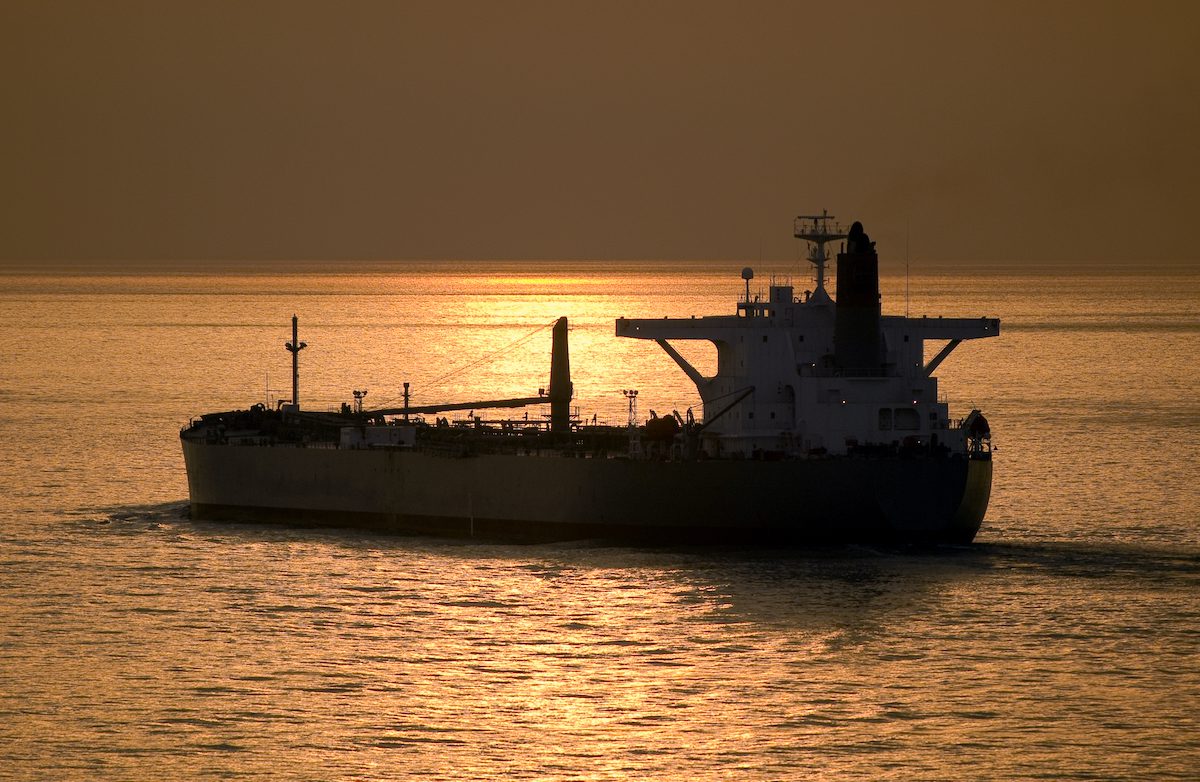
What the data shows is not a weakening of Iran’s sanctions-evasion capability, but the durability of a mature “dark fleet” ecosystem. Ageing tankers operating under opaque ownership structures continue to rely on AIS manipulation, frequent flag changes, and permissive coastal jurisdictions to move crude quietly through the global system. The logistics are well rehearsed, but they are also becoming riskier as enforcement pressure intensifies.
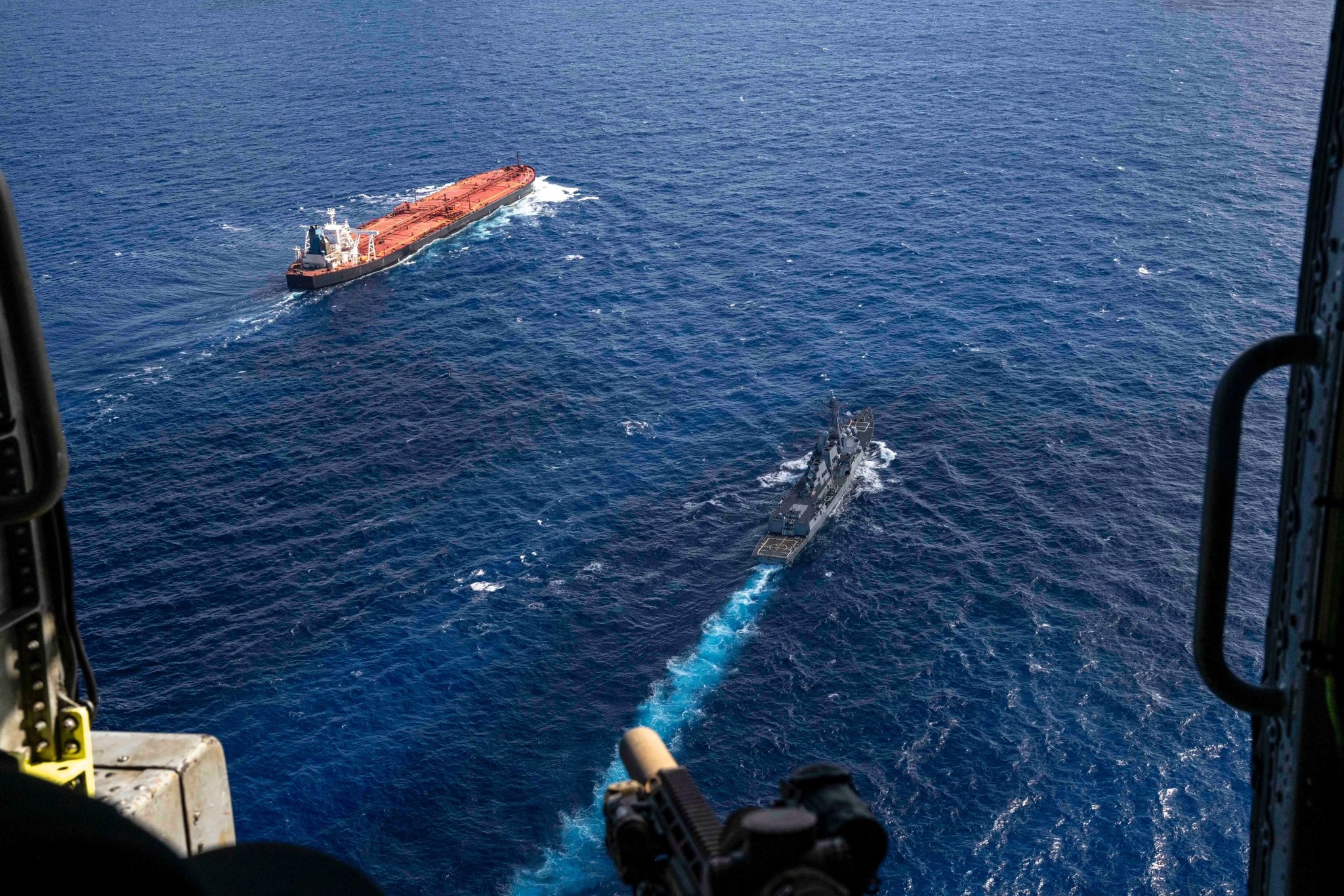
Recent U.S. actions against sanctions-busting tankers linked to Venezuela have sent a clear signal to the broader illicit shipping community. Following the dramatic detention of Venezuela’s leadership and the imposition of a maritime quarantine, U.S. authorities moved aggressively against vessels attempting to evade restrictions, including boardings and seizures far beyond the Caribbean. Some of these actions occurred in waters close to U.S. allies, including areas adjacent to the United Kingdom, underscoring a crucial shift in enforcement posture.
UAIN Senior Advisor Charlie Brown commented, “Sanctions enforcement is going global. If dark fleet activity continues unchecked, Malaysia risks shifting from transit point with assumed plausible deniability to primary pressure point on a facilitator in Iran’s oil trade.”
The message to dark fleet operators is unmistakable: geography no longer provides a safe haven. Flag-hopping, last-minute re-registrations, or nominal alignment with Russia offer diminishing protection when vessels intersect with the international system through ports, insurers, classification societies, or allied maritime jurisdictions. For Iran, this matters directly. Many of the same ships, managers, and brokers involved in moving Venezuelan crude are also central to Iranian export networks. January’s slight dip in volumes may therefore reflect growing friction and operational caution within these overlapping illicit trades, rather than any genuine reduction in activity.
Yet while enforcement pressure has expanded across the Atlantic and into new theatres, one area remains conspicuously permissive: Malaysian waters. January 2026 saw record levels of Iranian crude staged offshore near Johor, particularly around the Eastern Outer Port Limits. At one point mid-month, roughly 60 dark fleet tankers laden with Iranian oil were observed loitering in the area, awaiting ship-to-ship transfers. These cargoes were subsequently consolidated and forwarded to China, primarily to independent “teapot” refineries willing to accept discounted barrels of questionable origin.
The operational patterns are now unmistakable. Prolonged anchorage, coordinated AIS gaps, rapid vessel swaps, and labyrinthine ownership structures point to a sophisticated laundering operation operating in plain sight. As other transit routes become more hazardous, Malaysia has emerged as one of the last major nodes where Iranian oil can be blended, relabelled, and dispatched with minimal interference.
This growing concentration carries risks, not just for Iran’s customers, but for Malaysia itself. Continued tolerance of dark fleet activity exposes local ports, service providers, and bunkering operations to secondary sanctions, whether through direct involvement or inadvertent facilitation. There are also significant safety and environmental concerns. Many of the tankers involved are old, poorly maintained, and insured through opaque or dubious arrangements. A collision or spill in the congested anchorages off Johor would have immediate regional consequences.
Geopolitical tensions add another layer of uncertainty. The deployment of a U.S. aircraft carrier to the Middle East, against a backdrop of renewed protests and violent repression inside Iran, signals heightened readiness to deter or disrupt Iranian maritime activity. Historically, such moments of internal instability combined with visible U.S. force posture have increased the likelihood of sudden enforcement actions rather than gradual market-driven declines.
January’s export figures therefore tell a more complex story than a simple month-on-month drop. Iran’s oil trade remains resilient, but it is increasingly concentrated, more visible, and more vulnerable to disruption. As enforcement closes in elsewhere, pressure is building on the remaining permissive hubs. Malaysia now faces a narrowing set of choices: assert control over its maritime domain, or risk becoming the focal point for international sanctions enforcement carried out by others.
Editorial Standards · Corrections · About gCaptain

 Join The Club