U.S. containerized imports are expected to remain below last year’s levels through the first half of 2026 as tariff uncertainty continues to weigh on trade flows, according to the latest Global Port Tracker report released Monday by the National Retail Federation (NRF) and Hackett Associates.
The outlook comes as global supply chains navigate a rapidly shifting trade policy landscape following a recent U.S. Supreme Court decision striking down tariffs imposed under the International Emergency Economic Powers Act (IEEPA), alongside new duties introduced by the Trump administration and rising geopolitical risks tied to the conflict involving Iran.
“The Supreme Court has struck down IEEPA tariffs but other tariffs have already been announced and others will be coming, so uncertainty continues for retailers,” said Jonathan Gold, NRF vice president for supply chain and customs policy. “The need for clear and predictable trade policy remains, and long-term planning continues to be difficult for merchants and other businesses.”
In response to the Supreme Court ruling, President Donald Trump announced a temporary 10% tariff under Section 122 of the Trade Act of 1974, which the administration has said could increase to 15%. Officials have also indicated that additional Section 301 trade investigations could be launched, further adding to the uncertainty surrounding U.S. trade policy.
According to the report, U.S. ports handled 2.08 million TEU in January, an increase of 3.8% from December but a decline of 6.4% compared to the same month last year. Data from the ports of New York/New Jersey and Miami had not yet been reported at the time of the analysis.
Ports have not yet released February figures, but Global Port Tracker projects volumes of 2.01 million TEU, down 1.3% year over year. Imports are forecast to fall more sharply in the coming months, with March projected at 1.91 million TEU, a decline of 11.2% from the same month in 2025, followed by 2.03 million TEU in April, down 8.1% year over year.
The report expects some improvement later in the spring as year-over-year comparisons ease. Imports are forecast to reach 2.09 million TEU in May and 2.1 million TEU in June, reflecting gains compared with the same months last year when cargo volumes dropped sharply following the announcement of “Liberation Day” tariffs in April 2025. July imports are projected at 2.2 million TEU, representing an 8% decline from a year earlier.
Taken together, the projections would bring total U.S. container imports for the first half of 2026 to 12.21 million TEU, down 2.5% from the 12.53 million TEU recorded during the same period in 2025. Full-year imports in 2025 totaled 25.4 million TEU, a slight decline from 25.5 million TEU in 2024.
While tariff policy remains the primary factor influencing the outlook, analysts say the escalating conflict involving Iran is being closely watched for potential economic ripple effects.
Hackett Associates founder Ben Hackett said the immediate impact on U.S.-bound containerized trade is likely to be limited because relatively little cargo destined for the United States originates in the Middle East. However, he warned that sustained disruptions could still affect the broader economy through energy markets.
“The immediate impact on containerized traffic to the United States is not likely to be substantial since little U.S.-bound container cargo is sourced from the region,” Hackett said. “While it is too early to measure in the monthly data, increasing oil and gasoline prices will inevitably drive structural inflation if the conflict persists. That, in turn, could squeeze consumer discretionary spending and U.S. manufacturing, and ultimately drive down import volumes in the longer term.”
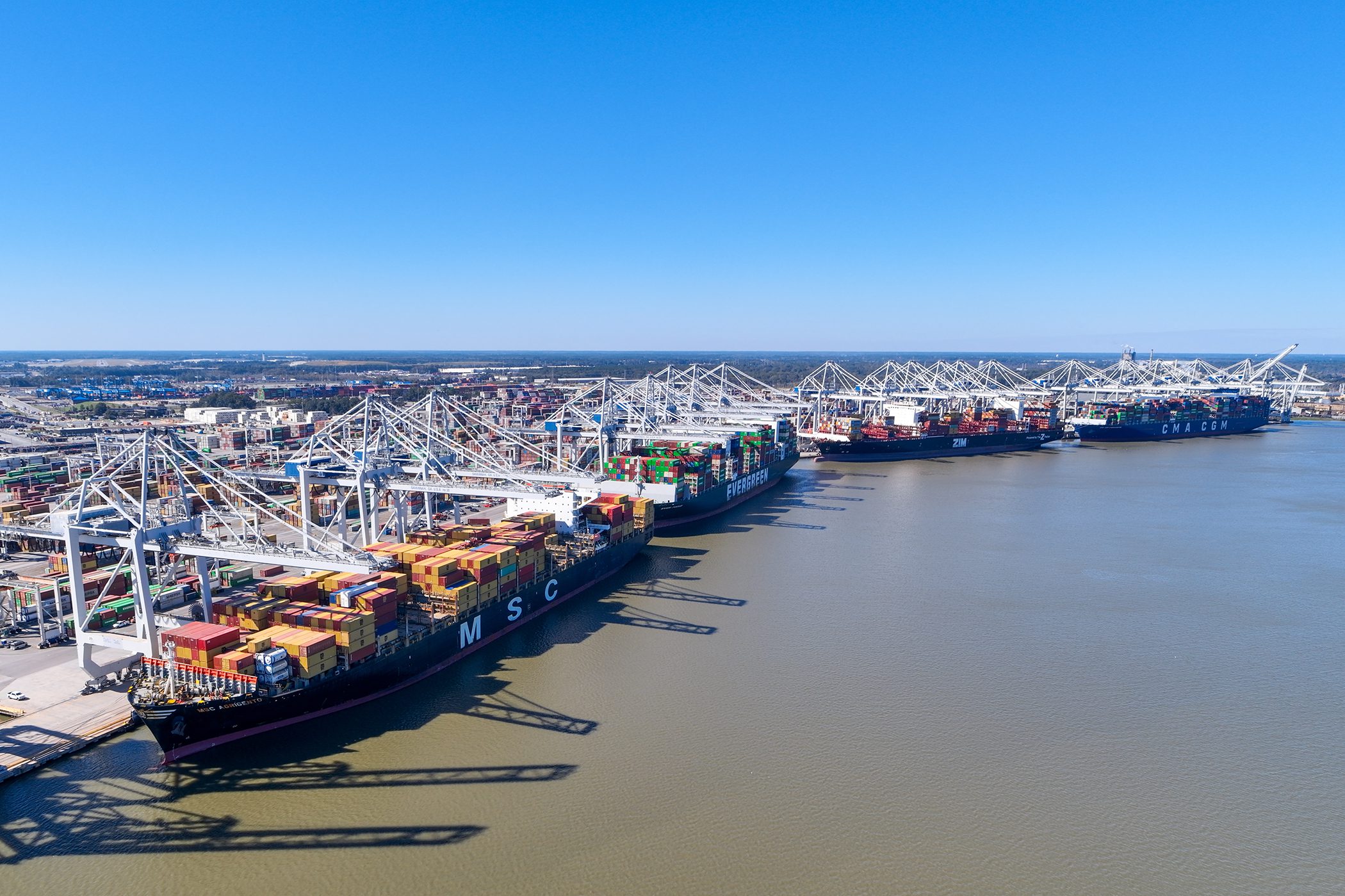
Global Port Tracker tracks container volumes across major U.S. gateways including Los Angeles and Long Beach, Oakland, Seattle and Tacoma on the West Coast; New York and New Jersey, Virginia, Charleston, Savannah, Port Everglades, Miami and Jacksonville on the East Coast; and Houston on the Gulf Coast.
Editorial Standards · Corrections · About gCaptain

 Join The Club