A new series of maritime attacks has struck commercial vessels across the Persian Gulf overnight, signaling that the shipping conflict linked to the escalating U.S.–Israel confrontation with Iran is continuing to spread beyond the Strait of Hormuz.
According to multiple security advisories issued by the United Kingdom Maritime Trade Operations (UKMTO), two tankers were struck by projectiles roughly five nautical miles south of Al Basrah, Iraq, late on Wednesday, March 11.
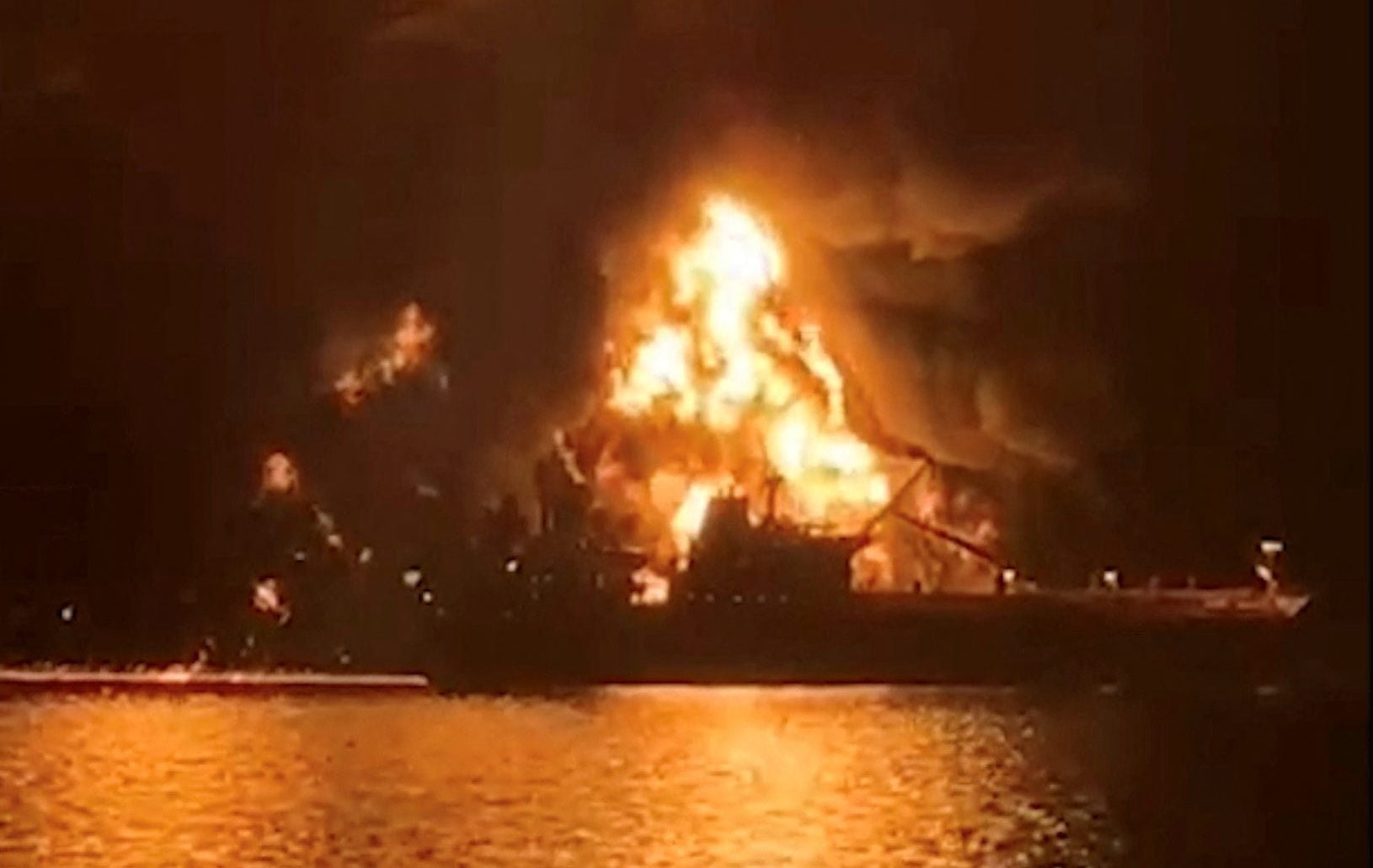
Initial reports indicated one tanker had been hit by an unknown projectile that caused a fire onboard. An update issued early March 12 confirmed that a second tanker in the same area was also struck, with the impact likewise triggering a fire. Crew members from both vessels were evacuated safely and no environmental damage has been reported.
Video of one of the incidents was shared widely online, showing a tanker engulfed in flames.
In a separate incident hours earlier, UKMTO said a containership was struck by an unknown projectile about 35 nautical miles north of Jebel Ali in the United Arab Emirates, causing a small fire onboard. The vessel’s crew was reported safe.
Authorities are continuing to investigate the incidents.
Open-source maritime analysts reported that multiple ship-to-ship (STS) transfer operations were underway off southern Iraq around the time of the attacks, highlighting the concentration of tanker traffic near the region’s critical oil export infrastructure.
According to monitoring group TankerTrackers.com, four STS operations were observed taking place off the southern Iraqi coast, including a transfer involving the tanker Zefyros (IMO 9515917) and Safesea Vishnu (IMO 9327009). The two tankers are suspected of being the two targeted in the attacks.
Zefyros is a Greek-owned tanker, while Safesea Vishnu is owned by New Jersey-based Safesea Transport, according to the analysts.
One Indian seafarer from the Safesea Vishnu has reportedly been killed.
Ship-to-ship transfers are commonly used in the area to facilitate crude exports linked to Iraq’s Basrah oil terminal complex, one of the world’s most important energy export hubs.
The three incidents bring the total number of new attacks on vessels to six in just 24 hours.
Earlier on Wednesday, the Joint Maritime Information Center (JMIC) reported that 13 commercial vessels had been struck during the first 12 days of the conflict, citing incident reporting compiled by UKMTO. The day’s other attacks included strikes on the container ship ONE Majesty and the bulk carriers Mayuree Naree and Star Gwyneth operating in or near the Strait of Hormuz.
The Thai-flagged bulk carrier Mayuree Naree suffered the most severe damage after an explosive strike triggered a major engine-room fire roughly 11 nautical miles off Oman’s coast. Twenty crew members were rescued while three remain missing.
The International Maritime Organization has reported that at least seven seafarers have been killed in attacks since the conflict began.
Beyond attacks on vessels themselves, regional infrastructure has also come under fire. Qatar on Thursday condemned what it described as an Iranian drone attack targeting fuel storage tanks at the Port of Salalah in Oman, calling the strike a violation of international law and a dangerous escalation that threatens regional stability.
Taken together, the incidents suggest the maritime conflict is expanding beyond the Strait of Hormuz transit corridor into the broader Persian Gulf and key regional energy and logistics hubs, including waters near Iraq’s Basrah oil export terminals and shipping lanes approaching Dubai.
Traffic through the Strait of Hormuz—which normally carries around 20% of the world’s seaborne oil shipments—has slowed dramatically since the conflict erupted.
UKMTO has advised vessels operating in the region to transit with caution and report any suspicious activity immediately.
Editorial Standards · Corrections · About gCaptain

 Join The Club