Swedish authorities have boarded and taken control of a cargo vessel in the Baltic Sea after determining the ship was operating as a suspected stateless ship, triggering an investigation and raising fresh concerns about illicit cargo flows tied to Russia’s war in Ukraine.
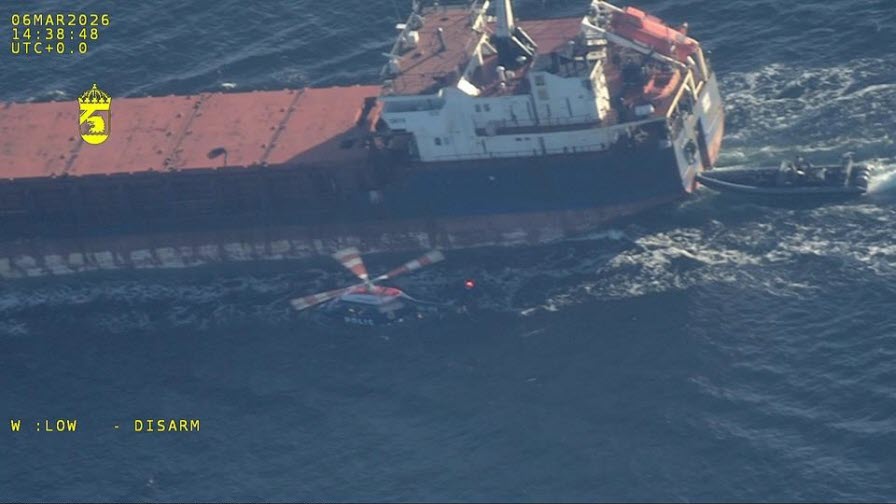
The operation took place Friday afternoon in Swedish territorial waters off Trelleborg, where the Swedish Coast Guard (Kustbevakningen) intercepted the general cargo ship Caffa. The vessel, built in 1997, had been broadcasting AIS data indicating a voyage from Casablanca, Morocco, to St. Petersburg, Russia.
According to the Coast Guard, the ship’s flag status could not be verified, leading authorities to classify the vessel as stateless under applicable national and international maritime law.
“At 15:50 today the Coast Guard took control of a vessel with unclear flag status and therefore suspected of being stateless,” the agency said in a statement.
Under maritime law, vessels lacking a recognized flag state may lose certain protections normally afforded under the principle of innocent passage through territorial waters. Swedish authorities said that without a confirmed flag state, no country can guarantee the vessel’s safety, seaworthiness, or regulatory compliance, giving authorities grounds to intervene.
The boarding operation involved Sweden’s National Task Force, the Coast Guard’s national boarding team, and a police helicopter, according to officials. Authorities described the action as planned and conducted calmly, with no reports of resistance.
Investigators have since launched a preliminary criminal investigation into suspected violations of maritime law related to seaworthiness. Coast Guard personnel remain aboard the vessel conducting searches, collecting documentation, and interviewing crew members.
“At this stage the investigation concerns suspected lack of seaworthiness,” the agency said, noting that additional authorities could become involved depending on what investigators uncover.
The vessel has drawn additional attention amid media reports suggesting it may be transporting stolen grain, potentially linked to cargoes originating from occupied Ukrainian territories.
The boarding also reflects a broader trend of more assertive maritime enforcement across Europe as authorities intensify scrutiny of vessels suspected of sanctions evasion, illicit cargo movements, or fraudulent registration.
In recent months, European states have increasingly used maritime law tools—including verification of nationality, denial of innocent passage, and operational boardings—to investigate ships suspected of operating under false flags or opaque ownership structures.
For now, Swedish authorities say the operation remains ongoing at sea as investigators continue reviewing information and documents found aboard the vessel.
“The Coast Guard is processing the information found on board Caffa, which requires time,” the agency said.
Editorial Standards · Corrections · About gCaptain

 Join The Club