About 10 years ago, a concept was developed by a group of Scandinavian engineers that provided a highly simplified cargo transfer solution for conventional oil tankers and LNG carriers.
The idea was called Remora “HiLoad” which is essentially a moored or dynamically positioned buoy that “sticks” to the bottom of ship’s hull after it deballasts itself, forming a very stable platform from which to transfer hydrocarbons. In 2005, the rights to develop the HiLoad technology for oil transfer and for the transfer of liquefied natural gas was split between Remora AS and a new company called TORP LNG.
TORP LNG was soon in discussions with officials on the U.S. Gulf Coast about installing an LNG import terminal offshore Alabama that utilized their patented docking technology, however as the shale gas boom took hold, this project never materialized.
Today, Sevan Marine has announced the acquisition of TORP LNG and the company’s proprietary technology. The Norwegian offshore engineering firm and its new subsidiary HiLoad LNG AS plans to revive this concept and their mission is supported by a number of developments which have occurred over the past few years.
In late 2012, Vancouver-based Teekay Corporation, which holds a 40 percent stake in Sevan Marine, bought a 49.9 percent stake in Remora AS as well as acquired the first HiLoad DP unit for use offshore Brazil. This system has since been proven viable in operation offshore Brazil.
In parallel, the concept of Floating offshore LNG production facilities is becoming a reality as Royal Dutch Shell and Petronas are racing to build the first such vessel.
The missing piece in this equation is how best to transfer LNG from a production facility to a conventional tanker while at sea.
In calm seas, LNG carriers can conceivably come along an FLNG facility and transfer the supercooled cargo. In areas where there is harsher weather however, or if the production facility itself has a cylindrical hull form, this may not be feasible for a number of reasons. The risk associated with ship-to-ship transfers is further multiplied when such FLNG facilities use gases like propane as a refrigerant to liquefy the methane.
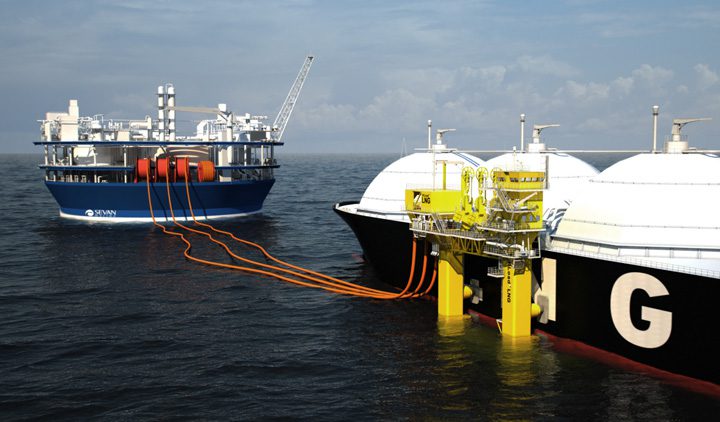
The solution is to offload the product using a tandem system, as the following image shows.
Image: Sevan Marine
Not only could this system be used to transfer huge quantities of cryogenic product to large LNG carriers, but it could also be used to transfer product to smaller, coastal LNG tankers.
In an emailed statement to gCaptain, Lars Odeskaug, Chief Operating Officer at Sevan Marine writes:
“We are familiar with the HiLoad technology, and now that the market for offshore transfer of LNG is emerging with an increasing number of planned offshore FLNG projects, we feel that the HiLoad provides the solution that many operators have been looking for. HiLoad secures safe approach, offloading operations and departure of any conventional LNG carrier, and now that the floating cryogenic hoses are becoming commercially available, we believe this could be just what the industry needs.”
The cost of hiring an oil tanker on the industry’s benchmark trade route topped $1 million a day for the first time, as the Iran war leaves too few ships willing to cross the Strait of Hormuz to collect cargoes.
Qatar appears to have loaded its first liquefied natural gas cargo after the widening conflict in the Middle East forced it to halt fuel production and declare an unprecedented force majeure to buyers.
President Donald Trump said Tuesday he has directed the U.S. government to provide political risk insurance and financial guarantees for maritime trade transiting the Persian Gulf, while signaling that U.S....
March 3, 2026
Total Views: 3449
Get The Industry’s Go-To News
Subscribe to gCaptain Daily and stay informed with the latest global maritime and offshore news
— just like 107,377 professionals
Secure Your Spot
on the gCaptain Crew
Stay informed with the latest maritime and offshore news, delivered daily straight to your inbox
— trusted by our 107,377 members
Your Gateway to the Maritime World!
Essential news coupled with the finest maritime content sourced from across the globe.

 Join The Club