Don’t Miss Your Daily Briefing for the Maritime Industry
Join the leading maritime news network
— trusted by our 106,969 members
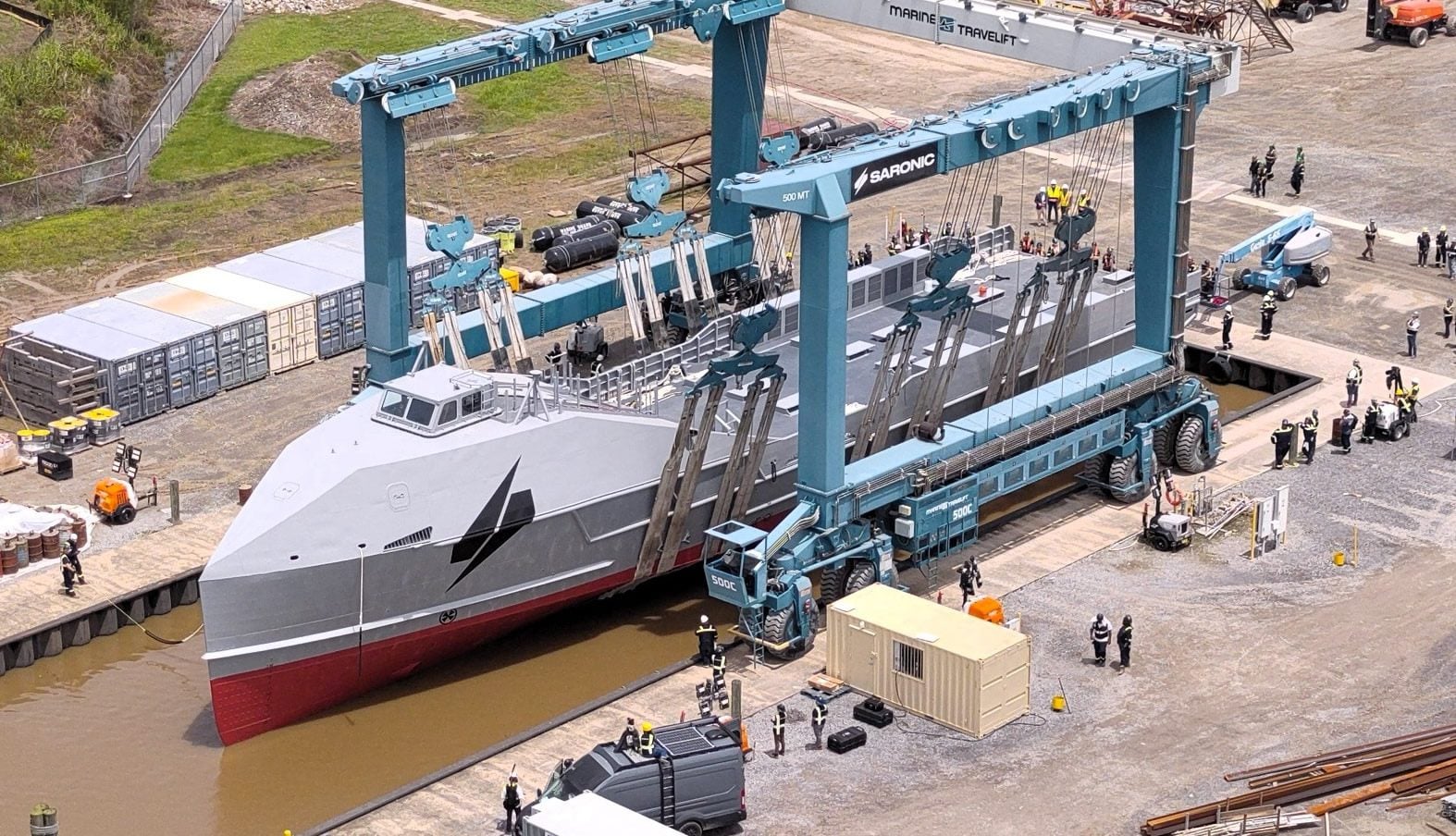
Saronic's first Marauder MUSV is lifted into the water by a 500-metric-ton Marine Travelift at the company's Franklin, Louisiana yard — a boat hoist, not a graving dock. Photo: Saronic
Stop Calling Saronic a Shipbuilder: The Dangerous Lie Behind Naval Drones
By Captain John Konrad (gCaptain op-ed) Let me start where I want to finish: Saronic’s Marauder, a Medium Unmanned Surface Vessel (MUSV) designed for the US Navy, is a real accomplishment. The company built something the Department of War genuinely needs, I’m a fan, and I want Congress to fund it aggressively. Hold onto that, because what follows is going to read like an attack and it isn’t. It’s a plea to tell the truth because the truth is a better story anyway.
This week Saronic launched its first Marauder, a 150-foot medium unmanned surface vessel, and moved it from design to on-water trials in under a year. Good. The problem isn’t the boat. The problem is the sentence wrapped around it, repeated by the company and its CEO Dino Mavrookas and amplified across the trade press: *a pace American shipbuilding hasn’t seen since World War II.*
We just launched our first Marauder — designed, built, and launched in under a year, at a pace American shipbuilding hasn't seen since World War II. The team that made it happen shows up every day and refuses to accept the timelines the rest of the industry takes for granted.… https://t.co/bU7OmcCxOd
Saronic is not alone. At the Navy’s large Sea Air Space conference this year, unmanned surface vessel manufacturers of all sizes leaned on the words “shipbuild” and “autonomous ships” — yet few of the products on display were larger than dinghies.
Saronic’s Marauder is much bigger, which gives it longer range and room to carry four shipping containers. But it’s not a ship. It’s barely a workboat. Semi-autonomous crewboat would be the most accurate description. Calling it a ship only works if you’ve never set foot in a shipyard.
This isn’t a once-in-eighty-years miracle. It’s Tuesday.
The use of the word “ship” is dishonest, and clearly intended to tap into billions of dollars of newly announced shipbuilding money and a media that has finally woken up to the death of our shipyards.
But the misinformation extends beyond that.
Designing, building, and launching a 150-foot aluminum workboat in under a year is not a historic feat. American yards do exactly this — tugs, towboats, ferries, patrol boats, crewboats, dredges, barges, aluminum hulls — every single year, by the hundreds, many on agressive timelines.
The numbers are not hard to find if you bother to look. WorkBoat’s own survey tracked 925 U.S. vessels delivered, under construction, or on order in a single recent year , up 34 percent from the year before. ShipbuildingHistory has documented hundreds of American yards turning out vessels like this continuously since 1945. We build so many workboats under 250 feet that the Department of Transportation can’t fully track them all.
Want a gut check on how alive this market is? The largest maritime trade show in America, by a wide margin, is the International WorkBoat Show in New Orleans every December, over 1,000 exhibitors and well over 13,000 attendees last year, a record. There is no oceangoing shipbuilding show in this country that comes within shouting distance, because that is the part of the industry that’s actually dying. The workboat sector isn’t being revived, the United States has always been and remains a world leader.
Building workboats is something the United States does well, and we should be leaning into that message and our boatbuilding capabilities. Painting boatbuilding as a failure gives voters the wrong impression and could choke off interest in marine highway projects around the country, projects that lean into our existing ability to build boats and barges quickly to compete with the trucks that are clogging our highways.
Saronic didn’t conjure the speed. It bought then improved it.
Here’s the part Dino left out of the victory lap. Saronic didn’t summon this build tempo from a clean sheet of paper. It acquired Gulf Craft, a Louisiana yard with a sixty-year head start, and built the Marauder using that yard’s existing workers, slips, and accumulated know-how in Franklin, Louisiana. The speed everyone is applauding was already sitting in that boatshed before Saronic’s logo went on the door.
That’s not a knock on the acquisition,it was a smart move. But let’s call it what it is. Saronic didn’t resurrect American shipbuilding. It certainly didn’t build enormous drydocks or massive cranes. It rented the muscle the workboat sector has been quietly building for generations, and then called itself a “shipbuilder” to claim a larger slice of expanding Department of War budgets.
Why the lie does real damage
I could let PR puffery slide. Every company inflates. But words matter, and these words, at this moment, do damage in two specific ways.
The framing lets a company thriving in a hot market siphon attention and budget away from the shipbuilders who are genuinely on life support, the deep-draft yards that build the hulls, the drydocks, and the capital ships a workboat can never replace. Those yards need massively expensive graving docks precisely because you can’t sling a destroyer onto a few straps and lift it out of the water like a 150-foot aluminum hull. They are fighting to survive, and a budget dollar that flows toward the part of the industry that’s already winning is a dollar that doesn’t reach the part that’s dying.
Second, and worse: a voter, a congressman, or a tired staffer who has never visited a shipyard building hulls the size of skyscrapers reads “a pace not seen since World War II” and may conclude that Saronic saved the Navy. It didn’t. It can’t. A swarm of autonomous workboats is a lethal threat, but logistics wins wars, and logistics is measured in ton-miles.
One Chinese-built containership moves more tonnage than every Marauder you could launch this decade. The Marauder carries the equivalent of eight TEUs; China builds boxships rated at 24,346 TEUs. That’s more than 3,000 times the capacity on a single hull. And that’s before we even talk about tonnage. For centuries ships have been classified by tonnage, not length.
My U.S. Coast Guard captain’s license says “Unlimited Tonnage,” not “Unlimited Length,” for a reason. The expertise needed to operate a 200,000-to-240,000 gross-ton steel ship in harsh ocean environments is exponentially greater than what’s required to pilot a small, lightweight aluminum vessel designed to operate near the coast.
Autonomous USVs are a vital capability. They are not, and will never be, a substitute for the industrial base that builds oceangoing ships at scale.
Truth is the better story.
The team at Saronic built an incredible company that fills a real and urgent need, fast, with American workers in a Louisiana boatshed. That is genuinely impressive on its own merits. It does not need a fairy tale stapled to it, least of all one that steps on the throat of the shipbuilders fighting to stay alive.
And it isn’t just Saronic Technologies. Every competitor in the autonomous “ship” defense sector is running the same playbook… a real product, inflated mythology to ride the nationwide alarm now sounding over shipbuilding. The autonomy startups have learned that the fastest route to a defense contract is a heroic origin story and that story is crowding out an honest conversation about what America actually needs to win at sea. Shipbuilding lobbiests in DC have adopted the story too because they like the attention tech investors provide which further confuses congress.
So tell the truth. The truth is that the workboat sector is alive and roaring, that the deep-draft yards are the ones in crisis, and that unmanned vessels are an essential complement to a real fleet of large steel ships rather than a replacement for them.
Both boatyards and shipyards need more investment. Shipyards to recover all they have lost. Boatyards to accelerate the growth they already have.
That only requires one thing.
Honesty about the difference.
With that out of the way, let’s talk about what they did accomplish — because it’s impressive.
The Marauder is a real accomplishment. At 25-plus knots with a range measured in the thousands of miles it can reposition fast and stay out for weeks on extended missions. Operating fully autonomously or under remote human supervision, it will be capable of doing dull, dangerous patrols without putting a crew in harm’s way. That’s a capability the Navy needs, and Saronic is building it.
The real achievement, though, is streamlining and digitilizing the production model. Saronic runs design, manufacturing, and autonomy under one roof at Franklin, with the promise that each subsequent hull will compound the lessons of the last. The first went from design to launch in under a year; the second is currently being outfitted and will reportedly coming together 25 percent faster; the third and fourth are already under construction. When the yard’s expansion finishes at the end of this year, Saronic says it’ll be capable of roughly 20 Marauders a year.
“China’s shipyards make use of high tech automation and robotics and vertically integrated software and hardware stacks,” engineering physicst Andrew Côté told gCaptain. “Meanwhile boatyards plan work schedules with a whiteboard and fridge magnets because its ‘good enough’ so the real question is how do you turn this around, and the answer is doing something like what Saronic has done, which is take an existing yard with experienced workforce and bring a modern automation stack to bear, both in design, and operations.”
And the autonomy is genuinely first-of-its-kind. Marauder is designed end-to-end for software control: every hardware component has an interface for monitoring and actuation plus live telemetry, subsystem status, logging, and replay for diagnostics with the ability to reach in and intervene remotely.
That is real, hard, valuable work. None of it needs a WWII fairy tale to sell it.
What (Acting) Secretary Hung Cao’s First Five Months Tell Us About the Job Ahead By Bruce Kimbrell (Policy Op-Ed) President Trump has nominated the Honorable Hung Cao to become the...
By Jennifer A. Dlouhy and María Paula Mijares Torres Sep 6, 2026 (Bloomberg) –US Navy escorts that are helping tankers cross the Strait of Hormuz are essential to sustaining crude flows...
Sept 6 (Reuters) – The U.S. aircraft carrier Abraham Lincoln left Thailand on Sunday after a five-day port visit, ending a respite from an extended deployment that included operations in the Middle East, the U.S. Navy said. “We...
September 6, 2026
Total Views: 2014
Get The Industry’s Go-To News
Subscribe to gCaptain Daily and stay informed with the latest global maritime and offshore news
— just like 106,969 professionals
Secure Your Spot
on the gCaptain Crew
Stay informed with the latest maritime and offshore news, delivered daily straight to your inbox
— trusted by our 106,969 members
Your Gateway to the Maritime World!
Essential news coupled with the finest maritime content sourced from across the globe.

 Join The Club