AUKUS defense chiefs set a hard date on Saturday for the pact’s most tangible promise. The year is 2027, and the milestone is standing up Submarine Rotational Force-West (SRF-West) at HMAS Stirling in Western Australia. It’s the rotational nuclear-submarine presence that will test whether the trilateral deal delivers steel in the water or stays a partnership on paper.
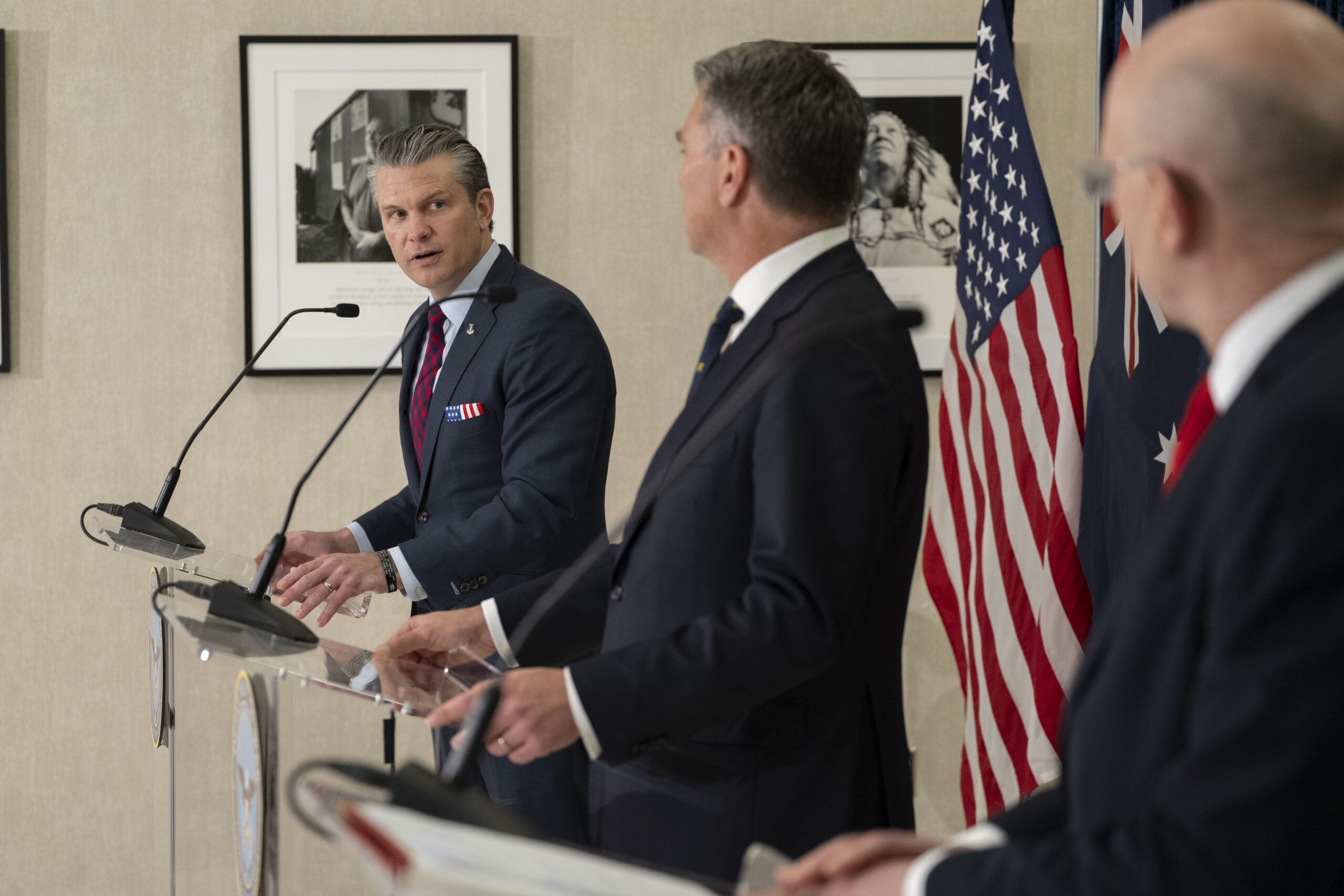
Australian Deputy Prime Minister and Defence Minister Richard Marles, U.S. Secretary of War Pete Hegseth, and U.K. Defence Secretary John Healey met in Singapore and announced they had finalized the AUKUS arrangements. Authorized U.S. Navy support elements will begin rotating the first American sailors to HMAS Stirling later this year. The U.K. reaffirmed it will join the rotation, and pointed to the maintenance period its Astute-class boat HMS Anson completed in Australia earlier this year as proof the concept already works.
For the maritime and naval-industrial world, the payoff is concrete. SRF-West expands maintenance options and sustainment infrastructure in the Indo-Pacific, and it’s meant to compress the timeline for Australia to own, operate and maintain nuclear-powered submarine force. The maintenance and crewing muscle built at Stirling now is what makes a sovereign capability credible later.
The money behind the milestone
The ministers acknowledged the scale of Australia’s spending is the real story. Canberra plans to invest up to AUD 8 billion at SRF-West for infrastructure and logistics support at HMAS Stirling. That sits on top of an initial AUD 3.9 billion down payment for the new Submarine Construction Yard in South Australia and AUD 12 billion for the Henderson Defense Precinct in Western Australia. Part of the Henderson money goes to contingency docking and depot-level maintenance, the kind of heavy-industrial dry-dock capacity the region has lacked.
The bet is straightforward. Australia is paying for the shipyards, dry docks, and logistics tail before the submarines arrive, on the theory that infrastructure is the long-lead item you can’t surge. The United States will be able to repair forward deployed submarines without having to sail back to the states. Whether Henderson and the South Australia yard can be built and crewed on schedule is the variable that will decide if 2027 holds.
Buying Virginia-class boats off the line, not off the drawing board
The ministers also announced a change to how Australia acquires its Virginia-class submarines (VCS). Rather than a mix of newly built and in-service variants, the new approach would have Australia acquire three in-service Virginia-class boats, simplifying supply-chain management, operations, and maintenance while squeezing out cost.
This is the pragmatic move but the unspoken constraint hasn’t changed: the U.S. submarine industrial base has struggled to build Virginia-class boats on time and on budget, and every hull transferred to Australia is one the U.S. Navy doesn’t keep. Streamlining Australia’s order doesn’t fix the throughput problem at Groton and Newport News. It just makes Australia’s slice of it cleaner.
On the longer horizon, the ministers reported “significant progress” on the design and delivery of SSN-AUKUS, the next-generation boat the U.K. and Australia will operate. The work is underwritten in part by the GBP 6 billion the U.K. committed in 2025.
Pillar II: the first project is underwater drones
On the advanced-capabilities side of AUKUS, known as Pillar II, the ministers named their first “Signature Project.” It will develop cutting-edge payloads and enabling systems for the partners’ uncrewed undersea vehicles (UUVs), with delivery starting in 2027.
This may be the more forward-looking announcement. Top of the Pillar II list is protecting critical national seabed infrastructure, the cables and pipelines whose vulnerability has been on display in the Baltic and elsewhere. The rest covers surveillance, reconnaissance, and strike, plus logistics, anti-submarine and anti-surface warfare, mine countermeasures, electronic warfare, and contested littoral maneuver. Crewed Virginia-class boats are the headline, but autonomous undersea systems are where the partnership can move at a tempo that doesn’t depend on a decade of shipyard buildout.
Tearing down the trade wall
Finally, the ministers backed widening the AUKUS license-free environment by narrowing the list of excluded technologies. Those carve-outs are what kept the export-control wall standing despite the headline reforms. The ministers also reaffirmed the Advanced Capabilities Industry Forum as the channel for deeper trilateral industrial collaboration.
The bottom line
The constraints that have dogged AUKUS from the start haven’t gone away, namely U.S. submarine production rates, Australian shipyard and dry-dock construction at Henderson and Osborne, and the workforce to crew and sustain nuclear boats. But the program has moved from promising to scheduling. Two years out, the question is no longer whether AUKUS is real. It’s whether the industrial base on three continents can keep the calendar it just signed.

 Join The Club