by Captain John Konrad (gCaptain) Shipyards have a way of telling the truth. Steel does not care about narratives, and submarines are unimpressed by talking points. You can feel almost immediately whether a place is alive or merely surviving, whether it is building toward something or simply managing decline. Inside the submarine construction building at Huntington Ingalls Industries in Newport News, there was no ambiguity. This was not a museum to American sea power. It was a factory, and it was humming with purpose.
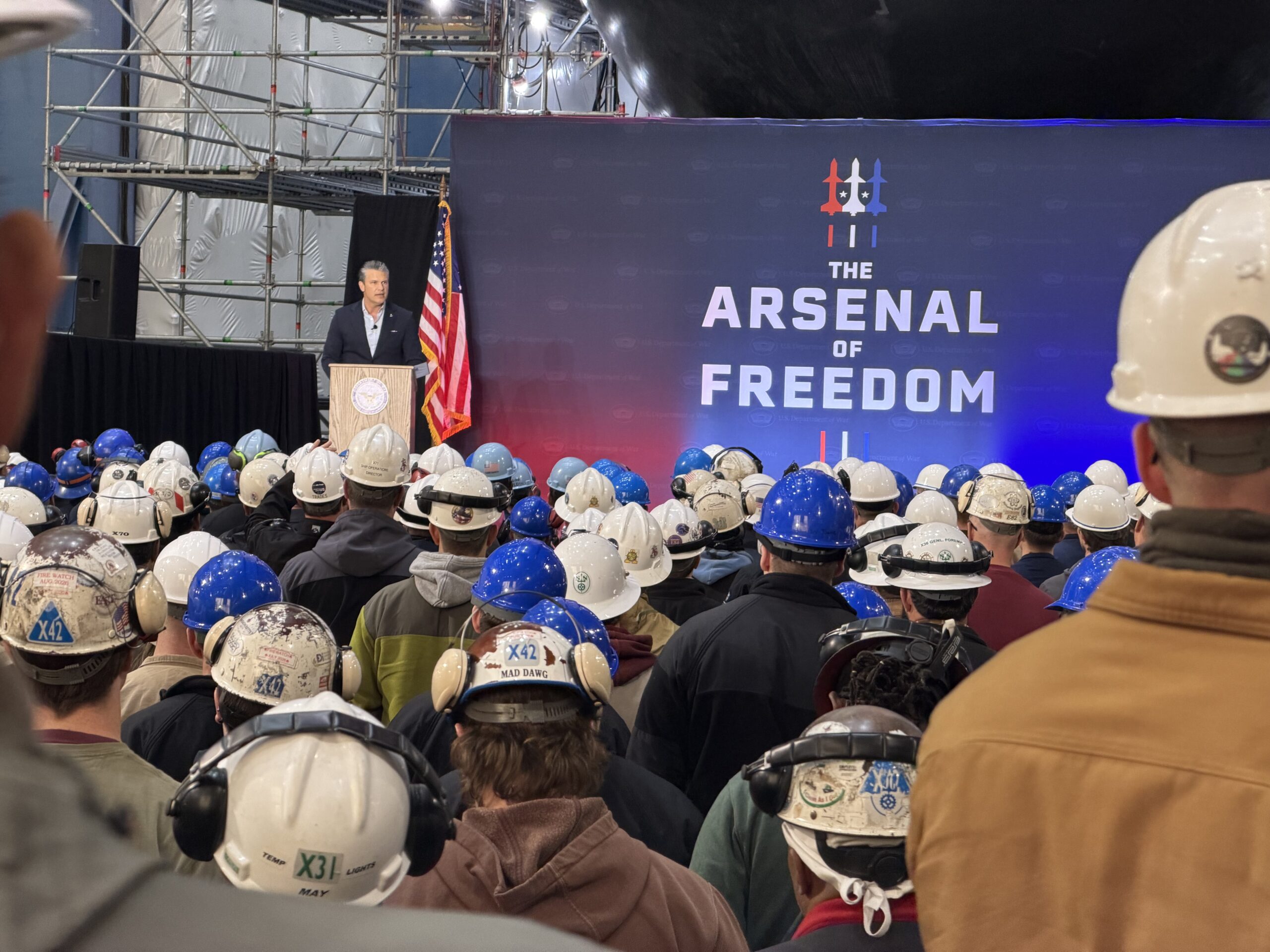
Behind the podium stood the USS Oklahoma, a Virginia-class submarine whose very existence is meant to complicate the lives of adversaries who will never see it, never hear it, and may never fully understand what went wrong until it is far too late. That, and the giant American flag hung above it, was the backdrop chosen by Pete Hegseth for the first stop of what the Trump administration calls the Arsenal of Freedom Tour, and the choice of venue was not incidental. It was the message.
Just days after the successful capture of Nicolás Maduro, a raid that focused global attention on American military power, competence, and resolve, Hegseth found himself under an intense international spotlight, both favorable and hostile. He could have used that moment to debate policy, score political points, or bask in victory. Instead, he redirected that attention toward shipbuilding and the American industrial base. And he asked gCaptain to be there with him to share his remarks with the world.
He came to speak directly to the men and women whose hands turn national strategy into steel reality. Welders, electricians, pipefitters, engineers, planners, apprentices, and master shipbuilders stood where lobbyists usually do not, listening as a cabinet secretary told them plainly that they are not an afterthought in American power. They are the arsenal.
That framing matters, because for decades American leadership has treated shipbuilding as something to be optimized, managed, or outsourced, rather than as the physical foundation of sovereignty and deterrence. Hegseth rejected that logic outright. A nation that cannot build its own tools, he argued, is a nation in managed decline. Standing beside a submarine that represents one of the most complex industrial undertakings ever attempted by human beings, it was difficult to dispute the point.
The speech itself was long, blunt, and unapologetically blunt. Hegseth spoke deliberately of the Department of War rather than the Department of Defense, not as provocation, but as reminder. Peace, he said, has never been preserved by euphemism. It has been preserved by credibility, by capability, and by the willingness to act decisively when deterrence fails. He laid out the administration’s theory of the case with clarity: putting America’s interests first, revive the warrior ethos, rebuild the force with speed and seriousness, and reestablish deterrence so overwhelming that no rational adversary chooses to test it.
“Under the previous administration, when our ships got shot at, we just said, ‘I guess we have to deal with it,'” he told a crowd that included shipyard workers, Navy sailors of every rank, Pentagon leaders, and the press. “All the way back to Thomas Jefferson, we said, ‘You’re not shooting at our ships–and if you do, you may not see tomorrow.’ We did that with the Houthis, and American ships now sail freely again. That’s peace through strength.”
What made those remarks resonate was not the rhetoric, but the linkage to action. Hegseth pointed to bombing runs that reopened shipping lanes, the seizure of shadow-fleet tankers, lethal interdictions of drug-smuggling vessels, and long-range strikes conducted at distances that leave adversaries uncertain and planners awake at night. Whether one agrees with every example or not, the intent was unmistakable. This administration believes ambiguity about American resolve is dangerous–and intends to remove it.
That intent became clearest when Hegseth turned to the future of sea power. Just weeks earlier, he said, the president and the Secretary of the Navy announced the creation of the Golden Fleet, a generational commitment to rebuilding American maritime dominance. Submarines like the one behind him would remain central, but they would not stand alone. New surface combatants, including the new Trump class of battleships, would anchor visible, undeniable command of the seas. Firepower and presence, lethality and endurance, built together rather than traded against one another.
For an audience that has watched competitors expand shipyard capacity while the U.S. shipbuilding industry collapsed to the point where every Navy newbuild is behind schedule and over budget, the message landed with force. While America decommissioned ships, others launched them. While American yards struggled under unpredictable funding and bureaucratic inertia, rivals poured concrete, trained workers, and laid keels. Hegseth’s argument was that this era is ending, not because of a think tank white paper, but because of a decision to build again at scale. A decision to appeal to the shipbuilders directly on their turf.
He was equally direct with industry leadership. The days of rewarding delay and cost overruns, he said, are over. Long-term, predictable contracts will go to companies that deliver on time and on budget, that invest in people and capacity rather than financial engineering, and that treat shipyard labor as a strategic asset instead of a cost to be minimized. He made clear that he does not care who wins contracts so long as the nation does. For a defense industrial base long accustomed to failing upward, this was not rhetoric. It was a warning.
What struck me most, after decades covering shipbuilding, was how little of this speech was aimed at journalists or politicians. It was aimed at the floor. At the people whose work is measured not in headlines, but in tolerances, weld integrity, and whether a boat comes home safely. Hegseth called the Virginia-class submarine an apex predator, and that is not marketing language. Boats like Oklahoma force adversaries to assume risk every day they exist. They reshape planning rooms thousands of miles away simply by being operational.
Near the end of the speech, Hegseth captured the moment more clearly than any policy declaration could. There is, he said, an unbreakable line between the wrench in a worker’s hand and the survival of a twenty-two-year-old sailor patrolling the Pacific. Anyone who has ever gone to sea understands that truth instinctively. Every shortcut is paid for later. Every missed deadline carries strategic cost. Every piece of craftsmanship matters when the ocean stops being forgiving.
“Our warfighters cannot win without you,” he told the shipbuilders standing in rapt attention. “We are in this fight together, shoulder to shoulder. That’s why we launched the Arsenal of Freedom Tour. It’s a beautiful codependence.”
Shipyards do not run on speeches, and no one in that hall believes otherwise. They run on schedules, supply chains, steel production, skilled labor, and leadership that understands what is at stake. America, to be honest, is struggling in all those areas and more. But culture matters, and signals matter. Inside that submarine construction building in Newport News, the signal was unmistakable: American industrial power is no longer being managed for decline. It is being summoned back into service.
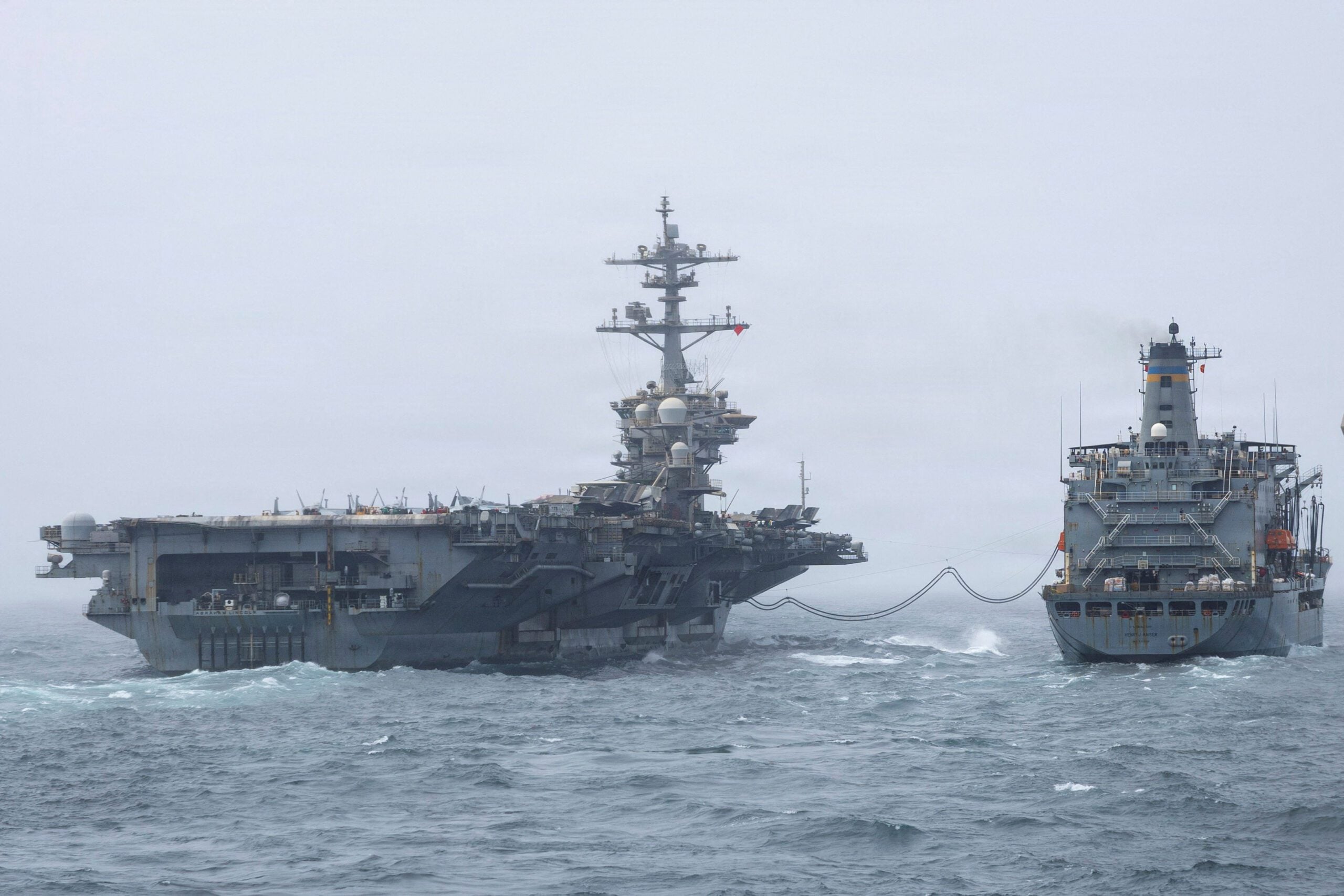
Critics will ask whether this is too little, too late for the U.S. Navy, if an inspiring speech can cut bloat and red tape, and what about the U.S.-flagged commercial fleet? It is a fair question. The Navy cannot surge shipyards in a crisis, nor can it surge merchant mariners, repair capacity, or commercial hulls that no longer exist under the U.S. flag. We are a 100 oil tankers short of minimum needs to supply a war in the Pacific and refineries are closing in California. Our problems are bigger than one man, even one who’s widely respected by most military members (if not allies and the press). Submarines and battleships deter wars, but merchant ships sustain them, and for decades America has allowed that side of sea power to atrophy through regulatory indifference and a bipartisan willingness to outsource logistics to foreign flags and foreign crews. Rebuilding naval combat power without rebuilding the commercial maritime base that feeds, fuels, and repairs it would be a half-measure, repeating the same blind spot that left the nation scrambling in past conflicts.
What remains unclear is how the Secretary of War’s vision integrates with the broader machinery of government. How does it align with the Departments of Transportation, Commerce, Homeland Security, home of the U.S. Coast Guard, or Treasury? How does it intersect with the Office of Management and Budget, the U.S. Trade Representative, the Federal Maritime Commission, and the American delegation to the International Maritime Organization in London? Shipyards are commercial enterprises. They require financing, regulatory coherence, and Wall Street confidence well beyond what the Department of War alone can provide.
If the administration sustains the pressure it promised, if it rewards performance instead of process and remembers that steel and time are unforgiving, this speech will not be remembered for its language. It will be remembered as the moment America decided, once again, to build the things that keep the peace. Watching the faces and body language of the workers in that hall, it was clear most believed the message. The remaining question is whether the Navy will attempt to go it alone, or whether the entire government will align behind Hegseth’s vision. And whether a world growing more chaotic by the week will allow the United States the focus required to rebuild itself from the keel up.
Regardless of the practical next steps and obstacles what I witnessed was a giant breath of relief from everyone in that building who cares about America’s heavy industry.
“Finally we have a leader who is rooting for us and driving us to do more,” one yard worker told me just before we left in the Secretary’s motorcade that blew past stop signs and traffic.

 Join The Club