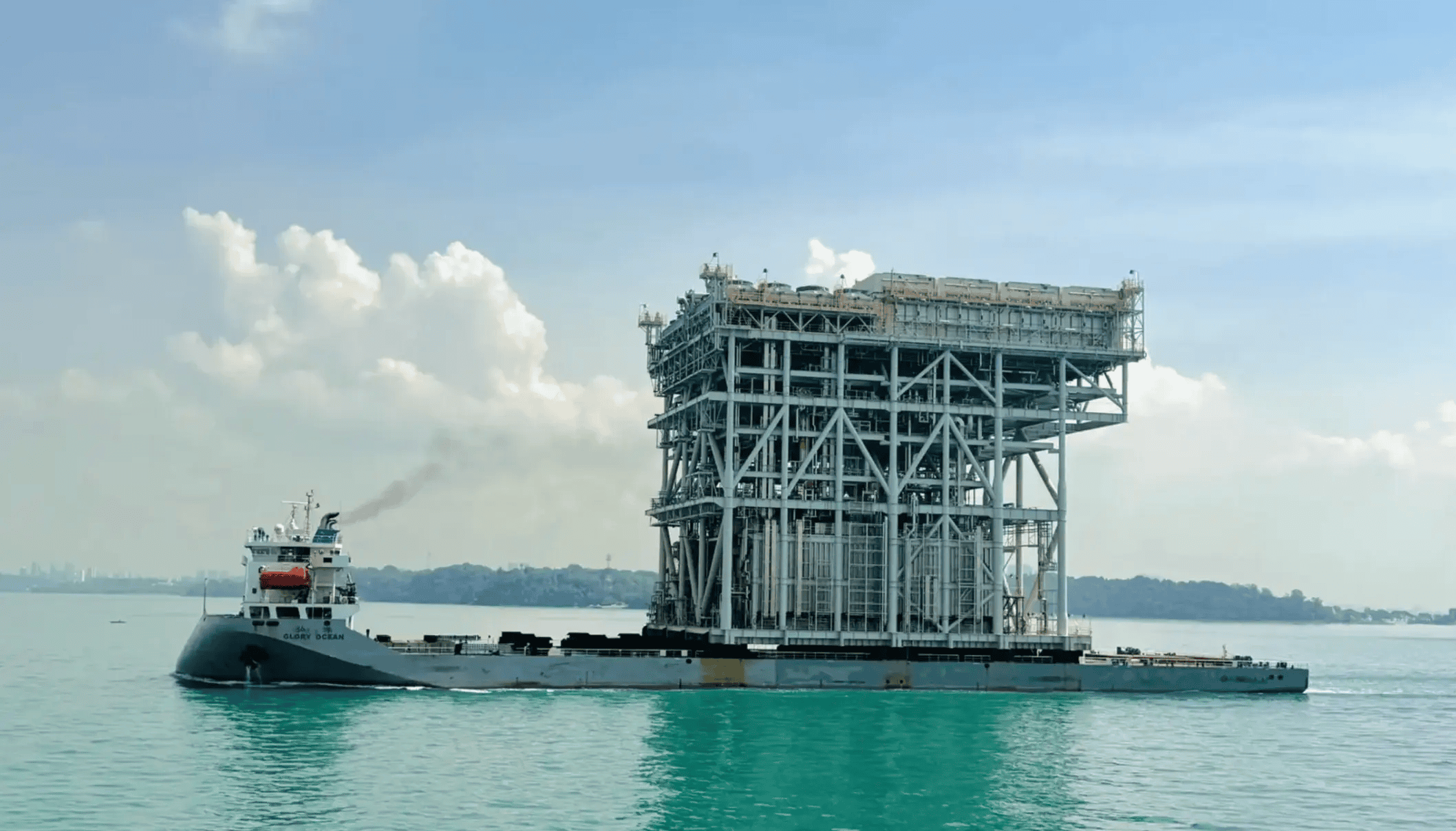
Two sanctioned heavy-lift vessels carrying key top-side modules for Russia’s Arctic LNG 2 project have arrived at Novatek’s Belokamenka construction yard after a journey of nearly 2½ months from eastern China, offering the clearest indication yet that work on the project’s long-stalled third production train could be resuming despite Western sanctions.
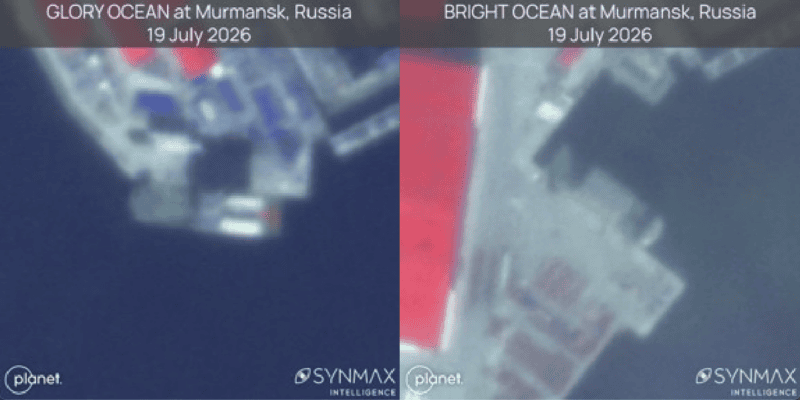
Satellite imagery obtained by Synmax from Planet Labs and shared with gCaptain shows the heavy-lift vessel GloryOcean and Bright Ocean berthed at Novatek’s Belokamenka facility near Murmansk, where giant liquefied natural gas (LNG) process modules are assembled onto gravity-based structures (GBS) before being towed to Arctic LNG 2 on the Gydan Peninsula.
Rather than being unloaded near Belokamenka’s large enclosed assembly hall, the module aboard Glory Ocean is being offloaded directly alongside the unfinished GBS3 structure, the platform intended for Arctic LNG 2’s third production train. At the same time Bright Ocean was docked closer to the assembly hall.
Glory Ocean and Bright Ocean on July 19, 2026 at Belokamenka near Murmansk. (Source: Synmax Intelligence)
The cargo carried by Glory Ocean is the TMR-001 pipe rack module, regarded as the first topside module that must be installed in the center of the gravity-based structure during assembly. Its sister vessel, BrightOcean, arrived carrying the TMR-002 module, which is designed to follow immediately afterward in the installation sequence.
While the arrivals strengthen speculation that construction of Train 3 could resume, they do not conclusively demonstrate a full restart. Two additional pipe rack modules, TMR-003 and TMR-004, remain at the former Wison Offshore fabrication yard in Zhoushan, China, now operating under new ownership after the facility itself became entangled in sanctions related to Arctic LNG 2.
The vessels themselves illustrate the increasingly complex logistics supporting Russia’s Arctic energy ambitions.
Glory Ocean, formerly known as Nan Feng Zhi Xing, and BrightOcean, previously named Hunter Star, both operated in earlier module deliveries for Arctic LNG 2 before being sanctioned by the United States in 2024. Despite those restrictions, both ships successfully completed the voyage from China to Russia carrying equipment essential for Novatek’s flagship Arctic LNG development.
Their arrival also coincides with fresh activity involving another vessel long associated with Russia’s Arctic LNG construction program.
The ice-class heavy-lift carrier Audax, purpose-built to transport oversized LNG modules into Arctic waters for both the Yamal LNG and Arctic LNG 2 projects, recently departed the anchorage off Lianyungang where it had remained since June 2024. Automatic Identification System data show the vessel sailed into Lianyungang Gangguanhe Port on July 10, where it remains.
The two ice-capable heavy-lift ships played a critical role delivering massive prefabricated modules from Chinese fabrication yards for the construction of both the Yamal LNG project and Arctic LNG 2.
Arctic LNG 2, led by Novatek, has faced mounting delays since sweeping U.S. sanctions imposed in late 2023 disrupted financing, technology supplies, and shipping. While the first production train was largely completed before sanctions tightened, Train 2 had to be redesigned and work ceased on Train 3 as key equipment remained stranded in China.
Whether the arrival of the latest modules marks the beginning of a sustained restart of Train 3, or merely the relocation of completed equipment from Chinese yards to Russian storage, remains to be seen.
Qatar has amassed a fleet of empty liquefied natural gas tankers in the Persian Gulf, a sign that one of the world’s biggest exporters of the fuel may be preparing to boost shipments through the Strait of Hormuz.
New company takes on four Arc4 LNG carriers as Seoul looks to expand Busan’s role in Arctic shipping. A newly established South Korean ship manager is emerging as a potential new player in Arctic LNG shipping, taking control of four ice-class LNG carriers while planning a rapid expansion into the specialized fleet needed to transport gas along Russia’s Northern Sea Route.
A nuclear-powered LNG carrier could cost roughly 2.5 times as much to build as a conventional vessel, but lower fuel costs could significantly change the economics over the ship’s operating...
October 1, 2026
Total Views: 1026
Get The Industry’s Go-To News
Subscribe to gCaptain Daily and stay informed with the latest global maritime and offshore news
— just like 106,969 professionals
Secure Your Spot
on the gCaptain Crew
Stay informed with the latest maritime and offshore news, delivered daily straight to your inbox
— trusted by our 106,969 members
Your Gateway to the Maritime World!
Essential news coupled with the finest maritime content sourced from across the globe.

 Join The Club