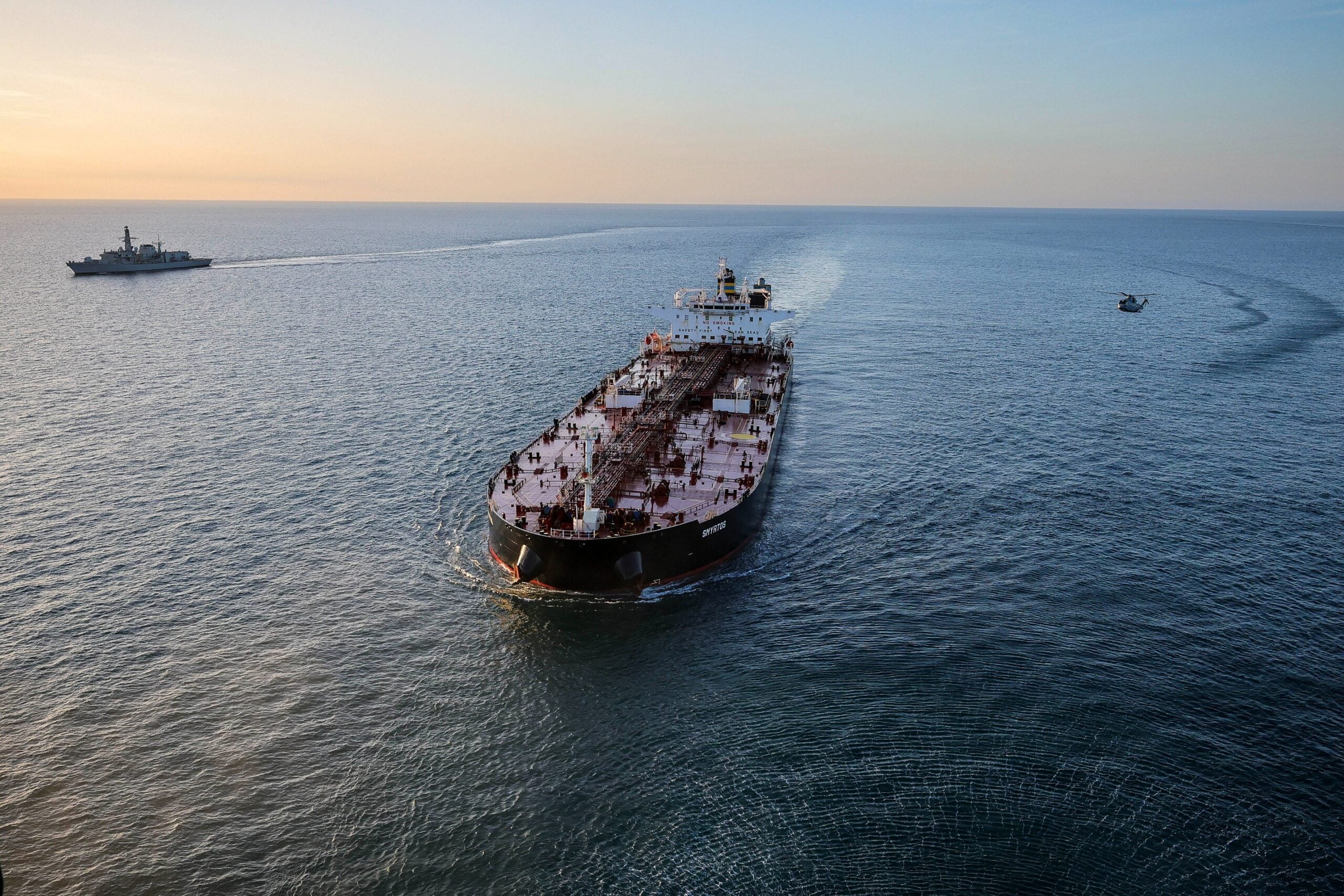
In the grey hours before dawn on Sunday, Royal Marine Commandos fast-roped from RAF Chinook helicopters onto the deck of a 244-meter Aframax tanker transiting the English Channel.
By Paul Morgan (gCaptain) – The operation, which lasted six hours and was supported by HMS Sutherland, HMS Ledbury, Merlin and Wildcat helicopters, and an RAF P-8 Poseidon maritime patrol aircraft, was the first of its kind led by British forces. The vessel, MV Smyrtos, was flying what authorities described as a Cameroonian flag. In a critical detail barely mentioned in official statements, that flag was almost certainly worthless.
Cameroon had quietly deregistered Smyrtos, along with approximately 35 other vessels, earlier this month following sustained European diplomatic pressure on Yaoundé to tighten oversight of its registry.
UK Boards Russian Shadow Fleet Tanker in First Direct Interdiction Operation
In maritime law, a ship without a flag is a ship without a state. That legal reality, grounded in Article 110 of the United Nations Convention on the Law of the Sea (UNCLOS), gave the Royal Navy the authority it needed to exercise a right of visit, and the National Crime Agency the domestic powers to act once the vessel’s stateless status was confirmed.
Smyrtos is not a new name to those tracking Russia’s sanctions-evasion apparatus. Formerly known as Myrtos, the vessel was renamed in early 2025 in the familiar pattern of identity-shuffling that characterizes the shadow fleet’s modus operandi. She was placed on UK and EU sanctions lists in October 2025 for transporting Russian-origin crude oil.
Her registered owner and commercial manager are listed in the Equasis database as Hong Kong-based Zhao Yao Shipping, with ISM management provided by India-based Vika Line Marine Services—a corporate geography spanning three continents that speaks volumes about the opacity on which such operations rely. On June 4, she loaded an estimated 101,400 tonnes of Urals crude at Russia’s Ust-Luga terminal on the Gulf of Finland and set a westward course. Her declared destination, according to vessel-tracking data, pointed variously toward Port Said and Sikka, India—the kind of routing ambiguity common to cargo whose ultimate consignee is best left unspecified.
She had made similar Channel transits before. What she had not done was attempt them as an effectively stateless vessel in UK territorial waters following a March 2026 policy decision by Prime Minister Keir Starmer explicitly authorizing British armed forces and law enforcement agencies to interdict sanctioned vessels in UK waters in accordance with international law.
Whether her owners or operators were unaware of the Cameroon deregistration, or whether they calculated, as many shadow fleet operators have done before, that sanctions would remain unenforced, remains a matter for investigators. What is beyond dispute is that the calculation failed, and Smyrtos now sits at anchor in Weymouth Bay, watched over by HMS Ledbury and HMS Sutherland, her cargo undelivered and her future uncertain.
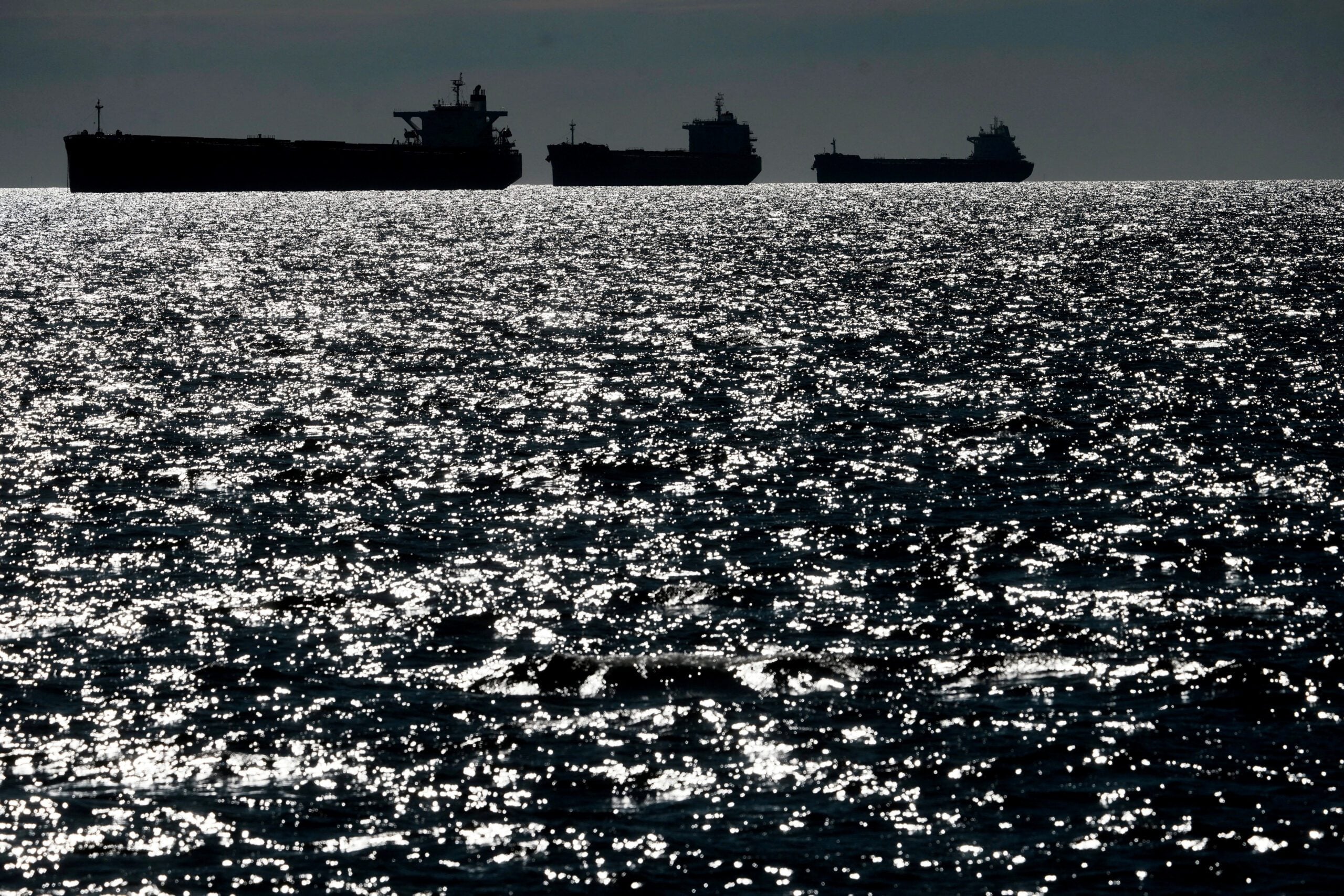
The scale and ambition of Russia’s shadow fleet are not in doubt. More than 700 vessels, most of them ageing tankers over 15 years old, form the backbone of an elaborate parallel logistics network that carries roughly 75% of Russia’s sanctioned crude oil exports to markets in Asia, the Middle East, and beyond.
These ships are typically registered under flags of convenience in jurisdictions willing to accept fees and ask few questions, insured through opaque mutual clubs or self-insurance arrangements, and managed through chains of nominally independent companies structured specifically to frustrate attribution. The commercial ecosystem sustaining them includes brokers, traders, port agents, and financing intermediaries across dozens of countries, many of whom have no direct contact with Russia at all. The result is a machine that, until recently, has proved remarkably resilient to Western pressure.
The interdiction of Smyrtos does not destroy that machine. It does, however, represent something significant: the first occasion on which British forces have boarded and detained a vessel as part of a nationally led shadow fleet enforcement operation. Previous UK involvement had been in support of allied actions, including logistical and surveillance contributions to U.S. and French operations.
France, for its part, has been more aggressive in this space for months, diverting the tanker Grinch in January and detaining Boracay off the French Atlantic coast in October 2025. Belgium has led its own actions. The United States seized the Russian-flagged Marinera in the North Atlantic in January 2026. Britain’s action places it in a growing coalition of states willing to move beyond sanctions listings and asset freezes to physical enforcement at sea.
The operation also illustrates how the legal architecture has been carefully constructed to withstand challenge. The Ministry of Defence statement cites UNCLOS Article 110, which grants warships the right to board vessels where there are reasonable grounds to suspect they are without nationality. A vessel that has lost its flag registration falls squarely within this provision. Once aboard and having established the vessel’s stateless status, domestic enforcement powers under the Russia (Sanctions) (EU Exit) Regulations 2019 and the Policing and Crime Act 2017 provide the basis for detention and investigation.
The operation was conducted in close coordination with France, whose experience in shadow-fleet interdictions appears to have informed the UK’s approach.
The financial picture behind these operations is far from marginal. Official UK figures indicate that Russia’s oil revenues fell 24% year-on-year in 2025 and are now down 27% from their October 2024 peak, the lowest level since the full-scale invasion of Ukraine began in February 2022. Ships sanctioned by the UK carried an estimated $1.6 billion less in Russian oil during the first quarter of 2025 than in the corresponding period a year earlier.
These are not trivial sums in the context of a war economy already under severe strain from military expenditure. Ukrainian President Volodymyr Zelenskyy, reacting to the Smyrtos seizure, made the connection explicit, noting that every decision by partners that reduces Russia’s oil revenues also limits the scope of the war itself.
He also called on Europe to go further, urging legislative changes that would enable not only the detention of shadow fleet tankers but also the confiscation of their cargoes—a step that would represent a significant escalation in economic pressure on Moscow.
The operation was carried out by 42 Commando Royal Marines, based at Bickleigh Barracks in Plymouth, who were validated earlier this year as part of the newly established Special Operations Maritime Task Group. The involvement of the National Crime Agency alongside the armed forces reflects the hybrid nature of the enforcement action: simultaneously a military operation, a law-enforcement exercise, and a sanctions-compliance matter.
The coordination required across those three domains, and the six-hour duration of the boarding operation itself, underline that these are not simple undertakings, whatever the political optics might suggest.
Putin has already characterized the interception of Russia-linked vessels by Western navies as piracy. The charge is unlikely to find many sympathetic ears within the maritime community, where the shadow fleet’s environmental and safety record has become a growing concern.
More than 50 incidents involving shadow fleet vessels have been recorded since the network expanded following the 2022 invasion. More than 72% of the fleet is over 15 years old, and inspections of detained vessels have frequently identified maintenance deficiencies consistent with operations conducted on minimal budgets, outside normal class supervision and free from the port state control scrutiny that reputable operators accept as routine.
Smyrtos herself will now be monitored for environmental and safety concerns while lying at anchor in Weymouth Bay, a precaution that speaks to the regulatory void from which many of these vessels operate.
Whether this operation marks the beginning of a sustained campaign of physical enforcement, or remains an isolated demonstration of capability and political will, depends on factors that are not yet visible. The legal framework exists. The military and law-enforcement assets demonstrated their readiness. The question is whether the appetite to use them again—and again after that—matches the scale of the challenge.
The shadow fleet did not materialize overnight, and it will not be dismantled by a single dawn boarding in the English Channel. But Smyrtos, now anchored beneath grey Dorset skies, represents more than a detained tanker. She is evidence that the invisible has been made visible—and that for operators who assumed Western enforcement would remain largely theoretical, the calculus may have changed.

 Join The Club