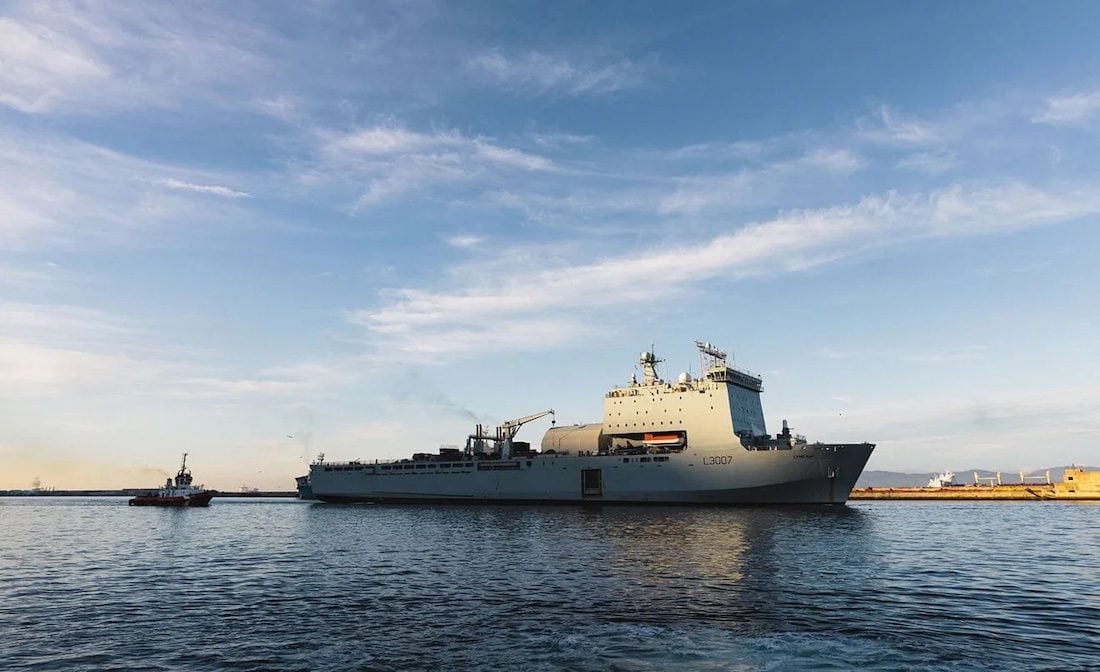
The United Kingdom is moving another major piece into place for a potential multinational operation in the Strait of Hormuz, with Royal Fleet Auxiliary vessel RFA Lyme Bay departing Gibraltar carrying a suite of advanced autonomous mine-hunting systems and more than 100 specialist Royal Navy personnel.
The deployment signals Britain’s growing focus on mine warfare and unmanned maritime operations as Western allies prepare for the possibility of a long-duration effort to restore commercial confidence in one of the world’s most strategically important shipping chokepoints.
According to the Royal Navy, Lyme Bay is preparing to serve as a “minehunting mothership” capable of deploying autonomous surface and underwater systems designed to detect and neutralize naval mines without placing sailors directly in minefields.
The Bay-class support ship sailed from Gibraltar carrying personnel from the Royal Navy’s Diving and Threat Exploitation Group (DTXG) and Mine and Threat Exploitation Group (MTXG), alongside an array of uncrewed mine warfare technology.
Among the systems onboard is the 12-meter uncrewed surface vessel RNMB Ariadne, designed specifically to locate and destroy naval mines remotely. Other systems include Seacat autonomous underwater vehicles capable of generating detailed 2D and 3D sonar maps of the seabed, along with Remus uncrewed underwater vehicles used for seabed surveys and mine detection operations.
“Personnel from MTXG will embark in RFA Lyme Bay with a clear purpose: to deliver a credible, modern Mine Countermeasures capability,” Commander Dan Herridge, Commanding Officer of MTXG, said in a statement.
“Enabled by the Minehunting Capability Programme, they will employ cutting-edge sensors delivered through autonomy and AI to detect threats to the maritime community in some of the world’s most challenging environments,” he added.
The move comes as concerns over naval mines remain one of the biggest unresolved obstacles to restoring normal commercial shipping flows through the Strait of Hormuz following months of conflict and maritime disruption in the region.
While Western officials continue discussing future coalition escort and maritime security operations, industry groups including BIMCO and the IMO have repeatedly warned that confidence among shipowners and insurers is unlikely to recover until credible mine-clearance operations are underway and safe transit guarantees are established.
The UK Ministry of Defence earlier announced that Lyme Bay would be upgraded for a future role supporting autonomous mine-hunting operations as part of a broader multinational maritime security effort involving more than 40 nations.
That emerging coalition — led jointly by the UK and France — has increasingly taken shape as a defensive maritime security framework modeled in part on Europe’s Red Sea escort and protection missions, with a heavy emphasis on mine clearance, autonomous systems, aerial surveillance, and defensive naval operations.
The latest deployment also underscores how rapidly naval doctrine is shifting toward unmanned and AI-enabled maritime warfare capabilities.
Rear Admiral Philip Game, Director Operations for the UK National Armaments Director group, said the mission demonstrates how Britain is attempting to rapidly field autonomous systems developed alongside domestic industry partners.
“This mission is not just a temporary crisis response; it reflects our role as a trusted advisor and strategic partner, deploying UK tech to protect global commerce and reinforce our long-standing security commitments in the Gulf,” Game said.
The Royal Navy also said Lyme Bay underwent extensive cybersecurity checks ahead of deployment, including inspections of onboard IT systems and personal electronic devices, reflecting growing concern over digital espionage and cyber threats tied to modern naval operations.
The deployment follows the recent arrival of the Royal Navy destroyer HMS Dragon in the Middle East, where it is expected to support any future multinational Hormuz security mission with air-defense and counter-drone capabilities.
Despite limited commercial voyages through the Strait in recent weeks, maritime traffic remains far below pre-conflict norms as shipowners continue weighing risks from naval mines, drone attacks, missile strikes, overlapping military controls, and unresolved security guarantees.
Roughly one-fifth of global oil supplies and a major share of global LNG exports transit the Strait of Hormuz under normal conditions, making any sustained disruption a major concern for global energy markets, shipping supply chains, and inflation-sensitive economies worldwide.

 Join The Club