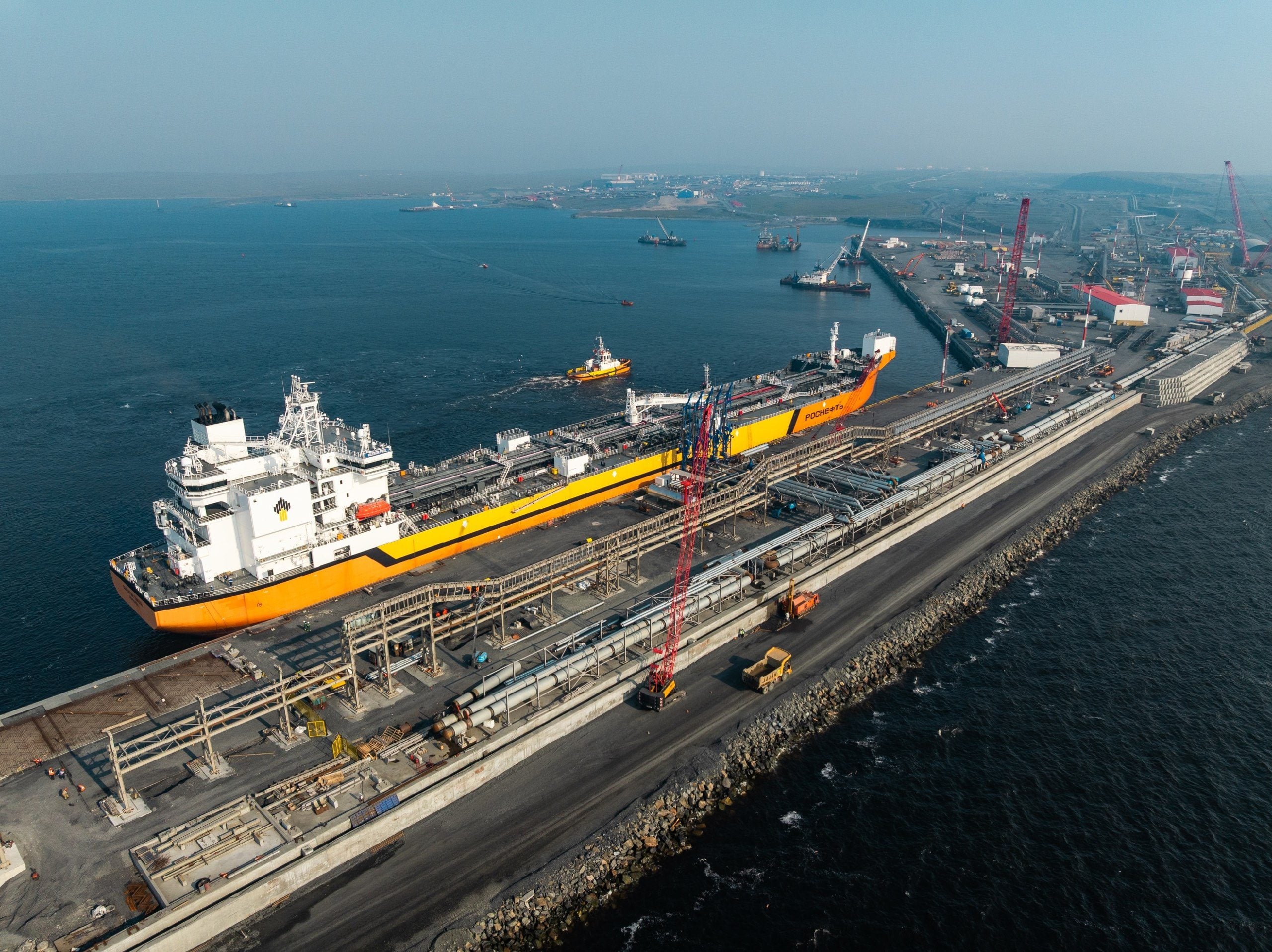
(Bloomberg) — Along Russia’s remote Arctic coast last month, Igor Sechin stood beside a waiting tanker in the freezing cold with a message for Vladimir Putin: After years of construction, the country’s next great oil frontier was finally coming to life.
Hundreds of miles of pipeline now connected oil fields to storage tanks and a new port for Vostok Oil, part of an almost $50 billion investment. With Putin watching by video link, Sechin, the powerful head of state-run Rosneft PJSC, asked to begin loading the first tanker with crude. “Permission granted,” Putin said.
The ceremony carried particular weight for Russia’s increasingly battered oil industry. Years of war and sanctions are making it harder for oil producers — including Rosneft, the nation’s largest — to maintain volumes today while developing reserves for tomorrow. Rosneft’s Vostok Oil project was supposed to show Russia could still do both. Sechin said it would add as much as 10% to the country’s current output by 2030 and supply millions of barrels to world markets for a century or more.
But the milestone obscured a more complicated reality: Years behind schedule, Vostok Oil is still far from becoming Russia’s new oil province.
The vast majority of crude flowing through the costly new Arctic network has been diverted from fields that have been producing for years. Just before the terminal opened in September, new oilfields in the Payakha cluster, expected to become key assets of Vostok Oil, accounted for less than 5% of its flows, according to a person familiar with the data, who asked not to be identified to discuss sensitive matters that aren’t public. Satellite imagery shows development continuing, but bringing those fields up to scale will require years more work and investment, according to Bloomberg analysis of the imagery and conversations with analysts.
“The development of the company’s fields is carried out in a planned manner, which allows maximum efficiency to be extracted both from existing fields and from new projects,” Rosneft said in a statement, adding that production ramp-ups at Vostok Oil depend on market needs and general economic conditions.
Viktor Kurilov, a senior analyst on the oil markets team at Rystad Energy, said building out Vostok Oil “is just one of the challenges Rosneft — and the Russian oil industry — is facing.” Among them is Ukraine’s dramatically expanded campaign of drone strikes against the country’s oil sector, which is inching closer to Vostok Oil facilities and repeatedly damaging refineries run by Rosneft and others in the European part of Russia. One of its biggest, Ryazan, which supplies fuel to Moscow and surrounding regions, has been shut for more than half the time since it was first attacked in May and has run well below full capacity when operating, according to damage assessments seen by Bloomberg.
In turn, Rosneft’s finances are suffering. The company’s profits are falling and debt is rising despite what should have been a windfall from the Iran war. Rosneft officials have expressed concern that even a few more months of the war in Ukraine could leave lasting damage across the business, according to people familiar with the matter.
The mounting toll to Rosneft and Russia’s wider oil industry helps explain why stopping Ukraine’s strikes on refineries has become such a priority for Moscow. This month, Putin and US President Donald Trump struck a deal opening the door to American purchases of Russian diesel, providing a potential boost as Washington also pressed Kyiv to halt the attacks, an important contributor to the squeeze on global diesel supplies. But an attempted energy truce quickly unraveled, narrowing Rosneft’s avenues for relief — and raising the stakes for a government that gets roughly a fifth of federal revenues from oil and gas.
This story is based on conversations with people familiar with the situation at Rosneft, expert analysis and a series of documents reviewed by Bloomberg over the last six months, including damage assessments and company plans for protecting and repairing refineries.
A ‘Perfect Storm’
Vostok Oil was conceived in a different era, when Russia’s oil refineries were not under constant threat of Ukrainian attacks and production was expected only to grow. Laying out his plans to Putin at a Kremlin meeting in February 2020, Sechin described a vast new Arctic oil province that would create jobs and industry in a remote part of the country. One goal, he said, was to turn the Northern Sea Route into a major global energy corridor.
The project was also intended to address a longer-term challenge: Many of Russia’s biggest oilfields had been producing since Soviet times, making new reserves increasingly important to offset their decline. The ambition attracted foreign investors, including commodity trading giant Trafigura, which acquired a 10% stake in 2020, and a Vitol-led consortium, which bought another 5% the following year.
Russia’s invasion of Ukraine in 2022 upended those plans. Both Trafigura and the consortium exited, while Western sanctions restricted access to the technology and equipment needed to develop Vostok Oil and build specialized tankers capable of navigating icy waters.
As the war dragged on, Ukraine intensified its campaign against Russia’s infrastructure, increasingly targeting the refineries that turn crude oil into fuel. So far this year, Ukrainian drones have carried out at least 114 strikes on Russian refineries, more than double the number over the same period last year, according to a Bloomberg tally, based on public statements from both countries.
The attacks have pushed Russian refinery runs to multi-year lows, triggered fuel shortages and forced Moscow to restrict exports of gasoline, diesel and jet fuel.
Rosneft has borne a significant share of the damage. The company operates 12 refineries accounting for about a third of Russia’s total oil-processing capacity. Of 15 confirmed drone strikes on the country’s oil-processing plants in September, five targeted major Rosneft facilities supplying fuel to European Russia, the largest consuming region, according to Bloomberg’s tally.
Rosneft is “taking appropriate measures to ensure the security and operation of our plants,” and will continue to make sure they are protected, the company said in its statement. “Not a single company petrol station has been closed, and consumers receive fuel in full at stable prices,” it said.
In March, while reflecting on Rosneft’s 2025 results, Sechin, a longtime Putin ally, said Russia’s oil producers had faced a “perfect storm” of low oil prices, Western sanctions and soaring borrowing costs. Since then, repeated attacks have forced some of Rosneft’s biggest refineries to operate at reduced capacity or shut altogether.
Ryazan has been among the hardest hit, repeatedly coming under attack as Rosneft has sought to restore operations. Another refinery, Syzran, has spent much of the past six months either completely shut or operating at less than a third of capacity, according to data reviewed by Bloomberg, and the company’s Tuapse refinery on the Black Sea coast has been offline since April.
Rosneft has managed to restart some refineries within weeks of an attack, only to see them struck again as repairs are completed or nearing completion. The need to repeatedly repair damaged equipment is straining operations and causing costs to pile up to levels that Rosneft officials have privately warned cannot be sustained long-term, according to people familiar with the matter, who asked not to be named to discuss sensitive information. Some plants have deliberately slowed repairs as a result, stretching work that should take days into weeks, the people said.
Efforts to protect the facilities with shipping containers, nets and steel cables have proved ineffective against swarms of drones, according to company plans reviewed by Bloomberg. The damage is particularly difficult to repair when strikes hit complex secondary units such as catalytic crackers, reformers and hydrocrackers, whose parts would previously have been sourced from the West.
Sanctions are compounding the problems by restricting access to replacement equipment, forcing Rosneft to rely on Russian-made copies and Chinese imports that can take months to obtain and are not always compatible with existing machinery, people familiar with the matter said.
More broadly, the International Energy Agency said drone strikes on Russian refineries are having a “cumulative negative effect.” In September, the agency cut its outlook for Russian oil processing over the next 18 months to around 4 million barrels a day, roughly 30% below prewar levels.
Financial Troubles
The financial toll is mounting. Rosneft’s first-half net income fell by almost a fifth to 200 billion rubles ($2.4 billion). Its ratio of net debt to earnings before interest, taxes, depreciation and amortization rose to 1.8 times at the end of June, the highest in more than five years, according to quarterly statements dating back to 2020, though three reports over the period don’t disclose the ratio, making estimations of the exact size and scope more challenging.
To be sure, conditions have improved since then. Middle East disruptions have pushed the price of Russia’s Urals crude used for tax calculations above $90 a barrel, more than double its level at the start of the year, while Moscow is providing billions of rubles in subsidies to domestic fuel producers, including Rosneft, in recent months. Russia’s central bank has also cut its key rate from a record 21% to 14% over the past two years, though Rosneft has complained that the pace of reductions is “clearly insufficient.”
The company’s financial picture and the extent of damage to its infrastructure are being closely monitored by the Qatar Investment Authority, which owns 18.46% of Rosneft and has seen its dividend payments fall sharply during the Ukraine war, according to three Qatari officials familiar with the matter, who asked not to be named to discuss sensitive information. QIA hopes for a swift end to the conflict so its investment is protected longer-term, one of the people said.
QIA declined to comment.
Rosneft’s problems have coincided with signs of distress at Credit Bank of Moscow PJSC, which market participants and officials view as being in the orbit of Sechin and his oil giant. MKB, as it is known, is dealing with $8 billion in problem loans, Bloomberg reported last month. That development highlights how both Russia’s energy and banking sectors are coming under strain at the same time, a dynamic that Russian finance officials have expressed concern about, people familiar with the matter said.
Rosneft said in its statement that its “relations with MKB, as with other Russian banks, are standard,” adding that “neither Rosneft nor its Chief Executive Officer are or have ever been beneficiaries of MKB.”
Rosneft faces another financial challenge: the enormous spending still required at Vostok Oil. The project remains heavily dependent on production from Vankor, a group of established fields that began pumping crude in 2009. Its new Arctic terminal gives Rosneft another route to market for that oil, but does little on its own to increase Russia’s output.
Rystad Energy, which has analyzed satellite imagery of construction at the project, expects Vostok Oil to produce about 310,000 barrels a day in 2027, with around 90% coming from the Vankor cluster, where fields have been producing for years. Output could rise to 440,000 barrels a day by 2030 — well short of the roughly 1 million Sechin has promised — with the new Payakha fields contributing only about 80,000 barrels a day, according to the consultancy.
Getting the oil to market is another obstacle. Rosneft needs specialized tankers to navigate frigid Arctic waters, but Western sanctions have complicated efforts to build them. At least 30 would be needed by 2030 to transport Vostok Oil’s planned output, according to Sergey Vakulenko, an industry veteran and scholar at the Carnegie Endowment for International Peace.
“They simply don’t exist today,” he said.
Missed Opportunities
With Russia’s war in Ukraine well into its fifth year, Putin has secured a potential reprieve from Washington. In an Oct. 9 phone call with Trump, the Russian president said Russia would partially relax its diesel export ban, releasing thousands of barrels a day into the global market. It’s unclear what, if anything, Russia will receive in return. But in the days since, Ukraine has faced temporary restrictions on its military access to SpaceX satellite technology and US intelligence.
For Trump, the immediate concern was closer to home. Diesel prices had surged to near-record levels ahead of November’s congressional elections, squeezed by the war in Iran and disruptions to global fuel supplies. The agreement was intended to help bring prices down, though US officials have acknowledged it is unlikely to have much effect on the international diesel market. Washington also pressed Kyiv to halt refinery strikes that had constrained Russian exports.
“Unless President Putin agrees to stop attacks on Ukrainian critical infrastructure, or President Trump agrees to give Ukraine additional offensive and defensive capabilities, Kyiv is unlikely to abide by a unilateral ceasefire,” said Fernando Ferreira, director of geopolitical risk at Rapidan Energy Group.
The limits of the arrangement soon became apparent. Neither Russia nor Ukraine confirmed the energy ceasefire Trump subsequently announced, and Kyiv resumed refinery attacks last week after accusing Moscow of continuing strikes on its energy infrastructure.
Even if the diplomacy eventually produces a more durable pause, Ukraine is already changing the battlefield. In 2022, its attacks reached targets some 650 kilometers (404 miles) from the border. By July this year, drones had struck the Omsk refinery deep in western Siberia, roughly 2,500 kilometers away.
Vostok Oil’s Arctic terminal lies another 800 kilometers beyond that, still outside Ukraine’s demonstrated reach. But the vast distances that have long sheltered Russia’s most remote energy assets offer less reassurance than they once did: If the range of Ukrainian drone strikes continues expanding at its recent pace, Vostok Oil could plausibly come within reach within months.
At last month’s opening ceremony, Sechin was still looking ahead. Bundled against the cold beside the Valentin Pikul, he told Putin that Vostok Oil would ship 30 million tons of crude as early as the second half of 2027.
It was another sign of how much the project has suffered: The terminal was meant to be ready for that volume two years ago.
© 2026 Bloomberg L.P.

 Join The Club