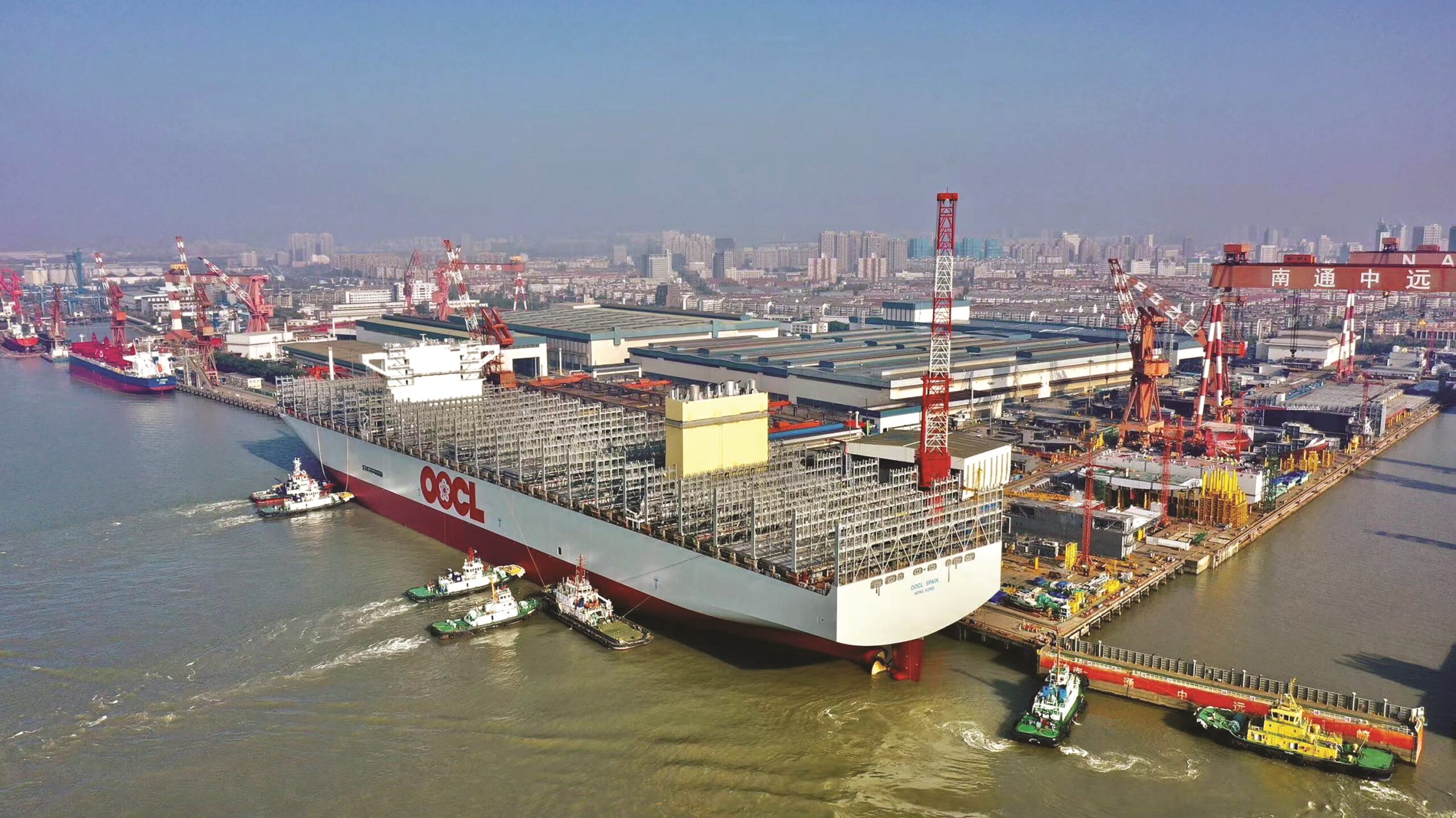
China has further cemented its dominance of global shipbuilding, capturing nearly three-quarters of new orders over the past year as the industry’s order book approaches record levels, according to new analysis from BIMCO.
The global shipyard order book reached an estimated 203.2 million compensated gross tonnage (CGT) as of September 1, 2026, up 13% from 180 million CGT a year earlier. While slightly below the all-time high of 210.4 million CGT reached in May, the backlog remains above the previous record of 195.4 million CGT set in 2008.
Chinese shipyards have been the biggest beneficiaries of the ordering boom, securing 74% of all CGT contracted over the past 12 months. China now controls 64% of the global order book, well ahead of South Korea at 19% and Japan at just 6%.
China’s lead is even more pronounced across the major commercial shipping sectors. Its yards hold more than 72% of the order book in each of the six main vessel categories, including containerships, tankers, gas carriers, bulk carriers, other dry cargo ships and RoRo vessels. Together, those segments account for 88% of the global order book.
Containerships are driving much of the growth.
“Container ships dominate both the order book and its growth over the past 12 months. They account for 30% of CGT on order and 68% of the increase during the past year,” said Niels Rasmussen, BIMCO’s Chief Shipping Analyst.
Chinese yards hold an especially commanding 81% share of the global containership order book.
But the massive backlog also presents a growing challenge for shipbuilders, particularly in China, where scheduled deliveries are set to far exceed recent production levels.
Based on each country’s highest annual output between 2021 and 2025, Chinese shipyards have enough orders to keep them busy for an average of 4.2 years. That compares with just 1.9 years for South Korean yards and 1.7 years for Japanese yards.
The challenge is the sheer volume of ships scheduled for delivery.
Combined output from China, South Korea and Japan reached 40.1 million CGT in 2025, but scheduled deliveries climb to 55.9 million CGT in 2027 and 60 million CGT in 2028.
China faces the steepest increase, with its shipyards scheduled to deliver a record 44 million CGT in 2028, nearly double the 22.7 million CGT delivered in 2025.
Meeting those commitments will require a significant increase in production capacity.
BIMCO estimates that if capacity is instead measured against the highest annual output delivered or scheduled between 2021 and 2030, China’s order book coverage falls to 2.1 years, compared with 1.6 years for both South Korea and Japan.
The figures highlight a potential downside to China’s rapid shipbuilding expansion. While its yards currently enjoy an enormous backlog, the investments needed to meet delivery commitments could leave the industry with excess capacity if demand for new ships slows.
“China has further strengthened its position as the world’s leading shipbuilding nation, but its shipyards must raise annual output to new record highs in order to deliver,” Rasmussen said.
“The capacity expansion needed to achieve this could increase the risk of underutilisation if contracting weakens in the future.”

 Join The Club