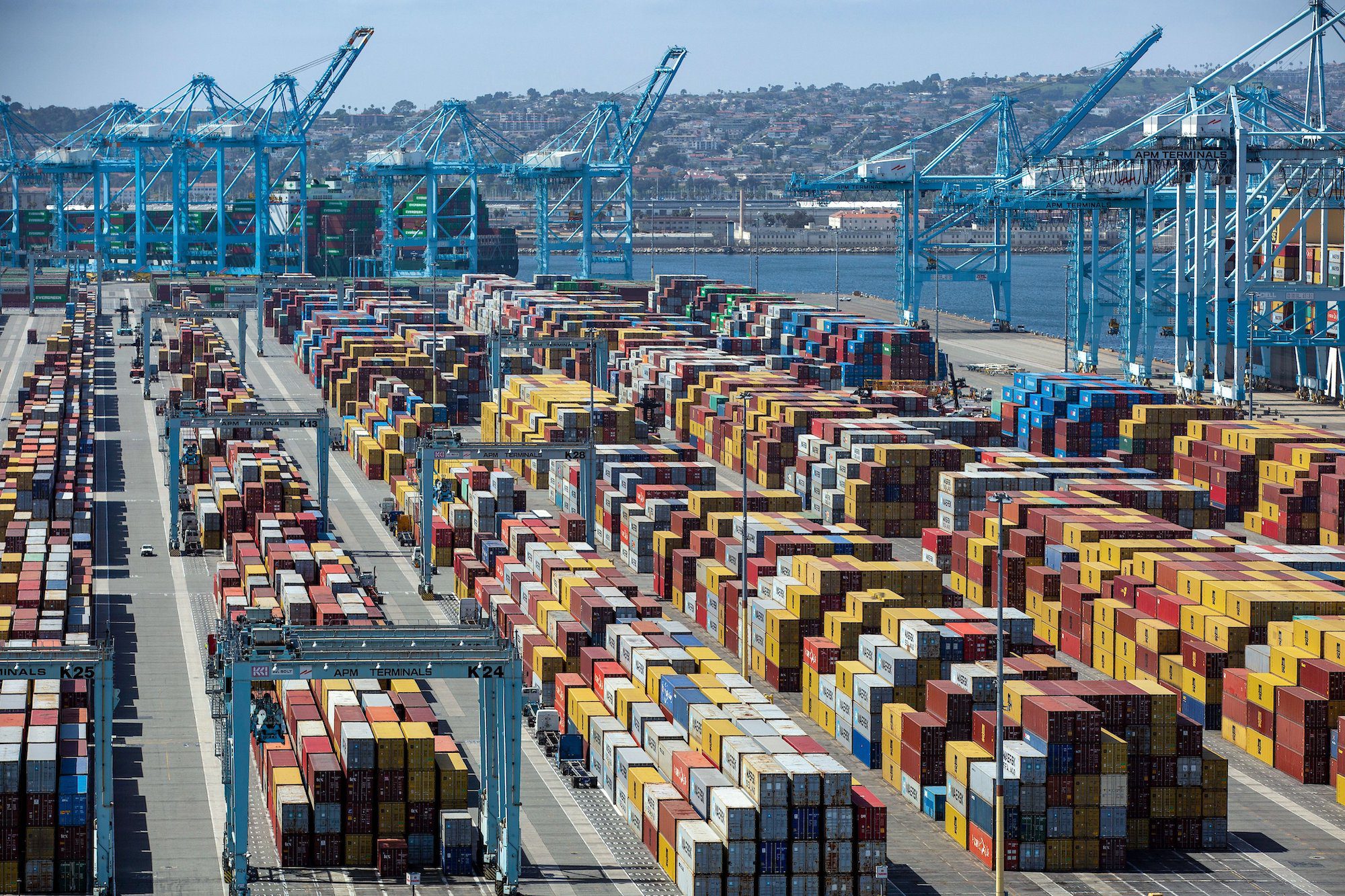
By Lori Ann LaRocco – The Port of Los Angeles reported strong results in April, but the port’s head warns that high energy prices are hitting the trucking community hard.
April was the best month of 2026 and the strongest since last August. The nation’s largest port handled 891,000 container units, up more than 5.5 percent from a year ago and 18 percent from the previous month.
“This ranks as our second-best April on record,” said Gene Seroka, executive director of the Port of Los Angeles. “What’s driving this is the American consumer. They are still resilient, still spending.”
The port processed 460,020 TEUs in April, up 1.5 percent from last year and 21 percent from March. Seroka said that was significant because last year’s numbers were already elevated as importers front-loaded cargo ahead of tariff changes.
Seroka told gCaptain that diesel prices are impacting the local trucking business.
“Diesel prices are up 50 percent here, and most of the 1,200 companies that do trucking business in and out of the Port of Los Angeles are small businesses, and we define those as five rigs or fewer. This impact is real,” said Seroka. “It’s a direct impact. Now, some are trying to pass that cost on through the supply chain to importers and exporters, but they also have to compete with the big trucking firms, which may be able to absorb a little bit more.”
Seroka added that the increase in both gasoline and diesel prices will have both a leading and lagging effect on the supply chain.
“Thirty percent of California’s crude imports come from the Middle East. Now the refining companies, the big oil and energy companies, are trying to find alternative supplies to that 30 percent. I don’t know that anyone thinks we can make up the entire 30 percent, but we’re going to have to find more supplies beyond those refined products,” said Seroka. “Here at the Port of LA, we also supply about two-thirds of the jet fuel that goes to LAX. So far, reports on supply are good. However, prices are increasing.”
Prices are soaring due to the Iran war. Seroka said uncertainty surrounding freedom of navigation will continue.
“There is a lack of confidence in the region, with only a handful of ships moving through the Strait compared to the usual 100,” said Seroka. “We’re just not there yet. I haven’t spoken to a single executive who wants to make the first move in this setting; the safety and security of ship crews is still the top priority.”
There are approximately 20,000 seafarers still aboard vessels in the Persian Gulf.
“What the industry needs is a sustained, proven peace agreement — something that holds over time. Even then, reopening is just the start, or the first step,” stressed Seroka.
“We’re now 75 days into this war with Iran,” said Seroka. “Based on my experience in the Middle East, it will take months to unwind the backlog and get vessels, cargo, and schedules back into a more normal rotation.”
“Until there’s lasting stability and real confidence in safe passage, we’re not going to see a return to normal shipping operations in the Middle East, nor will attention be redirected to other trades anytime soon,” warned Seroka.

 Join The Club