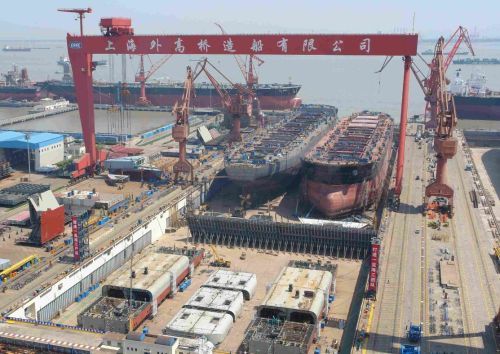
Bulk carriers under construction, image: Shanghai Waigaoqiao Shipbuilding
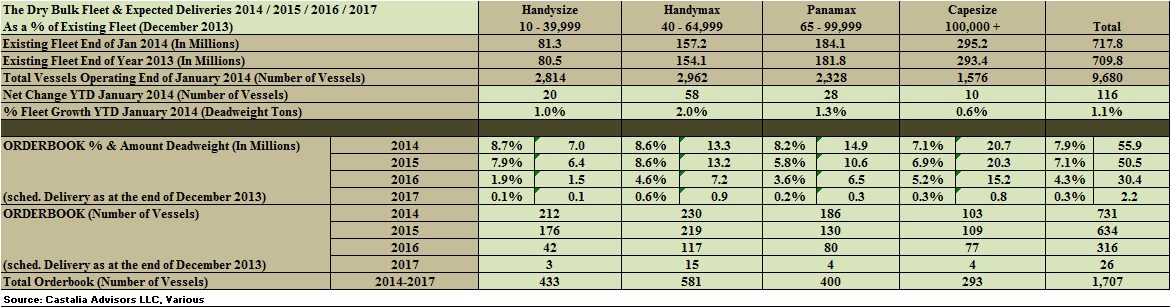
The dry bulk shipping market continues to see the fleet and orderbook grow. In January 2014, the worldwide capacity of dry bulk vessels grew by nearly 8 million deadweight tons (dwt), increasing 1.1% in the first month of 2014. The increase in January of 116 new bulk carriers was spread across all dry bulk sectors – Handysize, Handymax, Panamax and Capesizes.
By the end of January 2014, the orderbook for dry bulk increased from 133.3 million dwt to 139.0 million dwt corresponding to an order of 51 new ships, or 1,707 total vessels on order. The increase in January 2014 represents a 4.3% in one month. Approximately, 9% of the December 2013 gross dry bulk fleet is due by year-end (including January 2014 contribution). All sectors of the dry bulk fleet are expected to materially increase in 2013.
Click to enlarge
The growth of the dry bulk orderbook is a harbinger of challenges to come for the shipping market. The orderbook is now being ignored by analysts and shipowners/investors alike, as capital investment continues, while demand from steel and power plants trends lower.
The Chinese economy is slowing and we expect the impact to be reflected over time via lower shipping rates. The dry bulk shipping market will continue to remain under pressure as the orderbook over the next three years is delivered and beyond 2017 should the global economy experience slower growth. We do not expect central banks will be able to continue, at current level, their exceedingly strong accommodative monetary policies. As such, the dry bulk orderook may continue to pressure shipping rates for years to come. And, in so doing, the Chinese steel mills and power plants as well as other charterers will become “price takers,” a bad position for shipowners to end up becoming.
The question is, at what point do analysts and shipowners/investors come to this realization that the market will languish for years to come? And finally, what will be the action taken by those investors who entered the shipping markets, but who are really ”tourists”?
Twenty-two seafarers remain missing after the Panama-flagged bulk carrier Ocean Winner sank in the Bay of Bengal, triggering a major search and rescue operation involving the Indian Coast Guard and passing merchant...
The Republic of Korea and the United States have officially launched the Korea–U.S. Shipbuilding Partnership Center (KUSPC) in Washington, D.C., establishing a new hub intended to accelerate joint efforts to...
July 28, 2026
Total Views: 3766
Get The Industry’s Go-To News
Subscribe to gCaptain Daily and stay informed with the latest global maritime and offshore news
— just like 107,075 professionals
Secure Your Spot
on the gCaptain Crew
Stay informed with the latest maritime and offshore news, delivered daily straight to your inbox
— trusted by our 107,075 members
Your Gateway to the Maritime World!
Essential news coupled with the finest maritime content sourced from across the globe.

 Join The Club