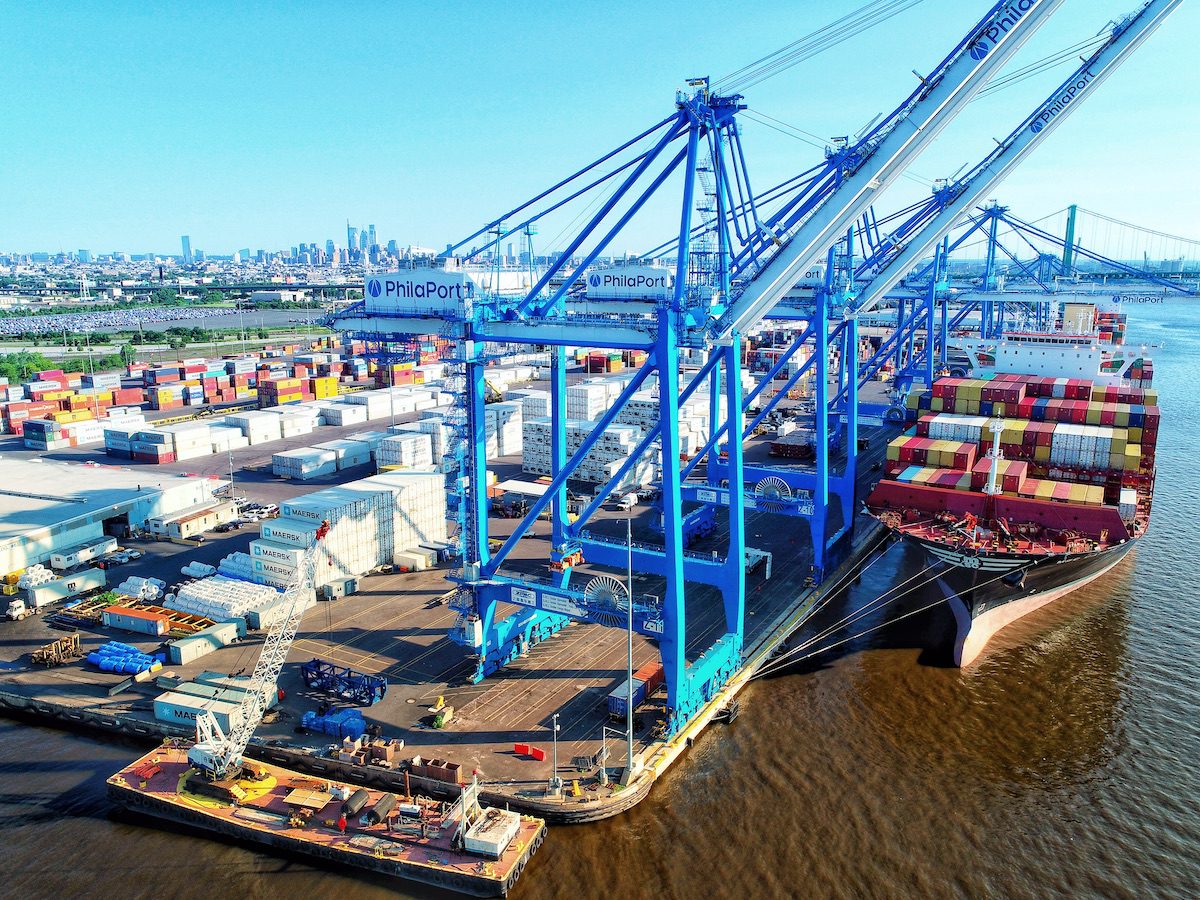
The Port of Philadelphia was the only U.S. port to rank among the world’s top 50 container ports in the Container Port Performance Index (CPPI) 2025, jointly issued by the World Bank Group and S&P Global Market Intelligence.
By Lori-Ann LaRocco – Now in its sixth edition, the annual report evaluated more than 400 global ports using data spanning 2020 to 2025. It highlights how extended vessel turnaround times—often caused by congestion and shipping rerouting—both reflect and exacerbate ongoing supply chain vulnerabilities.
“Understanding this two-way relationship is essential,” said Bertrand De la Borde, Global Director for Transport and Logistics at the World Bank Group. “Ports are not just passively exposed to external shocks; they also dynamically shape how those shocks are transmitted. They can either amplify disruptions or help contain them. Investing in port efficiency and digital management is not only beneficial to shipping lines—it is a core requirement to build more resilient supply chains and reduce the impact of volatility on economies and communities.”
U.S. ports were eclipsed by leading ports in Asia, the Middle East, and parts of Europe.
The list of U.S. ports by their 2025 CPPI ranking:
Philadelphia — 48
Jacksonville (USJAX) — 52
Miami (USMIA) — 75
New Orleans (USMSY) — 76
Port Everglades (USPEF) — 83
Los Angeles — 88
Charleston — 90
New York & New Jersey (USNYC) — 117
Tampa Port (USTPA) — 229
Wilmington, N.C. (USILM) — 276
Port of Virginia (USNFF) — 281
Tacoma (USTIW) — 384
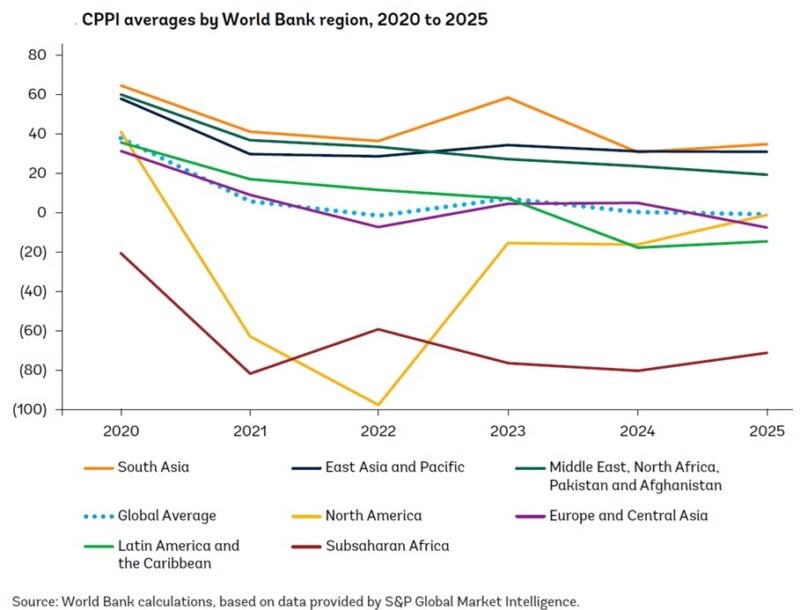
According to the report, North American ports, including those in the United States, continue to recover from earlier disruptions but still face challenges such as congestion, labor constraints, and hinterland bottlenecks.
Some U.S. ports, including Los Angeles and Charleston, were among the top year-on-year improvers. Los Angeles, in particular, improved vessel turnaround times, accompanied by a pronounced easing of congestion and supply chain stress.
In 2025, the global average CPPI score showed a slight deterioration relative to the 2024 benchmark, indicating longer average vessel time in port.
The CPPI shows that global port efficiency remains under pressure from geopolitical instability, shipping network disruptions, extreme weather events, and persistent market volatility.
Top-Performing Ports
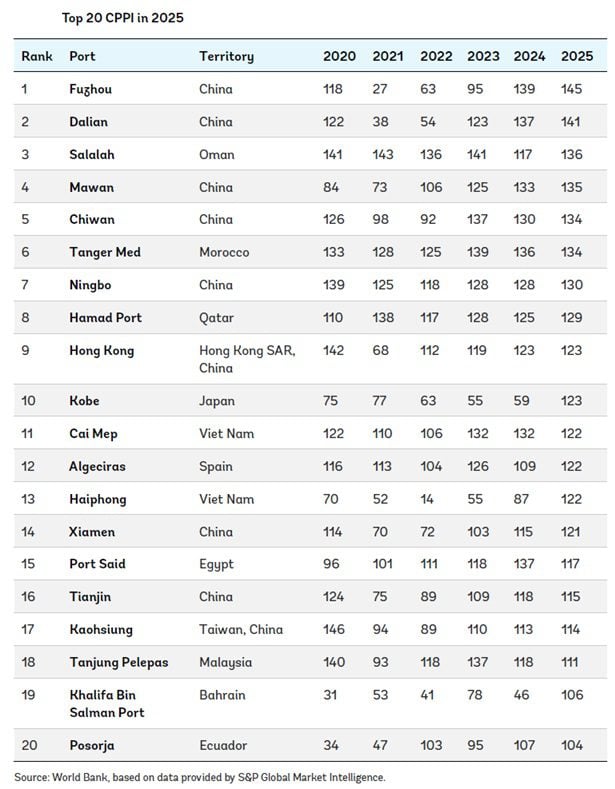
Ports in Asia and the Middle East dominated the top five rankings.
According to the report, these ports benefited from higher levels of investment, export-oriented trade, and more advanced digital systems. Those advantages contributed to stronger reliability scores, shorter vessel turnaround times, greater digitalization, and stronger operational coordination.
The authors of the report said this year’s edition is “particularly timely” given the supply chain shock caused by the Iran war.
“In 2026, disruption in the Strait of Hormuz reduced shipping flows to a trickle, reinforcing the risk of sudden schedule dislocation and arrival compression. As carriers re-sequence networks to bypass these zones, congestion often shifts to ‘relief’ nodes, which can quickly become overwhelmed by the ‘clumping’ or synchronized arrival of diverted vessels.”
The authors added that the time vessels spend in port has become even more central to the functioning and resilience of international trade.
“Efficient ports are not only a source of competitiveness but also a key determinant of how well supply chains absorb and recover from disruptions.”
Developed Countries vs. Lower-Income Countries
The findings showed that in 2025, ports in upper-middle-income and high-income economies recorded higher average CPPI scores than ports in lower-middle-income and low-income economies. However, ports in upper-middle-income economies slightly outperformed those in high-income economies on average.
This trend has been observed in previous editions of the CPPI.
“This underlines that income level alone does not mechanically determine port performance; structure, incentives, and exposure to shocks matter.”
The report strongly recommended digital tools that improve planning and sequencing to help ports shift from reactive to anticipatory operations.
“The findings reinforce that ports are critical nodes in the global supply chain,” said Turloch Mooney, Head of Port Intelligence & Analytics at S&P Global Market Intelligence. “By focusing on both improving port efficiency and understanding their active role in supply chain dynamics, stakeholders can better prepare for future shocks and support sustainable trade growth.”
By Bruce Kimbrell (Policy Op-Ed) Over the past year, the White House’s Maritime Action Plan, the President’s FY2027 budget proposal, and a series of maritime and industrial initiatives across the...
May 30 (Reuters) – Ukrainian drone strikes hit Russia’s oil infrastructure overnight, damaging a tanker and an oil refinery in Taganrog and striking an oil depot in Armavir, Russian regional officials and...
Chile has cleared the way for one of the largest infrastructure projects in its history after regional authorities unanimously approved the environmental permit for the massive “Puerto Exterior” expansion at...
May 26, 2026
Total Views: 795
Get The Industry’s Go-To News
Subscribe to gCaptain Daily and stay informed with the latest global maritime and offshore news
— just like 105,236 professionals
Secure Your Spot
on the gCaptain Crew
Stay informed with the latest maritime and offshore news, delivered daily straight to your inbox
— trusted by our 105,236 members
Your Gateway to the Maritime World!
Essential news coupled with the finest maritime content sourced from across the globe.

 Join The Club