Onboard carbon capture and storage, OCCS for short, has moved well beyond laboratory work. Several systems are now operating at sea. One full-scale installation is demonstrating capture of around fifty tonnes of CO2 a day.
By Paul Morgan (gCaptain) – A pilot project has just secured formal recognition under both the EU Emissions Trading System and, in principle, from the IMO. The regulatory framework needed to make captured carbon count is finally taking shape, though it remains a long way from finished.
The capture equipment itself works well. The unresolved problem is everything around it: energy consumption, ship space, storage capacity, CO2 offloading, traceability, port reception, permanent disposal and formal regulatory recognition. On balance, OCCS looks set to become a credible transitional option for selected ship types rather than a universal solution for the world fleet.
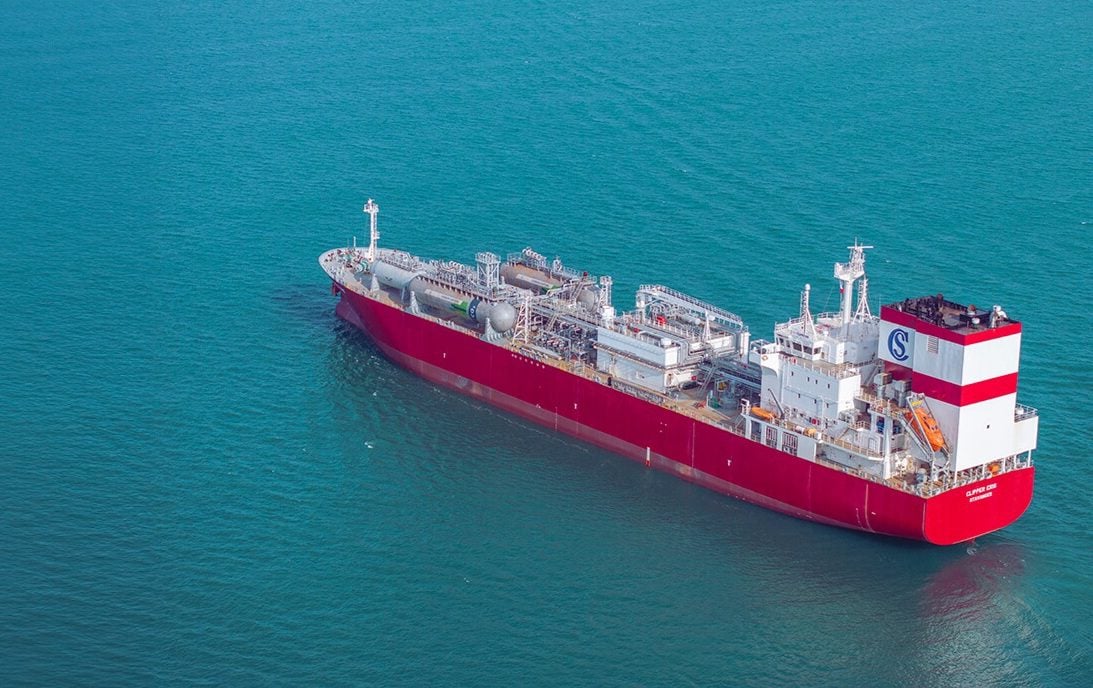
The clearest operational evidence so far comes from the Solvang ethylene carrier Clipper Eris, fitted with a full-scale Wärtsilä carbon capture system since early 2025. The retrofit was carried out at Seatrium’s Singapore yard, in a joint project with Wärtsilä, MAN Energy Solutions and the research institute SINTEF, with backing from the Norwegian state agency Enova. Wärtsilä and Solvang report the system capturing more than seventy percent of CO2 from the main engine exhaust, equivalent to roughly fifty tonnes a day, with some performance testing runs reaching around seventy-eight percent.
Solvang has since committed seven new very large gas carriers, under construction at HD Hyundai Heavy Industries for delivery in 2026 and 2027, built CCS-ready from the outset.
That seventy percent figure describes exhaust treated, not the ship’s total climate footprint. The net lifecycle reduction will always be lower once account is taken of the steam, electricity and cooling the capture plant itself consumes, the fuel burned to run it, the energy used to compress or liquefy the CO2, the emissions involved in transporting it ashore, and the eventual fate of the captured gas. Wärtsilä puts the all-in cost of its system, capital and operating combined, at fifty-four to seventy-six US dollars per tonne of CO2 captured, a figure it argues compares favourably with the cost of switching to green fuels.
The distinction between gross capture and net avoided emissions is the single most important idea in this field, and it runs through every part of the regulatory debate now under way at the IMO.
The IMO approved a work plan to build a regulatory framework for OCCS at MEPC 83 in April 2025. MEPC 84, held in London at the end of April 2026, took that further, agreeing that the correspondence group developing the framework should produce guidance on accounting, verification and certification, aligned with the calculation of a ship’s greenhouse gas fuel intensity under the wider Net-Zero Framework.
The Committee also invited further submissions on how captured CO2 discharged at sea should be regulated, whether under MARPOL or under the London Convention and Protocol, a question that remains open. An expert-level technical workshop is expected before the next full session, MEPC 85, and the IMO’s own submissions confirm the target for completing the OCCS framework remains 2028.
That target sits inside a wider and more contentious process. The IMO Net-Zero Framework, combining a global fuel-intensity standard with a GHG pricing mechanism, was approved in principle at MEPC 83 but failed to be formally adopted when a resumed extraordinary session in October 2025, adjourned for a year after a vote split fifty-seven to forty-nine among member states following intense opposition led by the United States.
MEPC 84 restored some momentum, and the timetable is now firmer than it was: intersessional working group meetings are scheduled for September and November 2026, MEPC 85 will run from 30 November to 3 December 2026, and the resumed extraordinary session at which the Framework is due for a further adoption vote is pencilled in for 4 December 2026. Whether that vote succeeds is genuinely uncertain, and the outcome matters directly to OCCS, because a shipowner will not install expensive capture plant unless the carbon it removes reduces a real compliance or pricing liability.
In Europe, that liability already exists. Shipping’s phase-in to the EU Emissions Trading System finished on 1 January 2026, so operators must now surrender allowances for one hundred percent of applicable CO2 emissions on EU-linked voyages, with methane and nitrous oxide also brought into scope for the first time this year. Allowance prices have been running at roughly seventy-five to ninety euros a tonne through 2026.
Verified CO2 that is captured and sent for permanent storage or qualifying utilisation can, in principle, reduce the emissions against which allowances must be surrendered, provided the capture and transfer chain meets EU monitoring and verification rules. On a ship with thirty thousand tonnes of applicable annual emissions, a verified fifty percent net reduction would avoid surrendering allowances for fifteen thousand tonnes, worth in the region of one to one point three million euros a year at current prices. That is an avoided cost, not a profit figure, and it has to be set against the fuel, sorbent, maintenance, liquefaction, transport, storage and capital costs the capture system itself creates.
FuelEU Maritime, the EU’s parallel fuel-intensity regulation, treats OCCS far more cautiously. The European Commission has been explicit that onboard capture is not currently recognised as a compliance technology under FuelEU, citing limited maturity, limited demonstrated results and the absence of an international framework for traceability and permanent storage.
The regulation itself, under Article 30.2(i), commits only to the Commission considering inclusion in future, once a verifiable accounting method exists. In practice this means a ship burning conventional heavy fuel oil with OCCS fitted can reduce its EU ETS bill while still failing to meet FuelEU’s well-to-wake intensity targets, because the fuel itself remains fossil-based. OCCS is not a substitute for switching fuel under this specific regulation, at least not yet.
A cluster of companies are now testing different versions of the technology. Alongside Solvang and Wärtsilä’s amine-based system on Clipper Eris, the UK start-up Seabound has taken a different route, using calcium oxide to bind exhaust CO2 into solid calcium carbonate rather than liquefying it onboard. Its first sea trial, aboard Lomar’s 3,200 TEU container ship Sounion Trader while under charter to Hapag-Lloyd, ran for two months in early 2024 and achieved a capture rate of around seventy-eight to eighty percent, alongside more than ninety percent sulphur removal, though the tonnages captured were modest, around one tonne of CO2 a day from a single engine’s exhaust.
Seabound completed its first full-scale commercial units in February 2026, and these are now destined for the cement carrier UBC Cork, owned by Hartmann Group and managed by Inter Maritime, on charter to Heidelberg Materials. The captured carbon, converted to limestone, will be offloaded at Heidelberg’s Brevik plant in Norway, where it will ultimately reach the Northern Lights CO2 storage project.
Value Maritime’s Filtree system, which combines exhaust scrubbing with an optional carbon capture module, has been fitted to Eastern Pacific Shipping tankers since 2022, capturing up to forty percent of CO2 with a stated potential to go higher, and in 2025 was installed on Mitsui O.S.K. Lines’ product tanker Nexus Victoria, capturing around ten percent of CO2 with headroom to scale to thirty percent.
MOL describes this as its first commercial step into onboard capture within its wider Environmental Vision 2.2 strategy. In April 2026, NYK Line signed a memorandum of understanding with Hokkaido Electric Power to study an OCCS demonstration in Tomakomai, Japan, using NYK’s coal carrier Pirika Moshiri Maru, with a three-year study running to the 2028 financial year. NYK has separately agreed to work with Chiyoda Corporation and its own carbon-carrier affiliate on wider CCS project development.
The most significant recent development, and one that postdates most of the commentary on this subject, concerns Project CAPTURED, a Singapore-led pilot run by the Global Centre for Maritime Decarbonisation. Completed in June 2025 aboard Evergreen Marine’s Ever Top container ship, the project demonstrated that CO2 captured onboard could be transferred ship-to-ship, moved overland and permanently bound through carbon mineralisation, turning it into materials such as precipitated calcium carbonate for use in construction and industrial products.
In recent weeks, this captured CO2 has been formally recognised as meeting EU ETS deduction requirements, and the IMO has given ‘in principle’ recognition to carbon mineralisation as a legitimate storage route. This is the first time captured maritime CO2 has cleared both hurdles together, and it matters more than the underlying capture percentage.
That percentage is worth dwelling on, because it illustrates the gap between gross capture and true benefit. GCMD’s independently verified lifecycle assessment found the pilot achieved a gross onboard capture rate of only 10.7 percent, but delivered a net greenhouse gas saving of 7.9 percent once the full value chain was accounted for. A separate, more detailed pass at the same data, comparing mineralization against conventional offshore storage at a common 40 percent capture rate, found mineralisation delivering 34 percent net savings against 21 percent for undersea injection, rising to 68 to 71 percent once the value chain was optimized. Not every commentator reads this result the same way.
At least one independent energy analyst has argued that, under standard attributional lifecycle accounting, the same GCMD data shows onboard capture delivering no net climate benefit at low capture rates and can even increase total emissions once shipping, handling and processing energy are included. The disagreement is less about the numbers than about which accounting method, and which capture rate is treated as representative, and it is a useful reminder that headline capture percentages and true net benefit are two different things.
Port and storage infrastructure remains the decisive constraint on how far any of this can scale. Northern Lights, the Norwegian CO2 transport and storage joint venture between Equinor, Shell and TotalEnergies, has been operating since 2024 with a first-phase capacity of one and a half million tonnes a year, fully booked by industrial customers including Heidelberg Materials. A final investment decision taken in March 2025 will lift that to more than five million tonnes a year from 2028. To support the expansion, Kawasaki Kisen Kaisha and MISC Berhad, along with Mitsui O.S.K. Lines, have taken long-term charters on new twelve thousand cubic metre liquefied CO2 carriers, with the first vessels expected to enter service between the second half of 2028 and the first half of 2029.
These ships will primarily move shore-captured industrial CO2 rather than ship-sourced material, but the same reception infrastructure could eventually serve a maritime OCCS chain, and a global industry report on port readiness in 2026 identified fewer than ten ports worldwide with existing or firmly announced CO2 reception facilities, almost all of them in northern Europe.
Talk of carbon credits in this context needs to be handled carefully, because the term covers at least four different things, and they should not be conflated. The most credible near-term value is a reduction in EU allowances that must be surrendered, which is a cost avoided rather than a tradeable credit generated.
A second possibility, still pending final rules, is a reduction in liability under the IMO Net-Zero Framework, assuming it is eventually adopted and assuming OCCS is formally recognised within it.
A third is a genuine voluntary carbon credit, which would require a recognised methodology addressing additionality, permanence, measurement uncertainty and, critically, the risk of the same tonne of CO2 being claimed twice, once against EU ETS and again as a voluntary offset.
Owners should treat this route with real caution until such a methodology exists. The fourth is a green freight premium or insetting arrangement, where a cargo owner pays for a verified emissions reduction allocated to its own supply chain, which may in practice be the most realistic near-term commercial route, though its value depends entirely on customer demand and agreed verification standards.
Whether OCCS is worth the cost depends heavily on the ship. The strongest candidates are vessels with high, steady engine loads, useful waste heat, spare deck or machinery space, predictable routes, regular calls at equipped ports, and enough remaining service life to earn back the investment.
Large gas carriers, tankers, large bulkers and cement carriers fit that profile reasonably well, which is exactly where the visible pilots and commercial deployments are concentrated. Small ships, irregular tramp traders, vessels nearing retirement and long-haul ships without frequent access to CO2 reception ports fit it far less well, and a poorly matched retrofit risks consuming fuel and cargo capacity for a fraction of the net benefit the headline capture rate suggests.
The honest answer, in July 2026, is that onboard carbon capture is becoming a credible engineering option for the right ship on the right route, with a genuine and growing body of operational evidence behind it. It is not yet a reliable source of tradeable carbon credits, it is explicitly excluded from FuelEU Maritime compliance, and its value under a future IMO framework depends on a Net-Zero Framework that has already been delayed once and faces a contested adoption vote in December 2026.
The turning point most people in the industry are watching for remains 2028, when the IMO’s OCCS accounting framework is due for completion and European CO2 storage capacity is due to expand materially. Until then, this is a technology worth serious feasibility study, not yet a guaranteed compliance solution.

 Join The Club