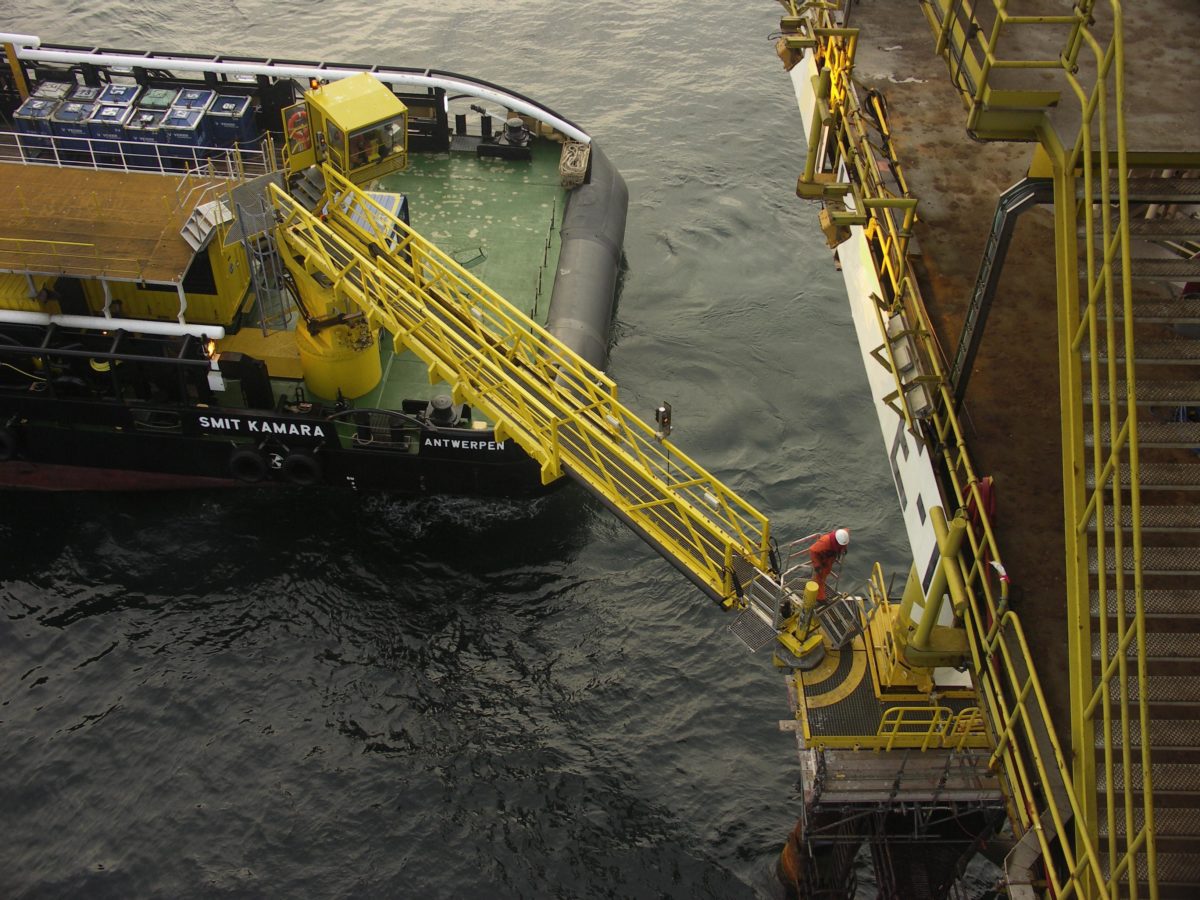
The Offshore Access System Connecting A Workboat To A RigFrom geronimo lines to Billy Pugh baskets, transferring personel from crewboats to rigs offshore has always been a percarious operation. And while the safety record and my personal experiences with the Billy Pugh baskets are both positive, both regulators and operators have long been looking for a safer way.
Some companies have moved to systems like Reflex Marine’s Frog, a unit that is basically a Billy Pugh basket with seats, but my personel experience with these units are mostly negative as they share the same basic principal, and thus same basic dangers, of their predecessors. What has been missing in this operation is a radical new design.
Enter The Offshore Access System (OAS) for heavy seas, a new product by Offshore Solutions. This heave-compensated gangway is built on a hydraulic pedestal equipped with motion sensors to detect the crewboat’s motions. The hydraulics are then engaged to maintain the gangway at a constant height relative to the horizon.
One problem with the technology is that, while it’s potentially useful for transferring personnel from boat to fixed platforms, it’s of less use transferring people to floating platforms due to the fact that the heave of boats never matches the heave of larger vessels. But with technology advancing at a rapid pace this could soon change. Fanbeam sensors currently use laser to line workboats up with dynamically positioned vessels and could possibly be used to match the motion of the ship with that of the gangway. If that happens then pilot boats could be outfitted with the device obviating the need for pilots to climb rope ladders.
Statoil has published the annual sustainability report and the payments to governments report for 2015. The company delivered annual equity production of 1.971 million barrels of oil equivalents per day...
The Bureau of Ocean Energy Management (BOEM) is proposing to update 36-year-old regulations to make sure that offshore oil and gas activities do not significantly harm the air quality of...
A Petrobras FPSO in Brazil’s Campos Basin has been shutdown after a fire on the facility on Thursday afternoon. The state-run oil company confirmed the incident aboard the P-48 FPSO...
March 18, 2016
Total Views: 98
Get The Industry’s Go-To News
Subscribe to gCaptain Daily and stay informed with the latest global maritime and offshore news
— just like 107,461 professionals
Secure Your Spot
on the gCaptain Crew
Stay informed with the latest maritime and offshore news, delivered daily straight to your inbox
— trusted by our 107,461 members
Your Gateway to the Maritime World!
Essential news coupled with the finest maritime content sourced from across the globe.

 Join The Club