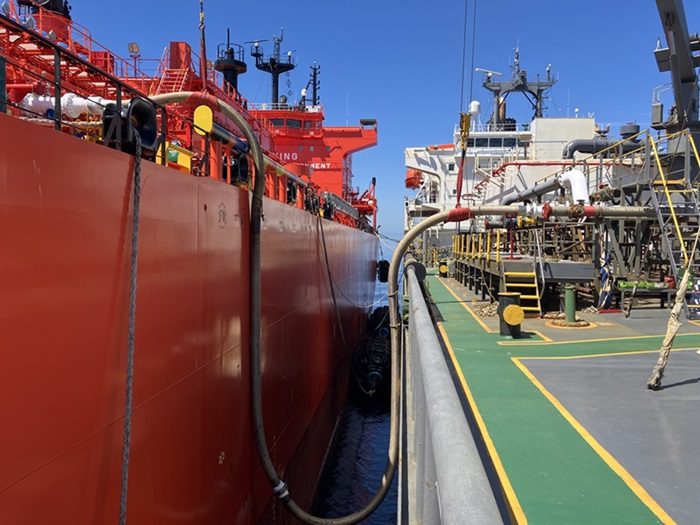
NYK has successfully completed its first-ever ship-to-ship (STS) transfer of liquefied ammonia, moving approximately 23,000 tons from the carrier Berlian Ekuator to the Eco Enchanted off the coast of Ceuta, Spain.
The operation, which took place September 2, represents a critical milestone in developing flexible supply methods for ammonia as both an industrial commodity and emerging clean energy source. While NYK and shipping industry at large have has extensive experience with STS transfers for crude oil, liquefied natural gas (LNG), and liquefied petroleum gas (LPG), this marks NYK’s first operation involving liquefied ammonia.
The Berlian Ekuator, owned by NYK and time-chartered by Mitsui & Co., Ltd., transferred its entire cargo to the Eco Enchanted, operated by leading ammonia trader Trammo, Inc. The operation was conducted under rigorous safety protocols with support from Trammo’s STS specialist provider, International Fender Providers Ltd.
Although uncommon, ship-to-ship transfers of ammonia have been carried out before, both commercially by ammonia carriers and in controlled pilot projects to prepare for future bunkering operations.
“The success of this operation marks a significant milestone in developing an international supply network for ammonia,” NYK said in a statement, highlighting the importance of STS transfers which are “not constrained by port size or onshore equipment” and provide greater flexibility compared to conventional land-based cargo handling methods.
Photo courtesy NYK
Ammonia’s emergence as a viable maritime fuel aligns with recent industry developments. According to DNV’s “Ammonia in Shipping” report, ammonia has progressed from concept to early implementation in just five years, establishing a clear pathway to become a low-GHG alternative fuel for deep-sea shipping.
“The groundwork for ammonia as a fuel is being laid, and the orderbook proves it’s no longer just a theoretical fuel,” said Knut Ørbeck-Nilssen, CEO of DNV Maritime, though he acknowledged challenges remain related to ammonia’s toxicity and high cost.
Industry momentum is building despite these challenges. Currently, 39 ammonia-fuelled vessels are on order globally, with commercial engines available and initial fuel use already demonstrated. While current production of blue and green ammonia remains limited, confirmed plans will increase capacity to 14 million tonnes per annum by 2030, with bunkering infrastructure developing in key maritime hubs including Singapore and Rotterdam.
“Scaling up use of ammonia as ship fuel requires a framework of standardized solutions that can be easily adopted across the industry,” explained Linda Hammer, Principal Consultant at DNV and lead author of their ammonia report. “The current risk-based approval framework must be replaced by prescriptive regulations mandated by the IGF Code.”
The maritime industry’s transition toward ammonia aligns with broader alternative fuel adoption trends. According to DNV’s Alternative Fuels Insight platform, orders for alternative-fuelled vessels reached 19.8 million gross tonnes in the first half of 2025, representing a 78% increase over the same period last year.
NYK states they will leverage insights from this successful operation to “further advance next-generation fuels and strengthen safe maritime transportation systems, thereby contributing to the broader goal of achieving a decarbonized society.”
The Global Maritime Forum’s Getting to Zero Coalition has recently reported that both methanol and ammonia have transitioned from theoretical solutions to practical reality as zero-emission shipping fuels, with ammonia now considered ready for piloting in maritime applications.
Russia has conducted two dark ship-to-ship (STS) transfers involving oil cargoes that traveled through the Northern Sea Route, highlighting the increasingly complex logistics being used to move Russian crude to Asian markets via the Arctic.
Saudi Aramco resumed oil loading from inside the Strait of Hormuz last week and has more tankers waiting to load as the state energy giant offers spot heavy crude cargoes, according to shipping data and trade sources.
HD Hyundai Samho has delivered its first-ever Very Large Ammonia Carrier (VLAC), marking another milestone in the growing market for vessels designed to transport low-carbon fuels. The South Korean shipbuilder...
July 28, 2026
Total Views: 1393
Get The Industry’s Go-To News
Subscribe to gCaptain Daily and stay informed with the latest global maritime and offshore news
— just like 106,328 professionals
Secure Your Spot
on the gCaptain Crew
Stay informed with the latest maritime and offshore news, delivered daily straight to your inbox
— trusted by our 106,328 members
Your Gateway to the Maritime World!
Essential news coupled with the finest maritime content sourced from across the globe.

 Join The Club