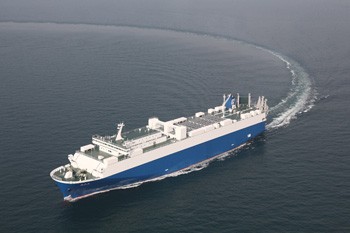
Sustainable mobility takes to the open water, as Nissan launches its first energy-efficient, coastal car carrier, the Nichioh Maru.
Built by Shin Kurushima Dockyard Co. over a 4-year period, she began her maiden voyage on January 27, 2012.
Nichioh Maru, image courtesy NISSAN
Nichioh Maru’s green secret is its energy-saving, electronically-controlled diesel engine, with 281 solar panels fitted to the carrier’s deck, as well as a low-friction coating on its hull, for better hydrodynamic performance.
Compared to an existing car carrier of the same type, the operator claims this ship can achieve a fuel reduction of up to nearly 1,400 tons annually, which converts to an annual reduction of 4,200 tons of CO2 emissions.
These panels, and the LED lights they illuminate in the ship’s hold and crew quarters, are a first in Japan, says Tomohiko Uchiyama, president of Nitto Kaiun Corporation, Roro’s operator.
“As Nissan went to the effort to launch the Nissan LEAF at that time, in terms of the logistical flow, we thought there would be a way for us to contribute using state-of-the-art technologies,” said Uchiyama.
“This is the first domestic vessel to have photovoltaic panels. Together using LED lighting on this ship, we aim to create an energy-efficient carrier.
“And, especially, if we use solar panels, we can reduce CO2 emissions because we don’t need to use oil for operating the generator. Already with this aspect, I believe that we can say that the introduction of this ship is a success.”
With a capacity of up to 1,380 cars, Nichioh Maru will join two other carriers in daily service on a 1,800 km domestic roundtrip route from Oppama Wharf near Yokohama, to Kobe, and then to the southern island of Kyushu — making two roundtrips per week.
The ship’s captain, 38-year veteran Tamotsu Sato, is pleased to be at the eco-helm.
“Something that’s gentle to the environment — that’s the most important thing, considering the current system on the ship. And, of course, we also have the solar power system,” said Sato. “This carrier is important in many ways. In my opinion, as a captain, I have no doubt that this ship will be a front runner in this industry…And from here on out, I plan to do my best to again boost my skill set to work with this new technology.”
Image courtesy NISSAN
The Nichioh Maru follows in the sustainability wake of the City of St. Petersburg eco-carrier, which Nissan began using in 2010 for international routes in Europe.
This makes the eco-ship a dream carrier, and with more carriers to follow, Nissan is positioned to stay leagues ahead in sustainable mobility.
Vessel Details:
Length: 169.95 m
Width: 26.00 m
Total weight: 11,400 tons
Load capacity: Completed vehicles: 880 units (without truck trailers: 1,380 units), with trailers: 115 units
What (Acting) Secretary Hung Cao’s First Five Months Tell Us About the Job Ahead By Bruce Kimbrell (Policy Op-Ed) President Trump has nominated the Honorable Hung Cao to become the...
In August 2001 the Bulk Carrier Windoc was lined up on the Welland Canal’s Bridge 11 in Ontario Canada. After receiving the flashing amber approach light indicating that the bridge...
Containerization is the reason we have a thriving global marketplace, but where did it all begin? The idea of it was actually conjured up on a busy dock in Hoboken,...
May 17, 2020
Total Views: 743
Get The Industry’s Go-To News
Subscribe to gCaptain Daily and stay informed with the latest global maritime and offshore news
— just like 106,406 professionals
Secure Your Spot
on the gCaptain Crew
Stay informed with the latest maritime and offshore news, delivered daily straight to your inbox
— trusted by our 106,406 members
Your Gateway to the Maritime World!
Essential news coupled with the finest maritime content sourced from across the globe.

 Join The Club