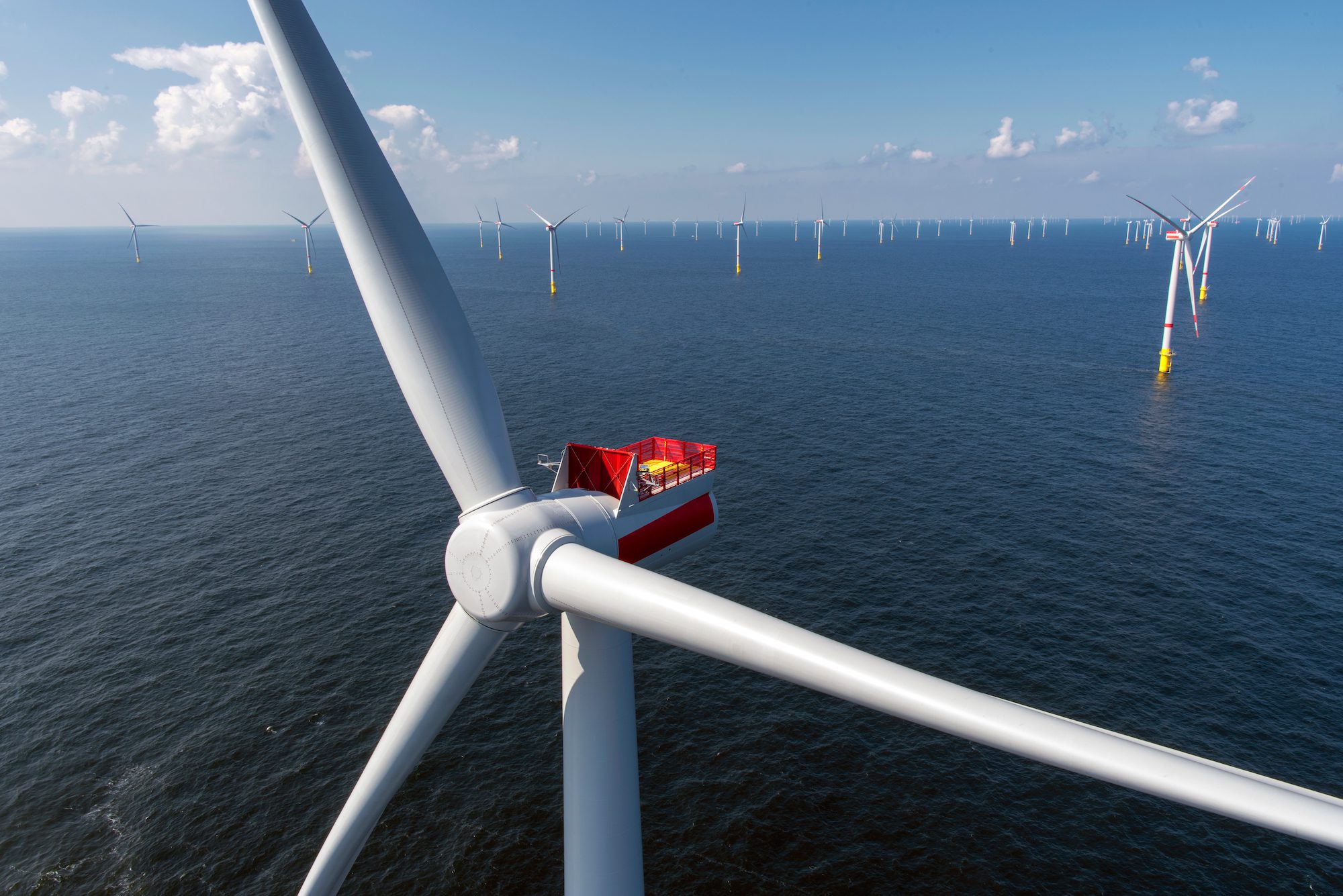
New York Attorney General Letitia James has filed two federal lawsuits challenging the Trump administration’s stop-work orders on major offshore wind projects.
The legal action, filed January 9 in U.S. District Court for the District of Columbia, seeks to block Department of the Interior orders that suspended construction on the Sunrise Wind and Empire Wind projects in late December, citing “national security” concerns.
“New Yorkers deserve clean, reliable energy, good-paying jobs, and a government that follows the law,” James said. “These projects were carefully reviewed and already under construction when the federal government pulled the plug without explanation. This reckless decision puts workers, families, and our climate goals at risk, and my office is taking action to stop it.”
Norwegian energy giant Equinor warns that its Empire Wind project faces imminent collapse with potential losses exceeding $5.3 billion. The company disclosed in court filings Monday that delaying work beyond January 16 would likely terminate the project due to “disruption of a tightly choreographed construction schedule” and create an “existential threat” for its financing. The project, over 60 percent complete, represents over $4 billion in investment, with $2.7 billion already drawn under project financing.
Potential losses include $4 billion already invested, $850 million in termination fees for 11 construction contracts, and $355 million to dismantle, scrap parts, and mothball facilities.
Critical to the dispute are contracts with two specialized vessels that have subsequent commitments making them unavailable for years if the schedule is disrupted. Equinor stated the situation “became more acute” on January 5, when the government prohibited even essential safety-related construction activities, “turning a dire situation for Empire Wind into a near terminal one, making immediate relief necessary.”
The December 22 suspension order from Interior Secretary Doug Burgum affected five major East Coast offshore wind projects under construction—Vineyard Wind 1, Revolution Wind, Coastal Virginia Offshore Wind, Sunrise Wind, and Empire Wind 1—representing combined investment exceeding $10 billion and collective capacity to power more than 2 million homes.
“The prime duty of the United States government is to protect the American people,” Burgum said. “Today’s action addresses emerging national security risks, including the rapid evolution of the relevant adversary technologies, and the vulnerabilities created by large-scale offshore wind projects with proximity near our east coast population centers.”
The administration’s justification centers on radar interference created by massive turbine blades and reflective towers, which officials claim can obscure legitimate targets and generate false readings.
However, Attorney General James argues the orders are arbitrary and unlawful, noting both projects underwent more than a decade of extensive review by federal, state, and local authorities, including environmental impact analysis, public comment periods, and coordination with numerous federal agencies, including the Department of Defense. Federal regulators repeatedly determined that any potential impacts, including national security considerations, could be addressed through mitigation measures formally incorporated into the projects’ approvals.
The stop-work orders “provided no project-specific findings, offered no explanation for why existing safeguards were insufficient, and left open the possibility of indefinite extensions,” James stated in her complaint.
For Empire Wind, this marks the second major suspension in less than a year. The project faced a previous stoppage earlier in 2025 when the administration ordered an immediate halt to activities as part of a broader freeze on offshore wind development. That suspension prompted Equinor to report a $763 million impairment in its second quarter 2025 financial results before work was allowed to resume.
New York Governor Kathy Hochul strongly backed the legal challenge: “The Trump administration’s incomprehensible obsession with shutting down these fully permitted projects lacks legal justification, hurts his stated goal of U.S. energy independence, and will cost New York thousands of jobs and needed power to keep the lights on and attract economic development opportunities. These unlawful actions cannot stand.”
The projects carry significant implications for New York’s energy infrastructure. Together, Sunrise Wind and Empire Wind would generate more than 1,700 megawatts of power—enough to meet roughly 10 percent of the electricity needs of New York City and Long Island. Empire Wind would be the first offshore wind project to deliver power directly to New York City, strengthening the energy grid in one of the most energy-constrained areas of the country.
Empire Wind’s construction phase alone has employed nearly 4,000 workers, both within the lease area and through the revitalization of the South Brooklyn Marine Terminal, set to become the nation’s largest dedicated port facility for offshore wind.
Denmark’s Ørsted has also filed legal challenges over the suspension of its Revolution Wind joint venture with Skyborn Renewables, which had reached 80 percent completion with all offshore foundations installed and 45 of 65 wind turbines in place after spending or committing about $5 billion.
“Revolution Wind has spent and committed billions of dollars in reliance upon, and has met the requests of, a thorough review process,” Ørsted said in a statement.
Industry groups have condemned the suspensions as creating “needless uncertainty for any company that seeks to build an energy project in the United States,” according to Jason Grumet, CEO of the American Clean Power Association, who noted that “all the projects suspended underwent rigorous national security reviews during the first Trump and Biden Administrations.”
The lawsuits come just weeks after Attorney General James secured a federal court ruling in December 2025 invalidating a broader federal freeze on wind energy approvals. U.S. District Judge Patti Saris ruled that agencies had failed to provide reasoned explanations for implementing Trump’s directive to halt all new approvals for onshore and offshore wind projects, violating the Administrative Procedure Act.
In the current lawsuits, James argues the stop-work orders similarly “fail to explain the federal government’s change in position and to provide a genuine justification for the suspension, making them arbitrary and capricious, in violation of the Administrative Procedure Act.” She is asking the court to declare the orders unlawful and block their enforcement.
The legal proceedings will now determine whether these multi-billion-dollar projects can proceed toward completion or whether the administration’s security concerns will permanently alter the trajectory of America’s offshore wind ambitions.
The U.S. Bureau of Ocean Energy Management (BOEM) generated $46.98 million in high bids at its latest offshore oil and gas auction Wednesday, marking a sharp drop in industry participation compared with...
The U.S. Bureau of Ocean Energy Management (BOEM) announced Wednesday that it will begin preparing a programmatic environmental impact statement (PEIS) to evaluate potential offshore oil and gas lease sales across California’s...
Equinor expects 10-20% production decline at Johan Sverdrup, Europe's largest oil field growth source. The decline signals broader challenges for global oil supply amid aging fields.
February 4, 2026
Total Views: 673
Get The Industry’s Go-To News
Subscribe to gCaptain Daily and stay informed with the latest global maritime and offshore news
— just like 107,412 professionals
Secure Your Spot
on the gCaptain Crew
Stay informed with the latest maritime and offshore news, delivered daily straight to your inbox
— trusted by our 107,412 members
Your Gateway to the Maritime World!
Essential news coupled with the finest maritime content sourced from across the globe.

 Join The Club