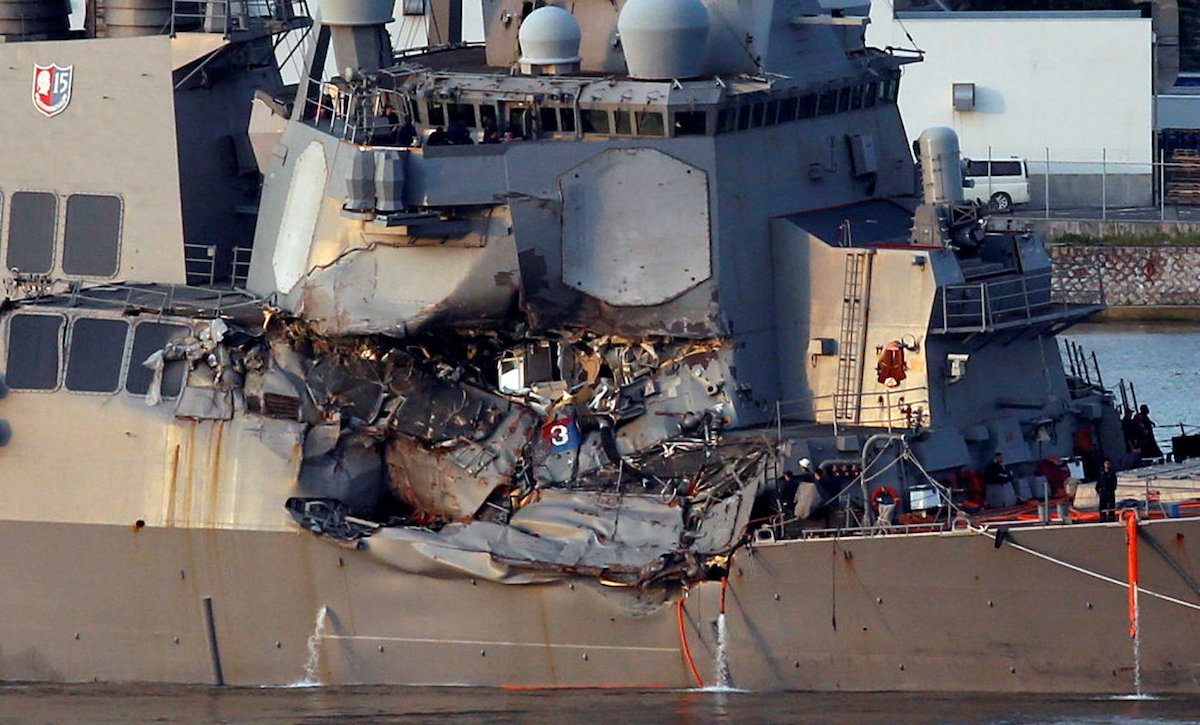
Damage to the Arleigh Burke-class guided-missile destroyer USS Fitzgerald after colliding Philippine-flagged merchant vessel off the coast of Japan in June 2017. REUTERS/Toru Hanai/File Photo
A myth persists in the maritime industry, a myth nearly as persistent as the Kraken, Flying Dutchman or Nessie. Like all good myths, this one has some basis in reality but is largely a result of common misconceptions. Also, like many myths, scientists have proven it false.
This myth is called the Error Chain. Usually taught in mandatory Bridge Resource Management, the concept says that a series of events leading up to a collision at sea all play a role in causing the incident. Remove one preliminary error before the time of the collision and you break the chain, the incident never happens.
The error chain is such a poor model that most competent deck officers ignore it completely and, instead, use the Swiss Cheese model where, rather than links in the chain, each error is a hole in a block of swiss cheese. Line up the holes the right way and an incident happens. Close one of the holes and it doesn’t. The problem is, this is just a slightly more complex version of the same myth, and it too has been proven wrong.
A fractal generated by a finite subdivision rule for an alternating link. Image via wikicommons.
The truth is far more complex. If you were to graph all the information leading up to an incident, it would not look like a linear hockey stick laid upon the x-axis (that’s what an error chain plotted looks like), nor would it look like a fancy three-dimensional chart created in Microsoft Excel. No, all but the simplest incidents, when plotted, look like a multi-dimensional fractal.
The reason the error chain and swiss cheese myths are so persistent is because they are simple, logical and empower the ship’s Officer to prevent incidents by breaking chains or plugging holes. Courts and big companies like it too because it gives society someone to blame (usually the Master) for not plugging the holes which are so obvious in hindsight.
Humans love simplicity and logic so – even though it’s blasphemy to do so – I will paint the theories of entropy, uncertainty, and complexity into a dead simple model of my own design. Incidents are not chains, not chunks of smooth and delicious swiss cheese… they are rotten cheese. Cheese that’s brittle and partially hardened with a bad smell but that is infested with myriad of microscopic organisms and fungi all working invisibly to destroy the cheese, leaving no trace except a malodorous that any smart Watch Officer can justify a reason for (after-all, some of the most expensive cheese in the world smells like a ripe turd, right?). And when the cheese falls apart or crumbles or decomposes (the ways rotting cheese can fail are numerous), it’s difficult to pinpoint any specific causes. The only thing a smart human can do to prevent getting sick from this rotten cheese is to avoid eating it.
In short, it doesn’t matter how many links you break or holes you plug… if you work aboard a ship where the company fails to support basic training (e.g. by closing the SWO school in Newport), discontinues rudimentary time-proven navigational theory (e.g. celnav), continues to blame the deck plate for systemic problems (e.g. the immediate firing of all officers and master chiefs aboard the Fitz), sails aging ships (the USS John S. McCain was built in 1992!) while cutting corners on maintenance…. it does not take a Ph.D. in incident management to realize that you (i.e. the US Navy’s top brass) are going to get people killed!
“Always blame the sailors, instead of fixing the foundational problem of your personnel system” says Donald Vandergriff, author of Mission Command. “What develops is self-serving careerists instead of dedicated professionals.”
But this article is not supposed to be about incident theory, Heisenberg’s theory of uncertainty or rotting cheese. It is supposed to be about the USS John S. McCain and USS Fitzgerald incidents. It is supposed to be about the recently released report on the results of an investigation into a string of U.S. Navy incidents this year that resulted in the death of 17 sailors and hundreds of millions of dollars in damages.
Unfortunately, that’s not possible in a blog post.
The Navy report lists many chains and holes in the swiss cheese but ignores the numerous systemic and institutional problems that lead to these deaths. To properly answer why these sailors died you have to look to similar sets of institutional fail and the closest I can come to the truth in a single blog post is to provide a quote written by my favorite movie director, Stanley Kubrick, and uttered by the Commanding Officer of a military newspaper shortly after the TET offensive:
Lt. Lockhart: “In strategic terms, Charlie’s cut the country in half… the civilian press are about to wet their pants and we’ve heard even Cronkite’s going to say the war is now unwinnable. In other words, it’s a huge shit sandwich, and we’re all gonna have to take a bite. “ (Youtube Link)
And I’ll add that bite is going to need to be taken by all of us, from Seaman recruit to CNO, from Civilian steward assistants to CEOs. We are all going to have to take a bite of this because both civilian ships and both the USS Fitzgerald and USS McCain were at fault this time and everyone from flag states, admirals, owners, Senators, operators and everyone is to blame.
We are all to blame not because we could have plugged any of the holes or broken any links in the incident chain. We are all to blame for accepting the error chain and swiss cheese models in the first place… and for publishing and reading reports like this one that is based on myth.
And we start by breaking the chain and refusing to eat the rotting cheese.
What (Acting) Secretary Hung Cao’s First Five Months Tell Us About the Job Ahead By Bruce Kimbrell (Policy Op-Ed) President Trump has nominated the Honorable Hung Cao to become the...
Anthropic says it disrupted an Iran-linked user that used its Claude artificial intelligence models to track U.S. naval forces, compile targeting material and research vulnerabilities in shipboard systems. The activity...
Hanwha’s push into U.S. naval shipbuilding was on display Wednesday as Acting Secretary of the Navy Hung Cao toured the company’s Philadelphia shipyard and met with executives about expanding domestic...
September 9, 2026
Total Views: 3985
Get The Industry’s Go-To News
Subscribe to gCaptain Daily and stay informed with the latest global maritime and offshore news
— just like 107,107 professionals
Secure Your Spot
on the gCaptain Crew
Stay informed with the latest maritime and offshore news, delivered daily straight to your inbox
— trusted by our 107,107 members
Your Gateway to the Maritime World!
Essential news coupled with the finest maritime content sourced from across the globe.

 Join The Club