Conditions in the global supply chain have returned to normal after three-years of pandemic-induced disruptions, according to the Federal Reserve Bank of New York.
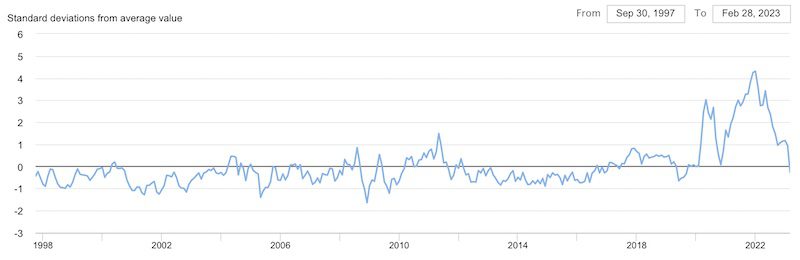
The latest reading of the NY Fed’s Global Supply Chain Pressure Index (GSCPI) shows global supply chain pressures decreased considerably in February.
“There were significant downward contributions by the majority of the factors, with the largest negative contribution from European Area delivery times,” NY Fed said in its update.
The GSCPI’s latest reading (of -0.26 for February) is the lowest reading since August 2019 and reflects that global supply chain pressures are actually now below the historical average.
The GSCPI dating back to 1997. Courtesy NY Fed.
With the onset of the COVID-19 pandemic, supply chain disruptions became a major challenge for the global economy.
Launched in January 2022, the GSCPI uses a range of transportation cost data and manufacturing indicators to provide a gauge of global supply chain conditions dating back to 1997. The index infuses two well known maritime indices, the Baltic Dry Index and the Harper Petersen index of containership hires, in addition to airfreight cost indices from the U.S. Bureau of Labor Statistics and multiple other economic datasets from the transportation and manufacturing sectors to “develop a parsimonious measure of global supply chain pressures.” The GSCPI is updated monthly on the fourth business day of each month.
“The GSCPI’s recent movements suggest that global supply chain conditions have returned to normal after experiencing temporary setbacks around the turn of the year,” the NY Fed said.
Global container shipping rates fell for a fourth consecutive week as the traditional pre-Lunar New Year cargo surge failed to materialize. Spot rates dropped across all major trade lanes, prompting carriers to announce an unusually large wave of blank sailings as uncertainty over demand and Suez Canal transits continues to cloud the market outlook.
Maersk slipped into a rare quarterly loss in its Ocean division as freight rates weakened and the container giant began a cautious return to Red Sea and Suez Canal transits. The setback underscores the financial strain facing carriers as overcapacity collides with the end of Cape of Good Hope diversions.
A.P. Moller-Maersk A/S plans to cut jobs and focus on cost discipline this year as the container giant seeks to insulate its earnings against deteriorating freight rates with Red Sea routes reopening. The shares fell.
4 hours ago
Total Views: 306
Get The Industry’s Go-To News
Subscribe to gCaptain Daily and stay informed with the latest global maritime and offshore news
— just like 107,556 professionals
Secure Your Spot
on the gCaptain Crew
Stay informed with the latest maritime and offshore news, delivered daily straight to your inbox
— trusted by our 107,556 members
Your Gateway to the Maritime World!
Essential news coupled with the finest maritime content sourced from across the globe.

 Join The Club