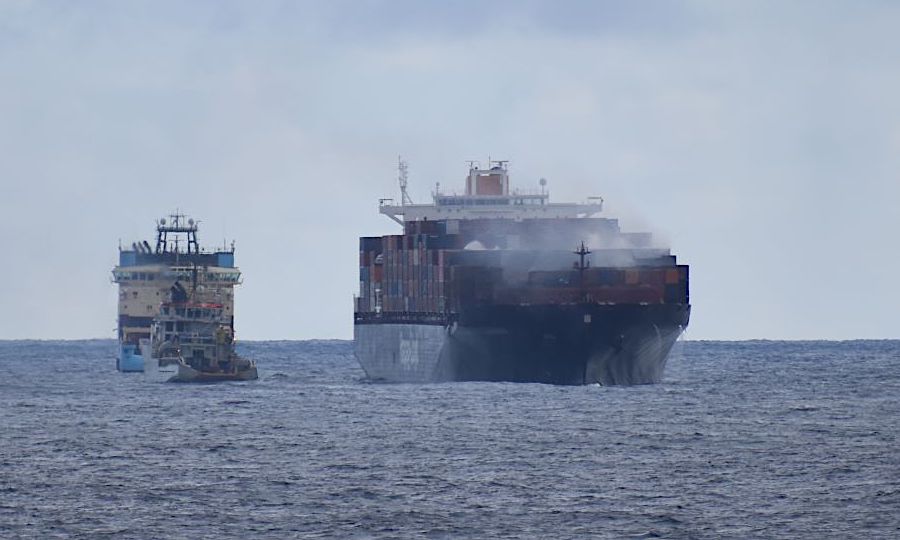
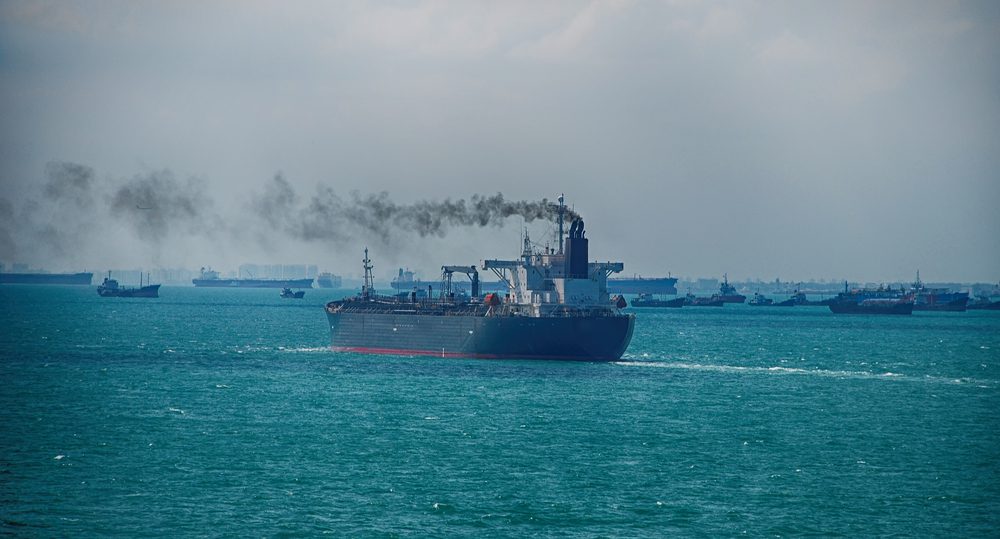
Yantian Express pictured January 15, 2019 in the Atlantic Ocean. Photo: Cameron Brunick
Marine investigators in Germany have identified misdeclared coconut charcoal as the most likely source of the fire on board the Yantian Express containership last year in the Atlantic Ocean.
Hapag-Lloyd’s Yantian Express caught fire January 3, 2019 as the German-flagged ship made its way to Halifax, Nova Scotia. The fire ended up burning for 21 days after igniting in the cargo area.
The ship was eventually towed to a port of refuge in Freeport, Bahamas where salvage and the investigations could take place.
Germany’s Federal Bureau of Maritime Casualty Investigation has now published its investigation into the incident, determining that the fire started in one of three containers identified on deck. However, due to the extent of the fire, investigators could not determine for certain which of the three containers was the actual source ignition.
Investigators said the most likely scenario, however, is that the fire started in a container containing coconut charcoal, which was erroneously declared as coconut pellet.
The Bureau’s report referenced similarities to the 2015 fire on board the MSC Katrina, where the self-ignition of charcoal cargo stowed in a container was determined to be the source. The report’s conclusion also references a number of inaccuracies in the Yantian Express’s fire and safety plan. The Bureau’s report referenced similarities to the 2015 fire on board the MSC Katrina, where the self-ignition of charcoal cargo stowed in a container was determined to be the source.
The Federal Bureau of Maritime Casualty Investigation has made a safety recommendation to Hapag-Lloyd to enter a drencher system for the transverse bulkheads in some of the cargo holds of the Yantian Express and similar vessels.
The report noted that Hapag-Lloyd has, in the course of its own investigation, determined that the time delay units of the Yantian Express’s CO2 fire-extinguishing system were not fully functional. “Therefore, the shipping company immediately started to initiate an inspection/maintenance on all ships to ensure the correct functioning of this time delay units,” the recommendation said.
The Federal Bureau of Maritime Casualty Investigation’s full report can be downloaded here.
Tags:
Updated: November 20, 2023 (Originally published February 4, 2020)
Iran has published a list of 46 vessels it says violated its arrangements for transiting the Strait of Hormuz, warning that the ships could face fines, detention, seizure or confiscation...
Treasury Secretary Scott Bessent threatened economic punishment against any country doing business with Iran as part of what he called an “economic D-Day” campaign to isolate the country and end nearly six months of war.
The U.S. Maritime Administration has signed an agreement with nuclear technology developer CORE POWER to explore a pathway toward U.S.-flagged nuclear-powered commercial ships, expanding the Trump administration’s push to bring...
3 hours ago
Total Views: 123
Get The Industry’s Go-To News
Subscribe to gCaptain Daily and stay informed with the latest global maritime and offshore news
— just like 104,415 professionals
Secure Your Spot
on the gCaptain Crew
Stay informed with the latest maritime and offshore news, delivered daily straight to your inbox
— trusted by our 104,415 members
Your Gateway to the Maritime World!
Essential news coupled with the finest maritime content sourced from across the globe.

 Join The Club