A plastic drift card from one of America’s most significant oil spills has surfaced on a Scottish beach after nearly five decades at sea.
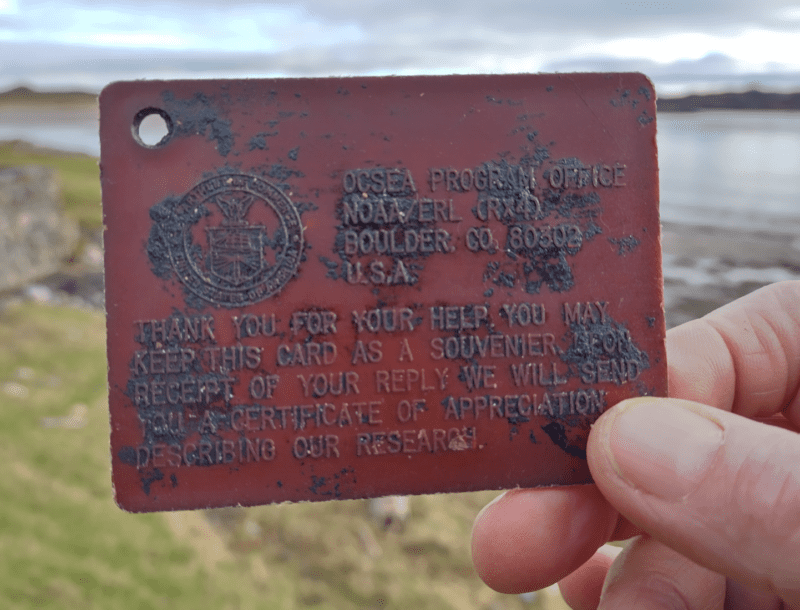
Barbara Payne, while cleaning debris from her property on Scotland’s Isle of Coll following an October 2024 storm, found a red, credit-card sized plastic item with instructions in multiple languages to contact NOAA in Boulder, Colorado.
Image courtesy Barbara Payne
The card’s origin traces back to the December 1976 Argo Merchant disaster, when the 640-foot tanker ran aground off Nantucket Island. The vessel, operating with faulty instruments and 24 miles off course, broke apart six days after grounding, releasing 7.5 million gallons of oil – marking the largest U.S. tanker spill at that time.
While the card’s exact path remains unknown, it’s journey from Massachusetts to Scotland was facilitated by the North Atlantic Gyre, a clockwise-rotating current system that carries objects from the U.S. East Coast toward Europe.
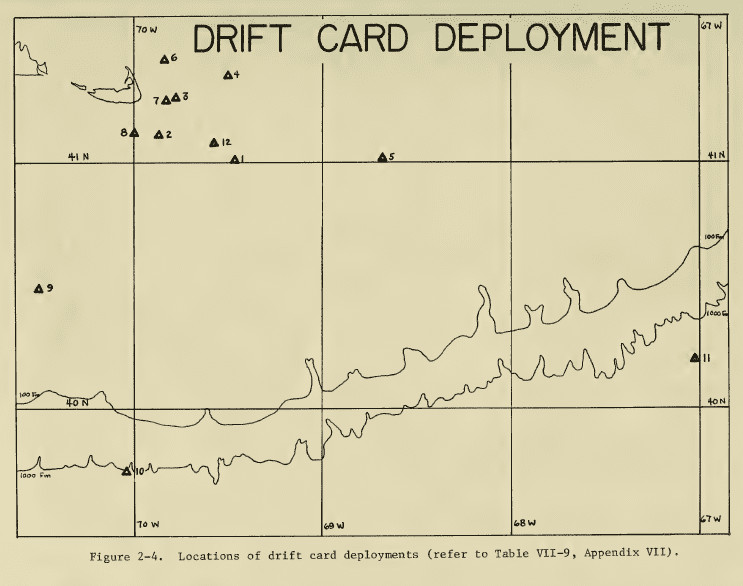
Map of drift card deployments in the region of the Argo Merchant oil spill, with Nantucket in the upper left corner. Image credit: NOAA
The finding also serves as a reminder of the long-lasting impact of plastics on the environment. While the oil from the spill has long since dissipated, the plastic card remains relatively good condition even after all these years adrift.
The Argo Merchant disaster led to the formation of the Office of Response and Restoration (OR&R), which became a center of expertise for preparing for, evaluating, and responding to coastal threats—including oil and chemical spills, hazardous waste releases, and marine debris.
Modern oil spill tracking has evolved beyond plastic drift cards to more environmentally conscious methods, with current drift cards made from biodegradable wood and non-toxic paint.
More than 80 years after the SS Richard Montgomery sank in the Thames Estuary with roughly 1,400 tons of explosives still aboard, marine contractors have begun one of the most delicate interventions...
Lloyd’s Register, the maritime society formed in a London coffee house in 1760, has put its modern glass headquarters up for sale as it prepares to move back into the property built to house it more than a century ago.
The iconic SS United States is set to embark on its final journey – not across the Atlantic, but towards a new life as the world’s largest artificial reef. On...
October 15, 2024
Total Views: 19577
Get The Industry’s Go-To News
Subscribe to gCaptain Daily and stay informed with the latest global maritime and offshore news
— just like 106,746 professionals
Secure Your Spot
on the gCaptain Crew
Stay informed with the latest maritime and offshore news, delivered daily straight to your inbox
— trusted by our 106,746 members
Your Gateway to the Maritime World!
Essential news coupled with the finest maritime content sourced from across the globe.

 Join The Club