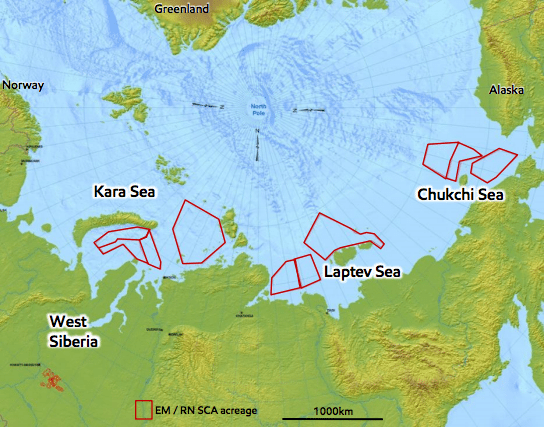
Acreage owned by Rosneft/ExxonMobil JV, Image: ExxonMobil
March 5 (Bloomberg) — Exxon Mobil Corp.’s biggest international exploration opportunity may be imperiled by Russian President Vladimir Putin’s Ukrainian foray.
U.S.-based companies could face restrictions on doing business in Russia if Putin’s regime is slapped with sanctions by western governments or the United Nations for its intervention in Ukraine’s Crimea region.
Exxon, under the terms of a 2011 contract with state- controlled OAO Rosneft, owns drilling rights across 11.4 million acres of Russian land, its biggest exploration holding outside the U.S. Sanctions could stall Exxon’s plans to begin drilling in the Russian Arctic later this year in partnership with Rosneft, and threaten the lucrative Sakhalin-1 oil license off Russia’s Pacific Coast.
Exxon Chairman and Chief Executive Officer Rex Tillerson agreed to invest billions of dollars and allow Rosneft to buy stakes in premier North American projects in exchange for access to Russia’s vast Arctic, deep-water and shale resources.
The 61-year-old University of Texas-trained engineer is seeking to reverse sliding oil and natural gas output at the world’s biggest energy producer by market value. Since assuming the leadership post of Exxon in January 2006, the company’s stock has increased 65 percent, lagging the 77 percent advance in the price of crude, according to data compiled by Bloomberg.
Drilling Rights
Exxon’s 11.4 million acres of Russian drilling rights are eclipsed in size only by the company’s 15.1 million acres in its home country, according to a filing with the U.S. Securities and Exchange Commission on Feb. 26. The next largest Exxon holdings are in Canada, Germany and Indonesia, where the company owns rights to 6.3 million acres, 5 million acres and 2.3 million acres, respectively.
Exxon has repeatedly declined to comment on the impact the Russian imbroglio in Ukraine may have on its operations or investment decisions. Tillerson is scheduled to take questions from analysts and the media later today at the company’s annual strategy presentation at the New York Stock Exchange.
Exxon’s interests in the region aren’t confined to Russian oil fields. The company dispatched high-level executives to the Ukraine’s capital of Kiev six weeks ago to discuss exploring the country’s vast shale deposits, Interfax reported on Jan. 23, citing the website of then-President Viktor Yanukovych.
Yanukovych was ousted amid violent streets protests in late February and has since fled to Russia. The January meetings included Exxon executives Stephen Greenlee and Kevin Biddle, according to the Interfax report.
Rising Costs
The Russian turmoil comes at a time when Exxon’s exploration effort have stalled worldwide and costs to pump oil and gas from the ground are rising.
The company found commercial quantities of oil or gas in 67 percent of the exploratory wells it drilled in 2013, unchanged from 2012, according to the Feb. 26 regulatory filing. At the same time, Exxon’s costs to produce the equivalent of a barrel of crude jumped to $11.48 last year from $9.91 in 2012.
Exxon’s Russian drilling rights include 11.3 million acres in the Kara and Black seas under the agreement with Rosneft, and another 85,000 offshore acres beneath the Sea of Okhotsk near Sakhalin Island. Rosneft is a partner in the Sakhalin-1 development, which began producing crude in 2005.
– Joe Carroll, Copyright 2014 Bloomberg.

 Join The Club