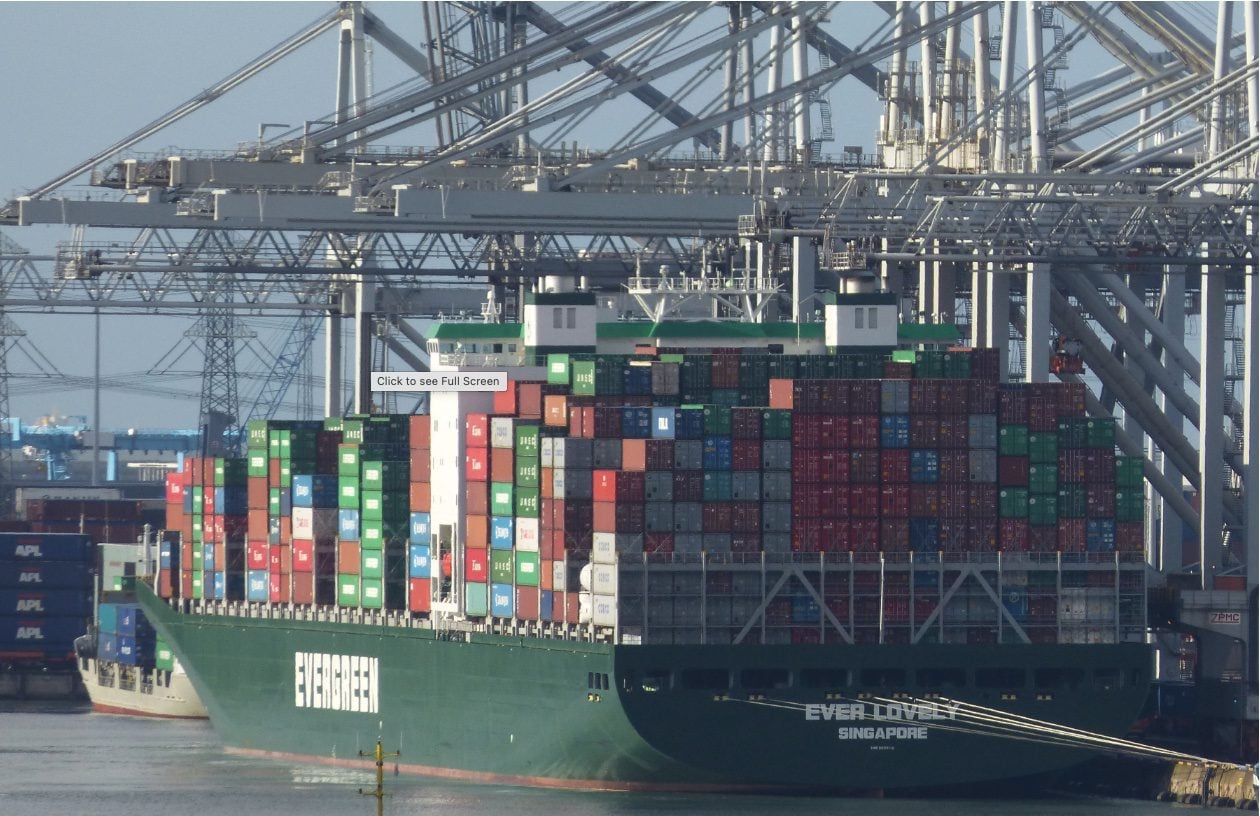
At 1410 UTC on 25 June 2026, the Singapore-flagged containership Ever Lovely, operated by Taiwan’s Evergreen Marine Corporation, was struck on her starboard side by an unknown projectile as she exited the Strait of Hormuz along the southern corridor close to the Omani coast, approximately 7.5 nautical miles south-east of Dahit, Oman.
By Paul Morgan (gCaptain) – The United Kingdom Maritime Trade Operations centre, UKMTO, confirmed the attack in Warning 074-26, reporting damage to the bridge structure but no casualties and no environmental impact. The master reported the vessel safe, and Ever Lovely subsequently completed her transit. Within hours, the United States government attributed the strike to a drone deployed by Iran’s Islamic Revolutionary Guard Corps Navy, the IRGC-N, a claim consistent with multiple US official sources speaking to reporters, though Iran has not formally claimed responsibility.
The self-proclaimed Persian Gulf Strait Authority, a body Tehran established specifically to manage traffic through the strait since the outbreak of hostilities in February, left little ambiguity about the political intent behind the attack, stating on X that vessels transiting outside routes it has designated “will not be covered by the guarantee of safe passage” and that “consequences arising from passage through unauthorised routes shall be the responsibility of the owner, operator, and vessel commander.” The message was unambiguous.
The southern route, promoted by the International Maritime Organization and the Sultanate of Oman as a mine-free passage along the Omani territorial coastline, is not recognised by Tehran as legitimate.
The timing was deliberate and the symbolism was brutal. The 25th of June is IMO’s Day of the Seafarer. IMO Secretary-General Arsenio Dominguez had launched the agency’s Strait of Hormuz Evacuation Framework just two days earlier, on June 23, a voluntary scheme developed in close cooperation with Oman, the United States, and coastal states to facilitate the orderly departure of the hundreds of vessels and approximately eleven thousand seafarers stranded in the Persian Gulf since Iran effectively closed the strait on March 4, following the US and Israeli strikes on Iran under Operation Epic Fury in late February.
The scheme offered two evacuation corridors: a northern route through waters adjacent to the Iranian coastline, under Tehran’s oversight, and the southern corridor in Omani waters with US monitoring. Dominguez made a point of publicly emphasising the Day of the Seafarer significance in his statement suspending the plan: “I have decided to temporarily pause its implementation in order to reconfirm that the necessary safety guarantees continue to be in place for the ships on our evacuation list and all those in the region.” The attack forced his hand.
Fourteen seafarers have been killed in the strait since the conflict began. The irony of a ship being struck on the one day set aside globally to recognise the contribution and vulnerability of those at sea will not be lost on anyone working in the maritime sector.
It is important to be precise about what happened and what did not. Ever Lovely was not transiting under the IMO evacuation framework. She appears to have been making an independent commercial transit using the southern route, which Oman’s Maritime Security Centre had issued guidance for in coordination with IMO. The IRGC-N had earlier that morning broadcast on VHF Channel 16 a warning to all vessels that transit without Iranian permission or AIS compliance would be at their own risk.
Maritime intelligence firm Windward reported that the IRGC published a claim on its official Telegram channel that three tankers using the southern corridor had been ordered to turn back, with five vessels exhibiting behaviour consistent with course reversals and a sixth losing AIS signal during the incident. The Togo-registered tanker Blue Star 1 reversed course mid-transit outbound. At least two Panama-flagged vessels were ordered by the IRGC to alter course, according to British maritime security company Ambrey.
Against this backdrop, Ever Lovely was struck, the evacuation framework was suspended, and the false confidence generated by seventy confirmed Hormuz crossings on Wednesday, June 24, the highest single-day figure since the crisis began and a 105% increase day-on-day, according to Kpler, evaporated within hours.
The geopolitical context is critical to understanding why this incident matters beyond the immediate damage to one vessel. The US-Iran Memorandum of Understanding signed in June at the Palace of Versailles, in the margins of the G7 summit, committed both parties to a 60-day negotiating process aimed at ending the conflict and reopening the strait. It included US agreement to lift the naval blockade of Iranian ports, and Iran’s commitment to reopen Hormuz without tolls. What it left unresolved, critically, was the question of who governs traffic through the strait and on what terms.
Iran’s position, forcefully restated by the IRGC on June 25, is that no routing arrangement is legitimate without its approval, and that the Persian Gulf Strait Authority is the sole competent body for issuing transit permits. Washington’s position is the direct opposite: Secretary of State Marco Rubio, who was in Bahrain meeting Gulf Cooperation Council foreign ministers when the attack occurred, stated plainly that no country has the right to charge for or control an international waterway, warning that accepting any such principle “will spread throughout the world like a contagion.”
A joint GCC ministerial statement issued on the same day rejected any tolls, fees, or unilateral assertions of control over the strait. The contradiction embedded in the MOU has now produced its first kinetic consequence.
For the maritime industry, the implications reach well beyond the political narrative. Before the conflict, the Strait of Hormuz carried roughly 20% of global seaborne oil trade and a comparable share of liquefied natural gas, according to IMO and US Energy Information Administration data, with pre-war traffic running at approximately 120 vessel transits per day. War-risk insurance premiums, which had already climbed from 0.125% to between 0.2% and 0.4% of hull value per transit in the days before Operation Epic Fury in late February, have since risen dramatically.
Han Shen Lin, China country director of The Asia Group, put the current reality bluntly in comments to CNBC: “Boardrooms aren’t asking about cargo safety, they’re asking if it is insurable. War-risk premiums have shot up from 0.05% to over 0.7% of hull value per transit. That’s not a risk premium, that’s a serious business model stress test.” For a VLCC, that premium movement represents a cost increase measured in hundreds of thousands of dollars per transit, and that is before considering the potential unavailability of cover altogether for vessels using routes not sanctioned by the Persian Gulf Strait Authority.
The PGSA’s post-attack statement explicitly warned that vessels on unauthorized routes would not be entitled to insurance coverage or related liabilities, a threat that, if it has any practical legal traction with insurers and P&I clubs, transforms the entire commercial calculus of a Hormuz transit.
The attack also exposes a structural fault in the current two-corridor arrangement that the maritime industry needs to understand clearly. The southern Omani route is not sovereign Iranian waters.
It is, in legal terms under the UN Convention on the Law of the Sea, a waterway subject to the right of transit passage, which is non-suspendable and applies to all vessels. Seatrade Maritime News correctly noted that an IRGC strike on a vessel in Omani coastal waters, if confirmed, represents a flagrant disregard for UNCLOS. But UNCLOS has no enforcement mechanism that operates in real time, and the IRGC does.
The gap between international maritime law and the physical reality on the water is the space in which this crisis has operated since March, and the Ever Lovely incident is simply the most pointed illustration of it to date. The standard Traffic Separation Scheme, the pre-war commercial lane, remains closed due to the threat of Iranian mines, the clearance of which has barely begun and which represents a separate and formidable technical and diplomatic challenge entirely.
The expert response within the industry has been notably measured rather than panicked, which itself says something about how the sector has recalibrated expectations since February. Aristidis Alafouzos, chief executive of Okeanis Eco Tankers, told CNBC’s Squawk Box Europe on Friday that he did not expect the attack to significantly disrupt the trend of increasing crude oil transits, pointing to the ongoing exit of Kuwaiti and Emirati crude from inside the Gulf. He flagged, however, that the one major missing piece remains Saudi Arabia, which has effectively rerouted all exports via the Red Sea from Yanbu, avoiding the Gulf entirely, and whose return to normal Hormuz-based operations would signal a genuine restoration of confidence.
Halvor Ellefsen, a director at Fearnleys Shipbrokers, characterized the current traffic as a trickle rather than a rush, noting that most movement represents the clearance of existing inventories rather than fresh Gulf loadings. Oil prices reflected the conflicting signals: Brent crude rose approximately 1.5 dollars a barrel in Asian trading on June 26 in the immediate aftermath of the news, with Murban crude, the Abu Dhabi benchmark, jumping nearly 4%, before partially retreating as markets weighed whether the incident was an isolated escalation or a harbinger of systematic disruption. Windward’s assessment was more direct, warning that the IRGC’s posture marks a reversal in the normalization trajectory that had been building since the MOU signing.
What this incident ultimately exposes is the gap between political signalling and operational reality in the strait. The MOU created the conditions for cautious optimism. The IRGC has made clear that it regards itself as operating under a different set of rules, and possibly a different set of instructions, to the Iranian government negotiators who signed the agreement in Versailles. Simmering frictions between the IRGC and the civilian Iranian government have been a feature of the crisis from the beginning, and the question of who ultimately controls Iranian military behaviour in the strait, and whether any diplomatic agreement can bind the IRGC-N operationally, remains entirely unresolved.
For shipowners, charterers, masters, and insurers, the Ever Lovely attack is a reminder that the southern route is not a sanctuary and that the strait, in its current state, cannot be treated as any form of normal commercial waterway. Every transit carries elevated political as well as operational risk, and any vessel proceeding without a clear understanding of both the IMO evacuation framework terms and the PGSA permitting requirements is navigating in contested legal and physical territory.
The industry awaits, with considerable interest, whether the IMO evacuation framework resumes and on what conditions, how the US and Omani governments respond to an apparent act of aggression in Omani-adjacent international waters, and whether the 60-day MOU process can produce a governing framework for the strait that the IRGC will actually observe. For the 11,000 or more seafarers still stranded inside the Gulf, including their families ashore, those are not abstract diplomatic questions.

 Join The Club