An Australian expedition cruise ship grounded on a reef while approaching a remote harbor in Papua New Guinea after a last-minute route modification in the ship’s electronic navigation system delayed a critical turn during the early-morning approach, according to a newly released preliminary investigation.
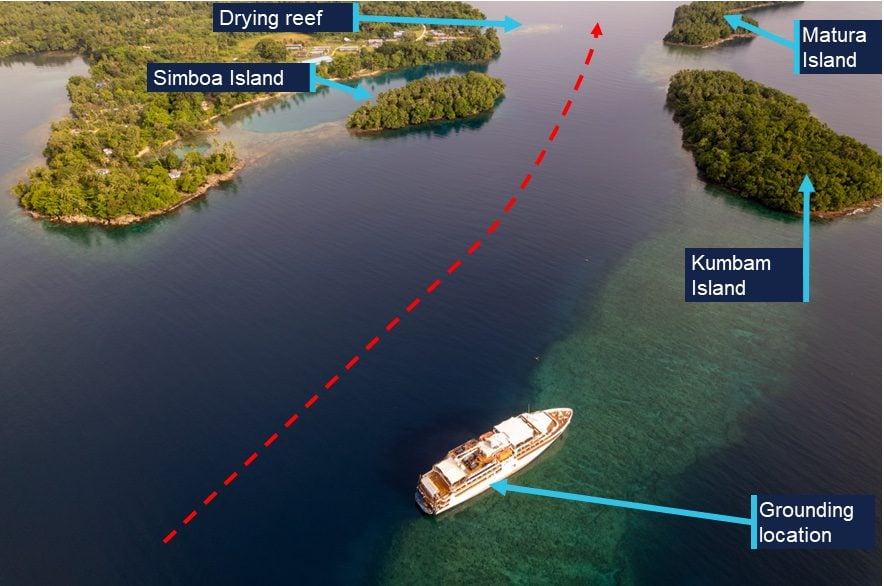
The 93-meter Australian-flagged expedition vessel Coral Adventurer ran aground at 0525 on December 27, 2025, near Nussing Island, about 100 kilometers east of Lae, while carrying 80 passengers and 44 crew on a 12-night cruise from Cairns. No injuries were reported, but the ship sustained hull indentation and structural damage after striking a reef at about 8.5 knots.
The grounding occurred during the ship’s final approach to Dregerhafen, a narrow and poorly marked harbor used by expedition cruise vessels visiting Papua New Guinea’s remote Huon Peninsula.
A Small Navigation Change With Big Consequences
According to the Australian Transport Safety Bureau (ATSB) preliminary report, the chain of events began hours earlier when the ship’s chief mate modified the pre-planned approach route in the vessel’s Electronic Chart Display and Information System (ECDIS).
The adjustment—adding an extra waypoint to smooth a tight turn around Nussing Island—appeared minor. But the change invalidated the system’s route safety verification, meaning the new route could not be activated until the officer performed a new safety check in the ECDIS route editor.
That delay proved critical.
At 0512, as the ship approached the key wheel-over point where the vessel should have begun turning toward the harbor entrance, the chief mate attempted to activate the modified route. The system refused to load it until the safety check was completed.
While the officer worked through the issue, the ship sailed past the planned turning point.
Hard Turn, Rising Speed
Realizing the waypoint had been missed, the chief mate switched the ship from autopilot to manual steering, commanding both Azipull thrusters simultaneously to execute a rapid turn back toward the planned track.
During the maneuver the vessel slowed sharply to 3.8 knots.
Believing a strong current was responsible for the loss of speed, the chief mate increased the power on both propulsion thrusters from 120 RPM to 180 RPM.
The ship regained the planned track several minutes later and autopilot was re-engaged. But by then the vessel had accelerated to over 8 knots, well above the intended approach speed.
Moments later the ship reached the next wheel-over point, where the autopilot was expected to execute a continuous turn toward the harbor entrance.
Instead, the turn came too slowly, causing the ship to overshoot the intended track.
Darkness and Confusion on the Bridge
The chief mate again switched to manual steering and increased the rate of turn, but the vessel continued drifting west of the planned route.
Complicating matters were the environmental conditions. The approach was being conducted in moonless darkness during nautical twilight, and the area had no navigational aids or lights ashore.
Investigators say the officer later reported difficulty reconciling what was visible outside with the electronic chart display.
The chief mate told investigators they were “unable to correctly visually identify the entrance into Dregerhafen” and began losing situational awareness while focusing on the ECDIS screen.
At 0524, the master arrived on the bridge.
About a minute later the master warned that the ship appeared to be heading toward shallow water.
The chief mate ordered a hard turn to port.
Seconds later, a loud grinding noise echoed through the ship.
Impact at 8.5 Knots
At 0525:17, Coral Adventurer struck a reef connecting Nussing and Kumbam Islands.
The vessel shuddered repeatedly before coming to a stop roughly 160 meters off the planned track.
The ship ended up resting on the seabed along its starboard side, though its propulsion and steering systems remained operational.
Passengers were informed of the grounding shortly afterward, but they were not mustered, and parts of the cruise excursion program continued ashore while the situation was assessed.
Three Days to Free the Ship
Initial attempts by the crew to refloat the vessel at high tide were unsuccessful.
Coral Expeditions subsequently brought in tug assistance from Pacific Towage. A first attempt by the tug Macedon was abandoned after the tug’s engines overheated.
On December 30, passengers were evacuated and flown back to Cairns while a more powerful tug, Langila, attempted another pull.
At 1534, the ship was finally refloated and moved to a nearby anchorage for inspection by classification society DNV.
Investigation Focuses on Human Factors
The ATSB says its investigation is continuing and will examine voyage data recorder recordings, CCTV footage from the bridge, bridge resource management and human factors, the ship’s passage planning and navigation procedures, and safety management oversight by the operator.
The preliminary report contains no formal conclusions, but the sequence of events highlights how a routine ECDIS modification, combined with automation reliance and challenging conditions, can quickly cascade into a major navigational incident.
A final report is expected once the investigation is complete.

 Join The Club