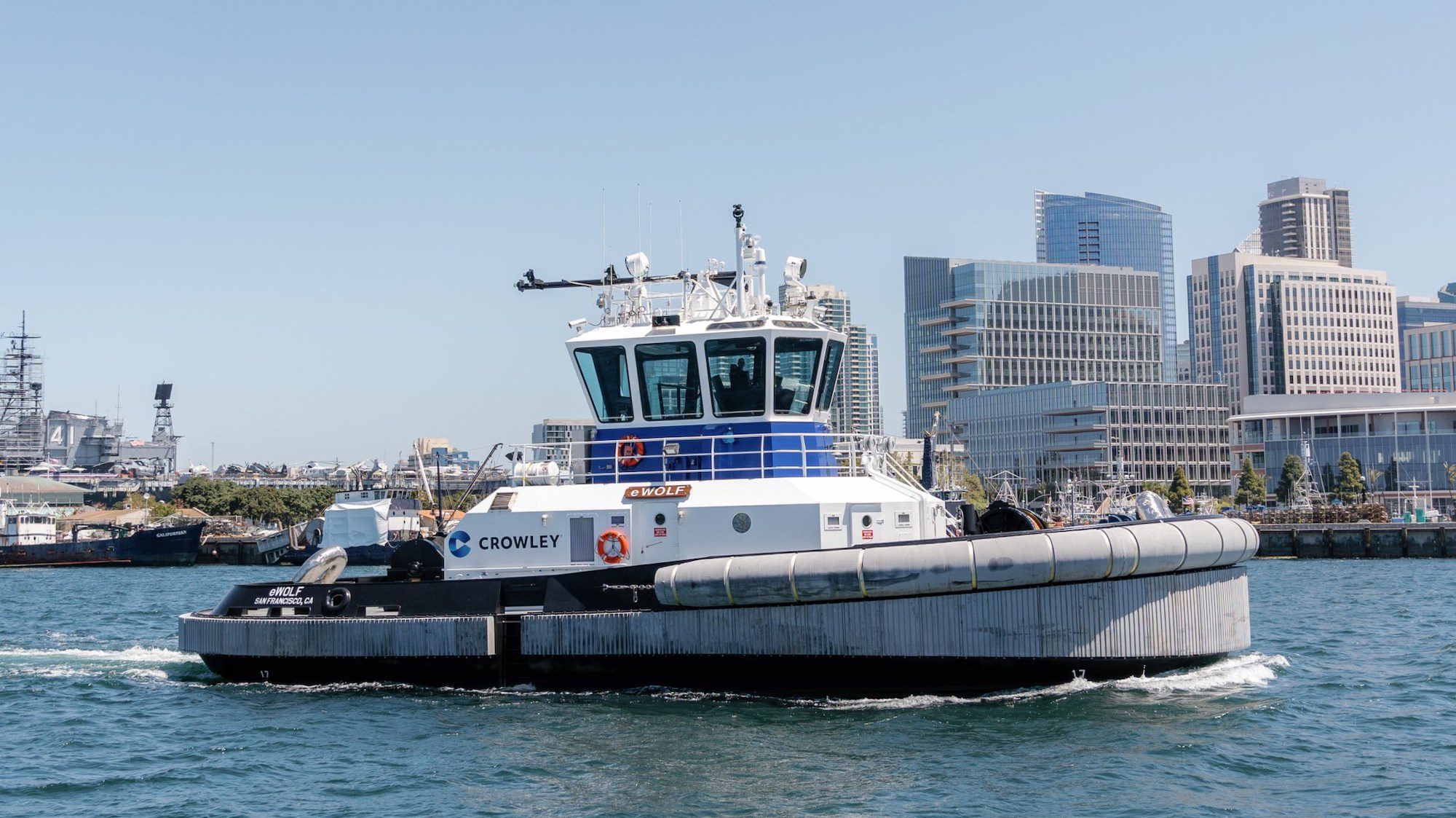
Crowley has launched eWolf, the first all-electric ship assist harbor tugboat in America. The launch marks a significant milestone in the maritime industry, as the tugboat operates with zero emissions and other sustainable technologies.
“The all-electric tugboat is the most technologically advanced vessel of its kind, and eWolf will help our customers and communities reach their decarbonization goals while delivering capabilities that strengthen our vital supply chain,” said Tom Crowley, Chairman and CEO.
The christening ceremony attended by key figures in eWolf’s development, including Gustav Hein, Director of the Mid-Pacific Gateway Region for the U.S. Maritime Administration, and Frank Urtasun, Port of San Diego Chairman. The initiative is a result of a collaborative effort involving Crowley, the Port of San Diego, San Diego County Air Pollution Control District, the California Air Resources Board (CARB), the U.S. EPA, and the U.S. Maritime Administration.
“This is truly a story of teamwork and collaboration. We are proud to work with Crowley and our state and local partners on this and other electrification initiatives at and around our port, including electric cargo handling equipment like our all-electric mobile harbor cranes, our microgrid, vessel shore power, and more,” said Urtasun.
Crowley Vice Chairwoman Christine Crowley served as the sponsor to give the blessing and conduct the christening on San Diego Bay. Photo courtesy Crowley
The eWolf is planned to enter commercial service this week at the Port of San Diego.
The 82-foot vessel, built by Master Boat Builders in Coden, Ala., delivers 70 tons of bollard pull, outperforming its conventionally-powered predecessor. It also includes a fully integrated electrical package for battery energy storage by ABB and is supported by a new microgrid shoreside charging station. The tug is expected to significantly reduce pollutants over its first decade of operations, producing 178 tons less of nitrogen oxide, 2.5 tons less of diesel particulate matter, and 3,100 metric tons fewer carbon dioxide emissions, according to the U.S. Environmental Protection Agency (EPA) calculations. This is equivalent to removing 350,000 gallons of gas from use.
The launch is seen as a step towards improving air quality in San Diego.
“Impacted Portside communities, like Barrio Logan and National City, breathe more diesel pollution than 90% of California communities and children experience up to 5 times more asthma hospitalizations,” said Takvorian, CARB board member. The eWolf will contribute significantly to creating a healthy environment for all communities.”
The eWolf’s name pays homage to a tugboat in the company’s initial fleet, the Sea Wolf, which operated more than a century ago in California.
Crowley has confirmed that one of its managed vessels has successfully transited the Strait of Hormuz, providing more visibility into the limited number of U.S.-flagged ships that have exited the...
A Crowley-managed product tanker was struck by projectiles while berthed at the Port of Bahrain early Monday, killing one shipyard worker and injuring two others in the latest escalation of...
Maritime services provider Crowley has launched mooring operations at the ports of Los Angeles and Long Beach, marking a strategic expansion of its West Coast harbor services capabilities. The new...
November 12, 2025
Total Views: 1023
Get The Industry’s Go-To News
Subscribe to gCaptain Daily and stay informed with the latest global maritime and offshore news
— just like 104,486 professionals
Secure Your Spot
on the gCaptain Crew
Stay informed with the latest maritime and offshore news, delivered daily straight to your inbox
— trusted by our 104,486 members
Your Gateway to the Maritime World!
Essential news coupled with the finest maritime content sourced from across the globe.

 Join The Club