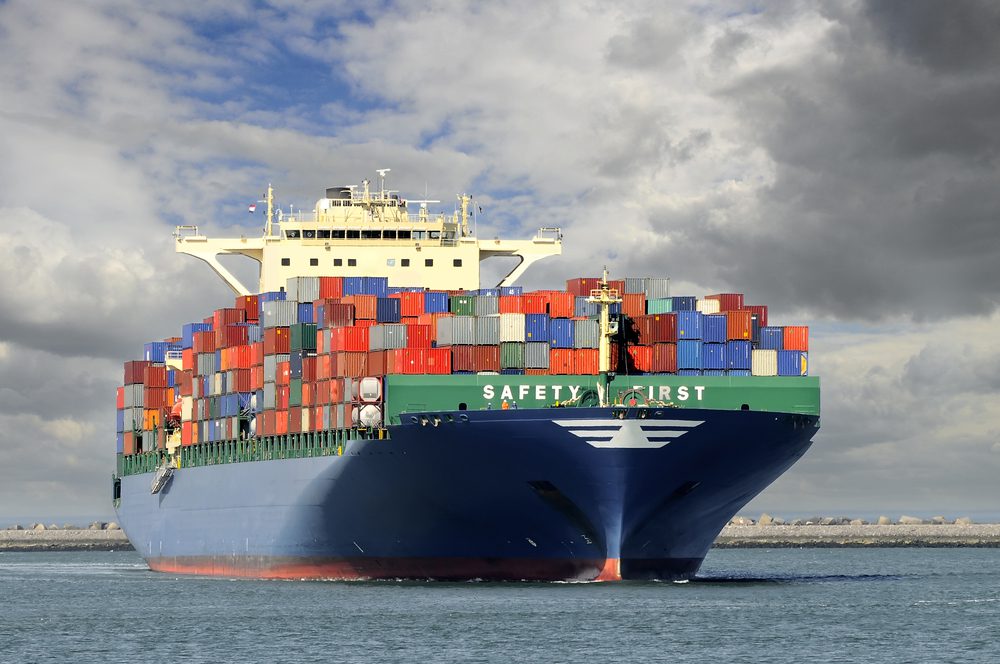
Drewry World Container Index reveals global container shipping rates fell 1% to $1,899 per 40-foot container this week, marking the seventh consecutive weekly decline as the traditional pre-Lunar New Year cargo surge failed to materialize and new U.S. tariff policies inject fresh uncertainty into trade lanes.
The Index’s continued slide underscores an unusual market dynamic playing out across major trade routes. Rates have been falling steadily since early January—a pattern that runs counter to typical seasonal behavior, when exporters traditionally rush cargo before factories close for the holiday.
Asia–Europe trade routes bore the brunt of the decline this week. Spot rates from Shanghai to Rotterdam fell 1% to $2,094 per 40-foot container, while Shanghai to Genoa dropped 2% to $2,826.”Volumes typically rebound in March as factories across Asia reopen, but rates are expected to remain under pressure due to rising capacity,” Drewry stated in its weekly assessment. “Hence, we expect spot rates on this trade to soften in the coming weeks.”
Transpacific routes showed similar pressure. Spot rates from Shanghai to Los Angeles decreased 1% to $2,191, while those on Shanghai to New York remained stable at $2,771 per 40-foot container.According to Drewry’s Container Capacity Insight, carriers announced 9 blank sailings for the coming week on Transpacific East and West Coast trade lanes—lower than the previous week as factories gradually return to full production following Chinese New Year.
The rate environment is unfolding against a backdrop of heightened policy uncertainty. Just days after the U.S. Supreme Court struck down sweeping tariffs imposed under emergency powers, potentially triggering refunds on more than $90 billion in collected duties, the Trump administration moved quickly to preserve its trade agenda.
Within hours of the February 20 ruling, President Trump announced a 10% global tariff for 150 days under Section 122 of the Trade Act of 1974. The new tariff began collection Tuesday, with confusion emerging after the rate remained at 10% despite earlier comments suggesting it could rise to 15%. The administration is now exploring alternative measures to reinstate tariffs, “including an immediate 10% global tariff with plans to increase it to 15%, signalling policy uncertainty,” according to Drewry’s assessment.
Moody’s Ratings warned that any sustained import surge from the court ruling will depend on how quickly and broadly new tariffs are imposed—and whether refunds on previously collected duties materialize .”We expect the Trump administration to pursue these routes to preserve tariffs and achieve its trade agenda, potentially increasing the cost of goods once again,” Moody’s said.
The downturn reflects a broader shift in the market. Last week, rates had fallen 1% to $1,919 per 40-foot container, with Drewry noting that “container spot rates are falling sharply, which indicates that the market is weak, contrary to the general expectation of rising demand and increasing spot rates before the CNY.” The firm warned that if normal seasonal patterns hold, rates could decline further in the coming weeks.
Capacity management remains complicated. Diversions around the Cape of Good Hope continue to absorb a significant share of the global container fleet, but the gradual return of some services to the Suez Canal is beginning to reintroduce supply and muddy the rate outlook.
Meanwhile, the container shipping industry is heading into a potential oversupply crisis as the orderbook has ballooned to more than one-third of the existing fleet—far exceeding normal replacement requirements, according to a recent report from Linerlytica. This surge follows an extraordinary ordering spree in 2025, when carriers placed orders for 633 ships totaling 5.08 million TEU, breaking records set in both 2021 and 2024.
Looking ahead, analysts continue to warn that global freight rates could fall by as much as 25% in 2026 as new vessel deliveries collide with softer demand, even if Red Sea conditions remain relatively stable. Linerlytica warned that this aggressive expansion “raises the spectre of over-supply in the next 4 years.”
With carriers planning 63 blank sailings for February—up sharply from 27 in January—the market appears braced for further rate pressure as the interplay between capacity, demand, and trade policy continues to unfold.
Editorial Standards · Corrections · About gCaptain

 Join The Club