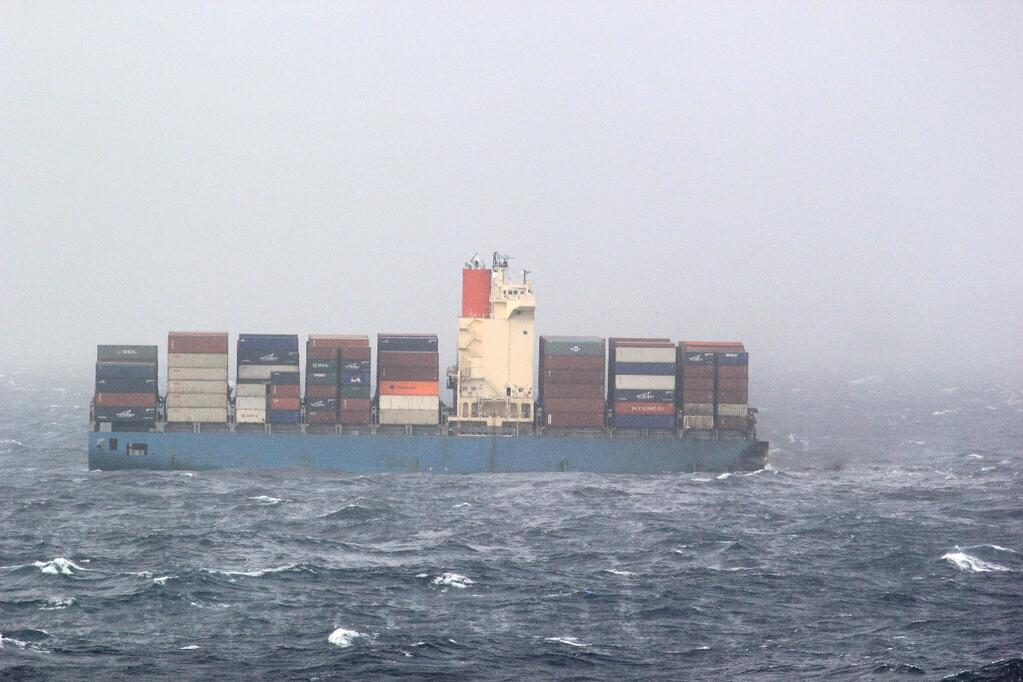
The aft section of the MOL Comfort, which is now at the bottom of the Indian Ocean. Photo: MRCC Mumbai
After the containership MOL Comfort cracked in half, partially sank, and then caught fire this past summer in spectacular fashion, Japanese classification society ClassNK established a special Casualty Investigation Team to investigate and determine the cause of the casualty on behalf of ship owner, Mitsui O.S.K. Lines (MOL).
Preliminary investigation findings released today, 1 November 2013 are as follows, via ClassNK:
Based on the presence of water-ingress in the bottom of the vessel’s midship at the outset of the casualty, the fracture in the vessel’s hull is considered to have originated from the bottom part of the vessel.
Hull strength and loads at the time of accident were assessed in order to investigate how the fracture occurred and progressed. Structural hull capacity was analyzed using non-linear finite element 3-hold modeling, and dynamic wave loads including whipping effects were also analyzed.
Weather, sea state and cargo loading condition data from the vessel’s previous voyages are being investigated to estimate the loads acting on the vessel. In addition, structural inspections were conducted on the sister vessels of the MOL COMFORT.
During the inspections of the sister vessels, buckling type deformations measuring approximately 20mm in height were observed on the bottom shell plates in the vicinity of center line of midship area. However, it remains unclear at this stage as to whether this type of deformation could have served as a trigger for the casualty. Reinforcement work to increase the hull strength of the sister vessels is already being carried out as a preventative safety measure.
With cooperation from shipowners, structural investigations are also being carried out to determine whether similar deformations have occurred in large container vessels with designs differing from those of the MOL COMFORT.
Numerical analyses of hull strength and applied loads continue to be conducted in order to develop a more detailed understanding of the casualty and establish countermeasures to prevent the occurrence of similar casualties in the future.
Based on the above findings, ClassNK proposes the following preventative safety measures:
It is recommended that crew inspect the midship section to the extent possible in order to determine whether deformations have occurred on the bottom shell plates. At the request of shipowners, ClassNK will dispatch qualified surveyors to attend such inspections free of charge.
If consecutive deformations in the transverse direction are observed on the bottom shell plates an occasional survey is recommended. ClassNK will dispatch qualified surveyors upon request.
The ClassNK Casualty Investigation Team will continue to work closely with the Committee on Large Container Ship Safety as it continues to investigate the MOL COMFORT casualty and compile its final report on the incident.
The Port of Los Angeles handled 840,165 twenty-foot equivalent units (TEUs) in May, marking a 17% increase from the same month last year as importers continued to move cargo amid...
Maersk is keeping significant cargo restrictions and emergency surcharges in place across the Persian Gulf, offering the latest sign that commercial shipping remains far from normal despite recent announcements of...
The Port of Long Beach handled 842,030 twenty-foot equivalent units (TEUs) in May, marking its third-busiest May on record and a sharp rebound from the tariff-driven slowdown that weighed on...
June 12, 2026
Total Views: 350
Get The Industry’s Go-To News
Subscribe to gCaptain Daily and stay informed with the latest global maritime and offshore news
— just like 105,069 professionals
Secure Your Spot
on the gCaptain Crew
Stay informed with the latest maritime and offshore news, delivered daily straight to your inbox
— trusted by our 105,069 members
Your Gateway to the Maritime World!
Essential news coupled with the finest maritime content sourced from across the globe.

 Join The Club