In an attempt to deliver a power plant to a Russian Arctic LNG project before winter two Chinese heavy lift vessels are inching along through increasing sea ice on the Northern Sea Route. A recent storm in the Bering Sea delayed both vessels by several days allowing more sea ice to form in the Chukchi Sea.
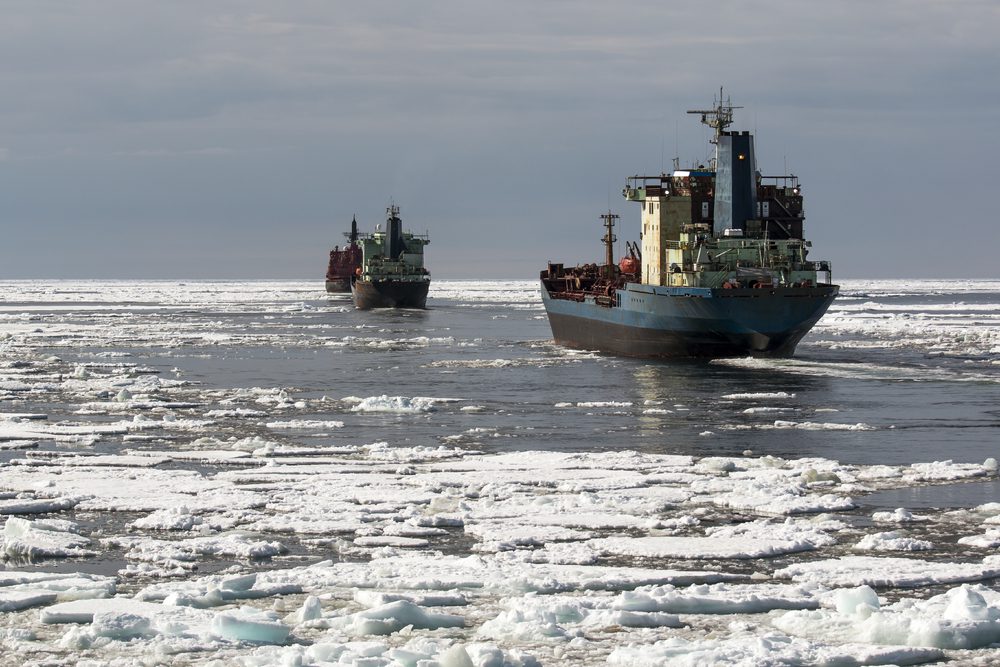
The two vessels Ocean 28 and Nan Feng Zhi Xing are traveling through broken first-year ice between 10-30 cm thick. Only the latter has an ice classification.
Russian officials closed the eastern sections of the route for vessels without ice class on Tuesday due to deteriorating ice conditions. And a nuclear icebreaker Sibir previously on station around Wrangel Island departed that day leaving Ocean 28 and Nan Feng Zhi Xing without escort.
The two Chinese heavy lift vessels have at least another two weeks to go en route to the Arctic LNG 2 project on the Gydan peninsula. Even more challenging ice conditions await in the Vilkitsky Strait around 1,500 nautical miles further west. Here sea ice has begun to choke the narrow strait with wind potentially pushing thicker multiyear ice into the shipping lane.
AIS map showing the locations of Sibir and the three Chinese heavy lift vessels. (Source: Shipatlas)
A third heavy lift vessel also carrying power plant modules, Hunter Star, is still in the Pacific lagging around a week behind. It will face even more sea ice when it reaches the waters around the Vilkitsky Strait in early November.
“I think it’s still possible for the Sibir to escort the three heavy cargo ships in convoy on the NSR, provided the wind doesn’t disturb the pack ice in formation too much,” confirms Hervé Baudu, Arctic shipping expert and Chief Professor of Maritime Education at the French Maritime Academy (ENSM).
However, currently Sibir is steaming at 17 knots away from the convoy heading west. Instead a Russian offshore tug, Hermes, with an icebreaking classification joined Ocean 28 overnight. Possibly a precautionary measure in case Ocean 28 runs into trouble.
Even without an ice-class Ocean 28 will be able to push thin and unconsolidated ice apart. The key challenge will be to avoid bumping into bigger floes, relatively easy to do during day time, but much more challenging at night.
With the Polar night quickly descending at 75 degrees North, daylight hours are quickly fading. Photos taken by the crew of Sibir earlier this week showcase the conditions the two Chinese vessels are currently navigating in.
Nuclear icebreaker Sibir in the Chukchi Sea on October 15. (Source: Atomflot)
Both vessels also almost certainly do not comply with the Polar Code, the IMO’s Regulation for Ships Operating in Polar Waters.
Russia shipped the most crude in a month-and-a-half, while a jump in prices propelled the value of those cargoes close to the highest since the start of the invasion of Ukraine in 2022. But the benefits to the Kremlin are being undermined by its ban on overseas diesel sales.
Russia's Arctic port of Murmansk will use equipment typically used to load fertilizer when it ships its first grain from southern Russia for export as early as next month, as the Black Sea route remains closed due to Ukrainian drone attacks.
A new U.S. sanctions law could put the specialized fleet that keeps Russia’s Yamal LNG project operating in the Arctic under unprecedented pressure, potentially forcing European shipping companies and service providers to confront sanctions exposure months earlier than expected.
September 21, 2026
Total Views: 1833
Get The Industry’s Go-To News
Subscribe to gCaptain Daily and stay informed with the latest global maritime and offshore news
— just like 107,116 professionals
Secure Your Spot
on the gCaptain Crew
Stay informed with the latest maritime and offshore news, delivered daily straight to your inbox
— trusted by our 107,116 members
Your Gateway to the Maritime World!
Essential news coupled with the finest maritime content sourced from across the globe.

 Join The Club