The debate over the Trump administration’s emergency Jones Act waiver intensified this week after the American Maritime Partnership (AMP) highlighted the arrival of a Chinese-owned tanker carrying asphalt from Louisiana to Connecticut under the national security exemption.
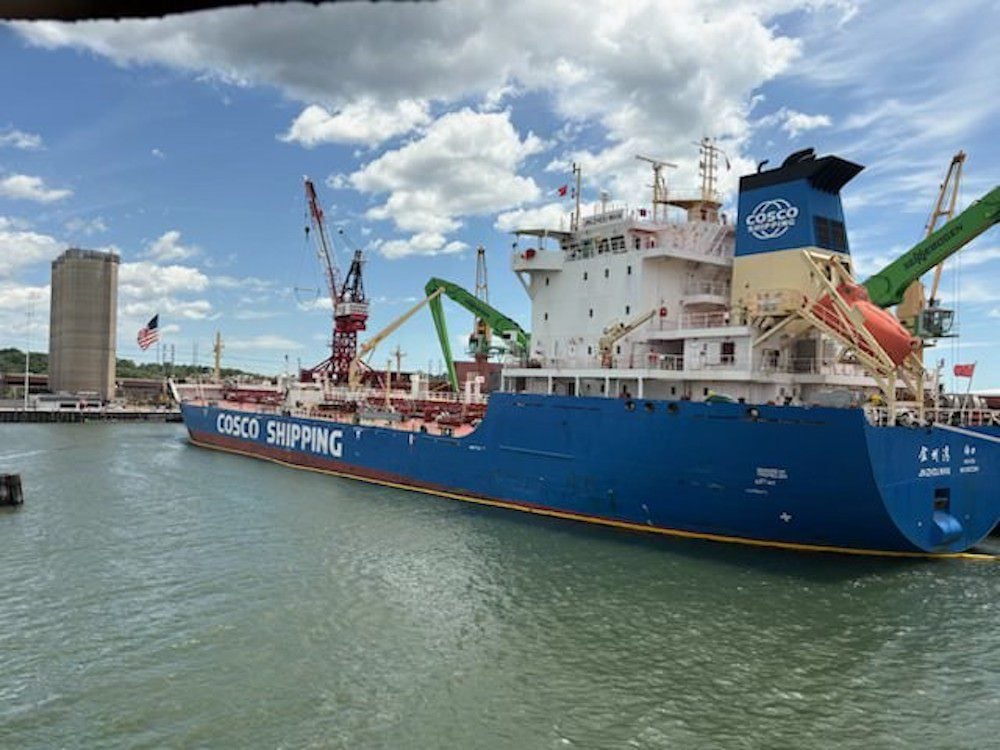
In a social media post Friday, AMP pointed to the Chinese-flagged asphalt tanker JIN ZHOU WAN (IMO 9802580), operated by COSCO Shipping Asphalt Hainan, which recently completed a voyage from New Orleans to New Haven. Vessel tracking data reviewed by gCaptain shows the ship departed New Orleans on May 21 and arrived in New Haven on May 28.
“A Department of War designated ‘Chinese Military Company’ just used the 501a national security Jones Act waiver to deliver asphalt to New Haven, CT,” AMP wrote, questioning how the shipment advanced immediate defense needs.
The voyage comes amid growing criticism of the Trump administration’s 150-day Jones Act waiver, which was initially enacted in March following the Strait of Hormuz crisis and later extended through mid-August. The waiver allows certain foreign-flagged vessels to transport cargo between U.S. ports that would normally be restricted to U.S.-built, U.S.-owned, U.S.-flagged, and U.S.-crewed vessels under the Jones Act.
According to international shipping databases, JIN ZHOU WAN is a 13,265-deadweight-ton asphalt/bitumen tanker built in 2017 and registered under the Chinese flag. The vessel is owned, managed, and operated by COSCO Shipping Asphalt Hainan, a subsidiary of state-owned China COSCO Shipping Corporation.
AMP has made opposition to the waiver a centerpiece of a new national advertising campaign launched this week. The group argues the exemption is costing American mariners jobs while delivering minimal economic benefits.
“Clearly, President Trump has been led to believe that waiving the Jones Act is an effective way to lower gas prices, when we all see that prices have not gone down with the waiver,” AMP President Jennifer Carpenter said in announcing the campaign. “What the waiver does is put America last by allowing foreign operators and mariners to take American business and jobs.”
AMP has sought to quantify the waiver’s impact through a public dashboard that argues the policy has delivered little measurable benefit to consumers. According to the group’s calculations, Jones Act waiver shipments have moved roughly 14.9 million barrels of fuel since March 17—equivalent to about 17.7 hours of total U.S.
The Pentagon maintains a list of companies it identifies as “Chinese military companies” operating in the United States. China COSCO Shipping Corporation has appeared on previous versions of that list, though the implications for its commercial shipping subsidiaries remain the subject of legal and political debate.
The Trump administration has defended the waiver as a temporary emergency measure designed to stabilize domestic energy supplies after disruptions to global oil and product flows caused by the Middle East conflict.
Industry analysis cited by gCaptain earlier this week found at least 60 waiver-approved voyages have moved crude oil and refined products between U.S. ports since March, with foreign-flagged tankers increasingly serving routes to California, the East Coast, Florida, and Puerto Rico.
Whether a cargo of asphalt moving from Louisiana to Connecticut qualifies as a national security necessity is likely to become a new flashpoint in the broader political battle over the future of the waiver—and the role foreign shipping companies are playing in America’s domestic maritime trade.

 Join The Club