By Laura Curtis
(Bloomberg) — A Southern California startup with plans to deploy floating nuclear power plants may be one step closer to providing electricity to the busiest seaport complex in the US.
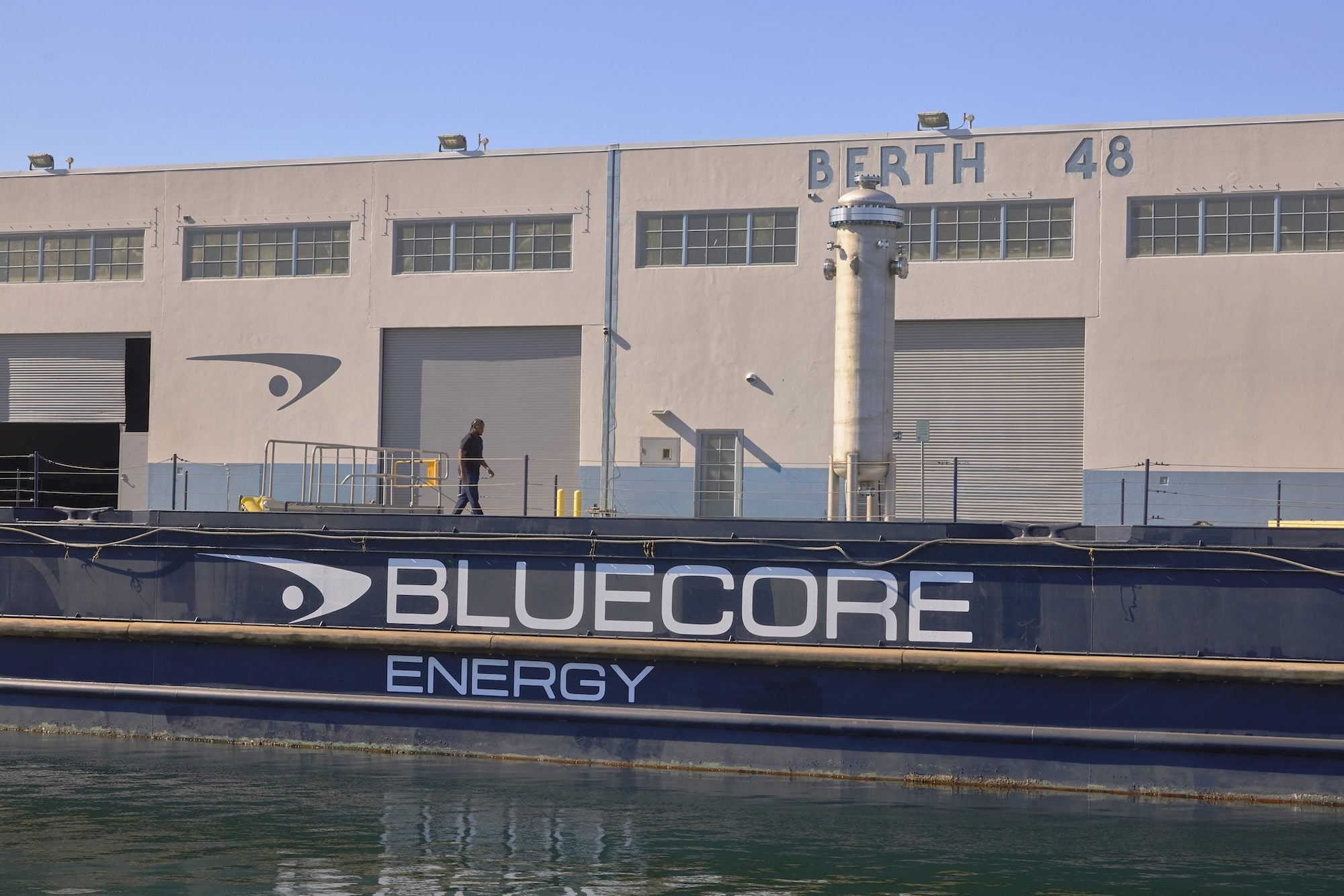
Though Bluecore Energy is still a few years away from a barge equipped with a small nuclear reactor serving the Port of Long Beach, its $50 million investment announced Tuesday is a milestone for the Long Beach-based company and its CEO Kofi Asante.
The funding round was led by Silverton Partners and will “support continued engineering and hardware development, testing and validation, regulatory and classification work, manufacturing, hiring and advancement of Bluecore Energy’s first system toward deployment,” the company said.
Bluecore is developing a water-cooled, small modular reactor on a barge, powered by commonly available low-enriched uranium fuel, Asante said in an interview ahead of the announcement.
“It’s out in the water, offshore, which means it’s miles away from any populated area,” he said. “Use a subsea cable, and you bring all the electricity back, just like offshore wind does.”
Despite mounting interest in nuclear power, the US has added very little new such capacity this century. There have only been a few traditional nuclear power plants to come online and no smaller reactors.
Data-Center Demand
Asante said he’s working with the US Nuclear Regulatory Commission and the Coast Guard to coordinate requirements that would be needed to deploy this type of marine technology.
The maneuverable power stations would be small, especially by traditional nuclear power plant or even container ship standards, and may eventually provide electricity not just the port, but to coastal communities, hospitals and other power-hungry users, according to Bluecore.
“We’re getting calls from data centers every week,” Asante said from Bluecore’s waterside offices in Long Beach.
Nationwide, demand from power-needy data centers, along with Trump administration’s turn away from renewable power sources like wind energy, have spurred a resurgence of interest in nuclear energy.
Efforts to electrify cargo handling equipment at the Long Beach port and the Port of Los Angeles — which together are by far the country’s busiest container hub — have been complicated by an already-strained electricity grid.
News of Bluecore’s involvement at with the Port of Long Beach came in July, with a memorandum of cooperation between the Department of Transportation and the port to test small modular reactors, or SMRs, for commercial vessels and other applications at the port.
Transportation Secretary Sean Duffy recently touted the promise not just of SMRs for power generation, but also nuclear-powered cargo ships.
Countering China
It’s one piece of the Trump administration’s Maritime Action Plan, intended to revitalize the US maritime industry and rein in China’s shipbuilding dominance.
“@USDOT is working to fast-track construction of a new fleet of vessels to change the game and DOMINATE China,” Duffy said in social media post Aug. 28.
UK-based Core Power and the DOT’s Maritime Administration announced a public-private partnership last month aimed at accelerating construction of a US-flagged fleet of fast, nuclear-powered merchant ships. Core Power is planning to begin construction on the nuclear-powered vessels in 2028.
In the meantime, South Carolina’s Port of Charleston and Port of Felixstowe, the UK’s largest container port, will work out the practicalities, with help from Lloyd’s Register and A.P. Moller-Maersk A/S, the world’s No. 2 container carrier.
The so-called Pink Corridor project will examine “operational, security and safeguarding requirements for a theoretical nuclear-powered container ship trading between the two ports,” according to a Sept. 2 press release.
© 2026 Bloomberg L.P.

 Join The Club