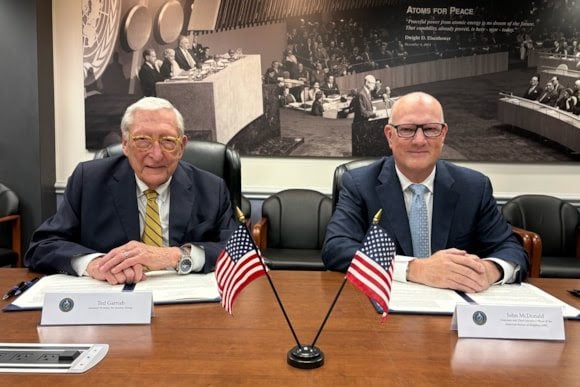
The American Bureau of Shipping (ABS) and the U.S. Department of Energy (DOE) have signed an agreement to advance the use of nuclear power in commercial shipping, including nuclear-powered vessels, floating power plants and the infrastructure needed to support them.
The memorandum of understanding, signed with DOE’s Office of Nuclear Energy, establishes a framework for joint work on advanced nuclear technologies and their potential maritime applications. The effort will also examine what would be required to develop a U.S. shipbuilding industry capable of constructing, operating and maintaining nuclear-powered vessels and offshore facilities.
Under the agreement, ABS and DOE will pursue concept and feasibility studies covering floating nuclear power systems and nuclear transportation corridors. The work will also address technical, regulatory, economic and policy challenges that have so far limited the commercial adoption of nuclear technology at sea.
“Advanced nuclear technology is moving from concept to application, and the maritime industry needs to be ready for it,” said ABS Chairman and CEO John McDonald.
“This agreement with DOE reflects the depth of work already underway and provides a framework to go further,” McDonald added.
ABS will also co-manage the Maritime Nuclear Applications Group (MNAG) and coordinate related work through the U.S. Maritime Administration’s U.S. Center for Maritime Innovation, where ABS serves as secretariat.
The agreement comes as interest in commercial maritime nuclear power continues to grow, driven by advances in smaller reactor designs that could make nuclear propulsion and floating power generation more practical.
While nuclear propulsion has been used aboard naval vessels for decades, its commercial adoption remains limited. Significant questions remain over reactor licensing, port access, liability, crew training and the regulatory responsibilities of flag and coastal states.
The U.S. government has stepped up efforts to address those barriers. In August, the Department of Energy hosted the launch of the International Atomic Energy Agency’s Atomic Technologies Licensed for Applications at Sea (ATLAS) initiative, aimed at developing an international framework for the safe and secure use of nuclear technology aboard ships and floating facilities.
ABS has also been expanding its work in the sector. The classification society has published rules for floating nuclear power plants and issued approvals in principle for several nuclear-powered vessel concepts, including a cargo ship propulsion system developed through an MIT-led maritime consortium.
Earlier this year, the U.S. Center for Maritime Innovation convened industry and government officials to examine regulatory barriers to deploying nuclear-powered ships and offshore energy platforms.
“Advanced nuclear technology has the potential to transform the commercial maritime industry and open new markets for American innovation,” said Assistant Secretary for Nuclear Energy Ted Garrish.
Garrish said the partnership would draw on decades of U.S. nuclear experience to examine how next-generation reactors could be safely introduced into commercial maritime operations.
The new agreement does not announce a specific vessel construction project or deployment schedule. Instead, it expands cooperation between the federal government and ABS as the industry works toward making commercial nuclear power at sea technically and economically viable.

 Join The Club