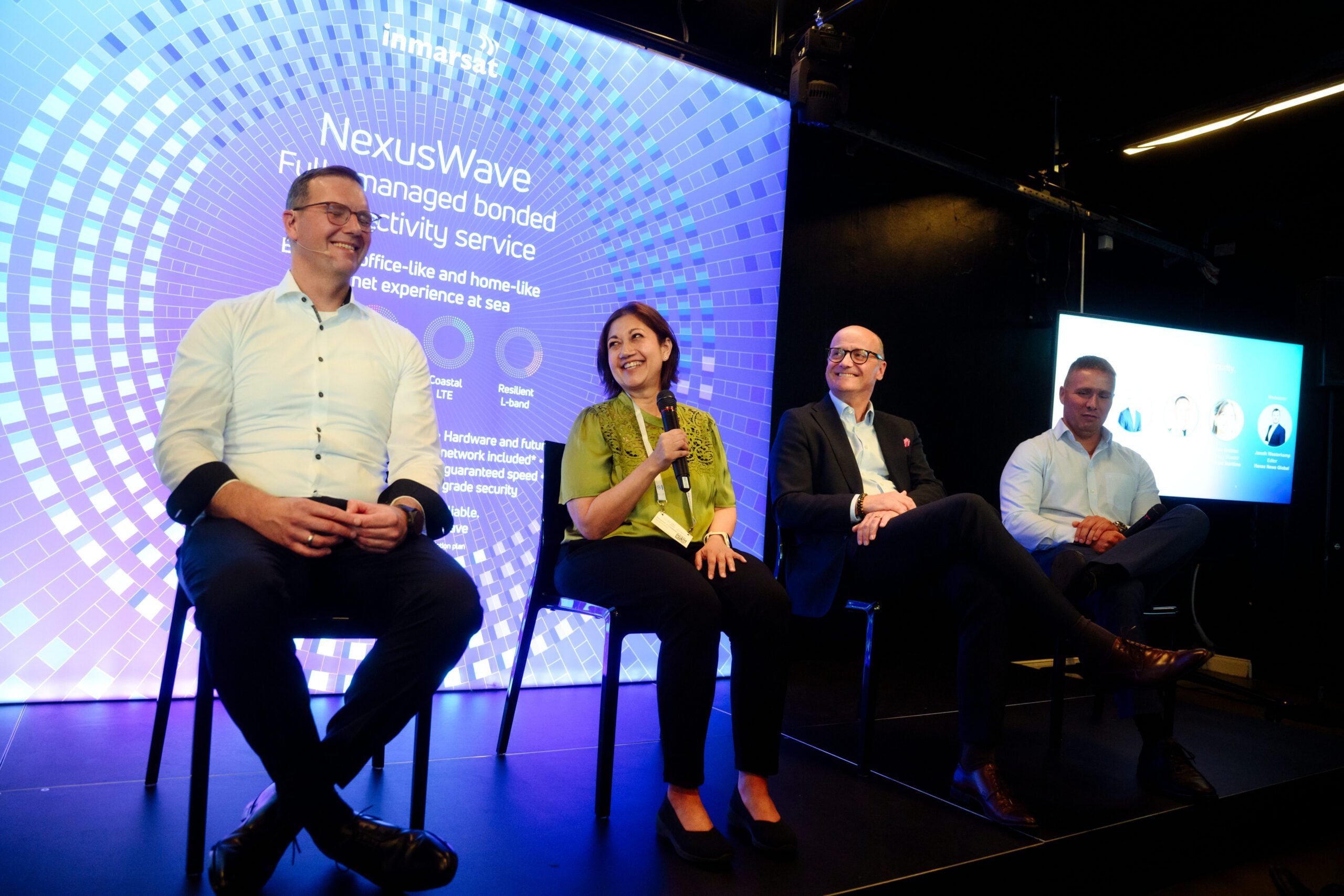
While the technology needed to digitalise maritime operations is already here, much remains to be done to ensure organisations and their people are equipped to use it effectively, according to panellists at a recent Inmarsat Maritime ‘Connected to Perform’ seminar.
The maritime sector is awash with digital technology and data – but gaps still need to be bridged before stakeholders can extract maximum value from the tools available. This was the consensus among a panel of industry experts at a recent Inmarsat Maritime ‘Connected to Perform’ seminar in Hamburg.
The panel discussion, held during SMM Hamburg, explored how shipping can enable a digital, secure, and human-centric fleet – and how modern connectivity can support this objective.
Asked to identify the most significant gap between “what connectivity and technology can provide and what is being used by shipping companies”, Audra Drablos, Strategy Director at Inmarsat Maritime, argued that technology itself is no longer the issue.
“We’re connecting global fleets,” she said. “We’re using advanced analytics. We’re using preventative maintenance. So the technology, I think, is definitely there.” Instead, she indicated, the gap may lie in how organisations are using those technologies: “If we want to digitalise things, we also have to transform all the decision processes that we have.”
Drablos’s co-panellists outlined how their companies are using modern technology to digitalise their operations.
Patrick Briest, Senior Director of Operations for IT Products at Hapag-Lloyd, pointed to the container carrier’s adoption of real-time cargo tracking and voyage optimisation to maximise speed and flexibility. Konstantin Pohsin, Fleet Captain at Fairplay Towage, described the way predictive maintenance preserved operational readiness. And Matthias Becker, Managing Director of Anglo-Eastern Germany, highlighted the ship manager’s use of artificial intelligence to manage vessel emissions.
While these organisations have already implemented modern technology on a fleet-wide scale, their representatives nevertheless echoed Drablos’s point, with each identifying areas where further work is underway to optimise digital- and data-driven processes.
For Anglo-Eastern, the focus is on integrating disparate systems. “We get a lot of data today, and that’s in isolated systems and products,” said Becker, who added that the company could “uncover more savings and make better decisions when [it connects] all the different systems”.
In comparable remarks, Briest said Hapag-Lloyd had established its Fleet Data Ecosystem to bring all its data together so that it can “look at it holistically, interconnect it, and then drive the right insights out of it”. Referring back to Drablos’s comments, he continued: “Even if you have the dashboard – the tool that tells you what you should be doing – you have to change the way the whole organisation works, that processes work, that people work, to actually make it happen.”
At Fairplay Towage, the emphasis is on training to address what Pohsin called a “gap in knowledge” regarding connected onboard systems. “We have to investigate what is the proper way for educating all our employees in the application of these facilities,” he commented.
In Becker’s view, however, the industry can only achieve so much through training alone; managing the “complex challenge” of digital transformation will also depend on interdepartmental and cross-industry collaboration.
“Seafarers will not become IT experts,” he said. “Technicians remain technicians, and we have to bridge the gap in some way. So we have to bring together the crew, the offshore personnel, and the data analytics and IT side. We also need cooperation between operators, owners, managers, OEMs, and providers of IT systems.”
Supporting crews with the tools to perform their roles effectively was a recurring theme throughout the session. The purpose of technologies like AI, the panellists suggested, is not to replace human expertise – “don’t stop thinking with your own brain” was Pohsin’s message to seafarers – but to relieve personnel of time-consuming data-analysis and compliance-related tasks.
“I think that’s where AI could really help,” Drablos commented, pointing to a recent Seafarers Happiness Index report that revealed the seafarers with the lowest happiness scores are those with the most responsibility. “It could help in prioritising all that data and helping [seafarers] make better decisions,” she said.
Building on Drablos’s remarks, Briest added that AI could allow crews to focus on running their vessels, while an increasing use of cloud-based AI applications could drive greater demand for connectivity. “I believe the general connectivity requirement for these more intelligent, AI-driven systems is probably going to get bigger,” he said.
As the maritime industry’s “general connectivity requirement” grows, so too does the need for robust cyber-security solutions. Yet, as Drablos noted, “the question isn’t really about connectivity versus security. The question is how you can build security as your basis when you’re implementing your connectivity. I think that’s the important part: making it secure by design.”
This is one of the pillars around which Inmarsat designed NexusWave. In a speech introducing the seminar, Gert-Jan Panken, General Manager and Vice President at Inmarsat Maritime, referenced recent cyber security type approval from ClassNK and Bureau Veritas for Inmarsat’s NexusWave fully managed, bonded multi-network connectivity solution, against the IACS’ Unified Requirement E27. “That shows from an independent source that the way NexusWave has been built is compliant and in line with the requirements our customers ask us for,” he said.
In line with the overarching theme of the panel discussion, Panken also contended that connectivity is becoming less about the connection itself and more about what it enables. “It’s not only about the fast internet connection,” he summarised. “It’s really about building that underlying infrastructure which actually helps us to drive business outcomes.”
Tags:

 Join The Club