Hapag-Lloyd, the world’s fifth-largest container carrier, operates 300 vessels on 133 liner services, transporting 13.5 million twenty-foot-equivalent units a year between 600 ports worldwide. Given the scale and complexity of these operations, every decision affects thousands of containers per vessel – with the consequences of any misstep felt throughout the supply chain.
The company’s proactive approach to fleetwide digitalisation has therefore been devised with one overarching objective in mind: to simplify its operations.
According to Patrick Briest, Hapag-Lloyd’s Senior Director of Operations and IT Products,digitalisation “can do many things”, but making things simpler – from both a commercial and operational perspective – is its one “superpower”.
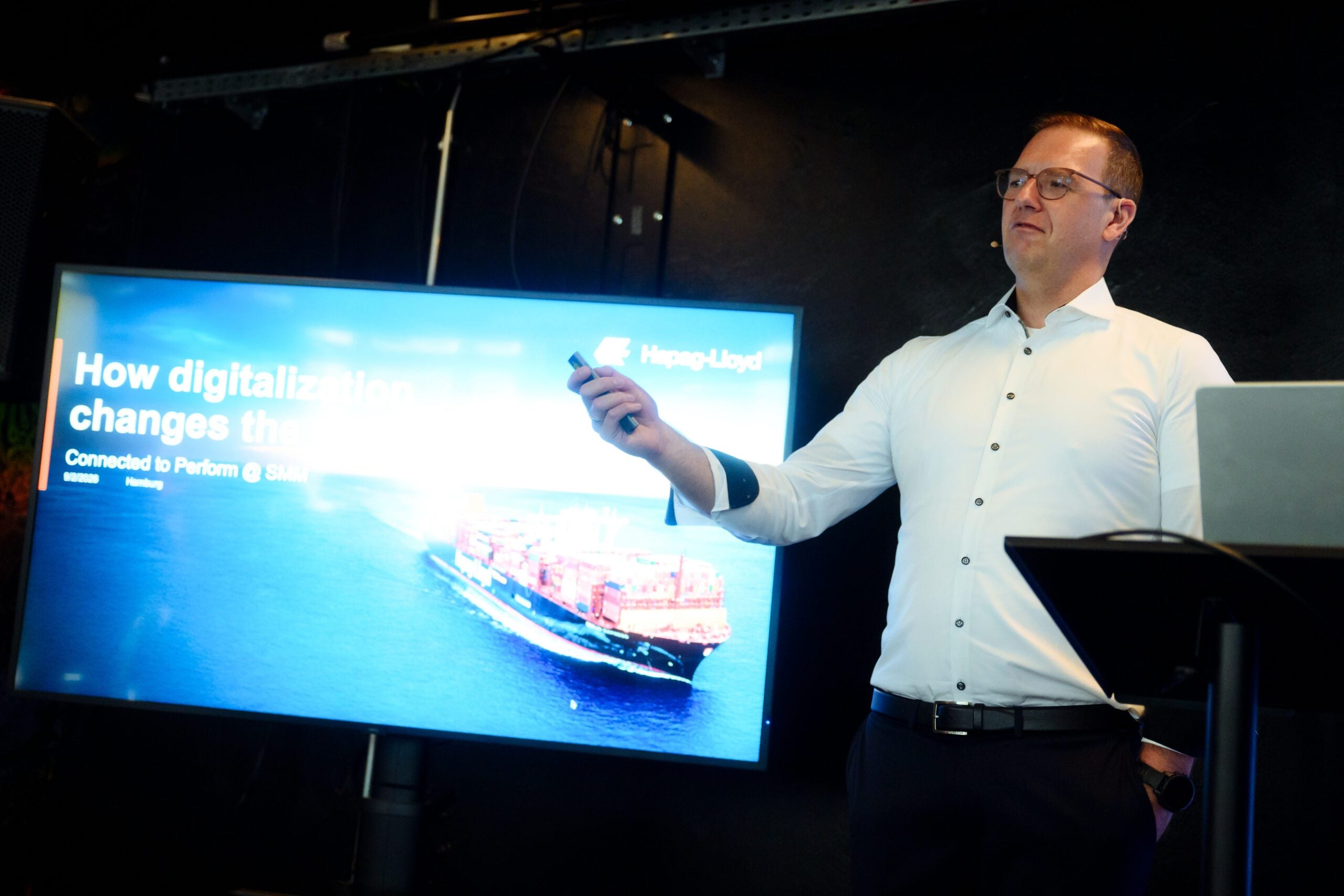
Digitalisation and the connectivity that supports it are increasingly judged by concrete commercial and operational outcomes. “We don’t digitalise just because we can,” Briest told the audience at a recent Inmarsat ‘Connected to Perform’ seminar during SMM 2026. “We digitalise because there’s a use case for it – because there’s value we can drive.”
For Hapag-Lloyd, tangible targets include maintaining schedule reliability above 90% across its network, reducing emissions per TEU by 30% by 2030, and approaching net-zero emissions by 2045 – all while cutting operating costs by approximately $100 per TEU.
Achieving these goals will require tapping into the “superpower” of digitalisation to facilitate faster and better-informed decisions, said Briest: “We want to enable ourselves, our people, to decide faster, decide better – because we’ve got the data and the tools to understand the impact of every one of the little operational decisions we make all the time.”
To illustrate the benefits of digitalisation and connectivity on Hapag-Lloyd’s operations, Briest presented a notional voyage involving a container ship transporting perishable goods from the west coast of South America to Northern Europe.
If a crane were to fail during the vessel’s final port call in South America, he said, the consequentdelays might result in the ship missing its slot to cross the Panama Canal. However, by retrieving operational data from the vessel’s digital cargo logbook, Hapag-Lloyd would know by exactly how long to extend its port call to maximise cargo intake without sacrificing its slot.
Later, if the vessel were to encounter extreme weather in the Atlantic Ocean, the operator would combine specific vessel data points with shore-based analysis to evaluate routing, speed, fuel consumption, and port arrival options. In this way, Briest explained, Hapag-Lloyd could keep commercial and environmental impacts to a minimum without compromising voyage safety.
Digitalisation and connectivity, then, enable shipping companies like Hapag-Lloyd to make smarter operational decisions based on a richer and more immediate view of what is happening on the vessel and across the network. As Briest demonstrated in the second scenario, they also help close the gap between ship and shore.
In another example, IT support teams can now connect directly with the vessel, remotely accessing even the engine room to help resolve technical issues efficiently. Whereas ships previously operated as isolated assets, they increasingly function as an extension of head office, with seafarers and shorestaff working as one team, and the Atlantic Ocean – in Briest’s words – becoming “as connected as downtown Frankfurt”.
Digitalisation is connecting vessels not only to their operator’s headquarters but also with the clientswhose goods they transport.
In a further operational scenario from the notional voyage, Briest explained that the Hapag-Lloyd LIVE tool allows customers to monitor refrigerated cargo and respond when circumstances change. If the vessel is delayed, temperature settings can be adjusted remotely to help ensure the cargo reaches its destination in optimal condition. “By being more digital, we want to be as easy to do business with for our customers as we possibly can be,” he commented.
Recognising that increased connectivity also has its challenges, Hapag-Lloyd’s digitalisation strategy emphasises cybersecurity and seafarer autonomy to maintain operational resilience.
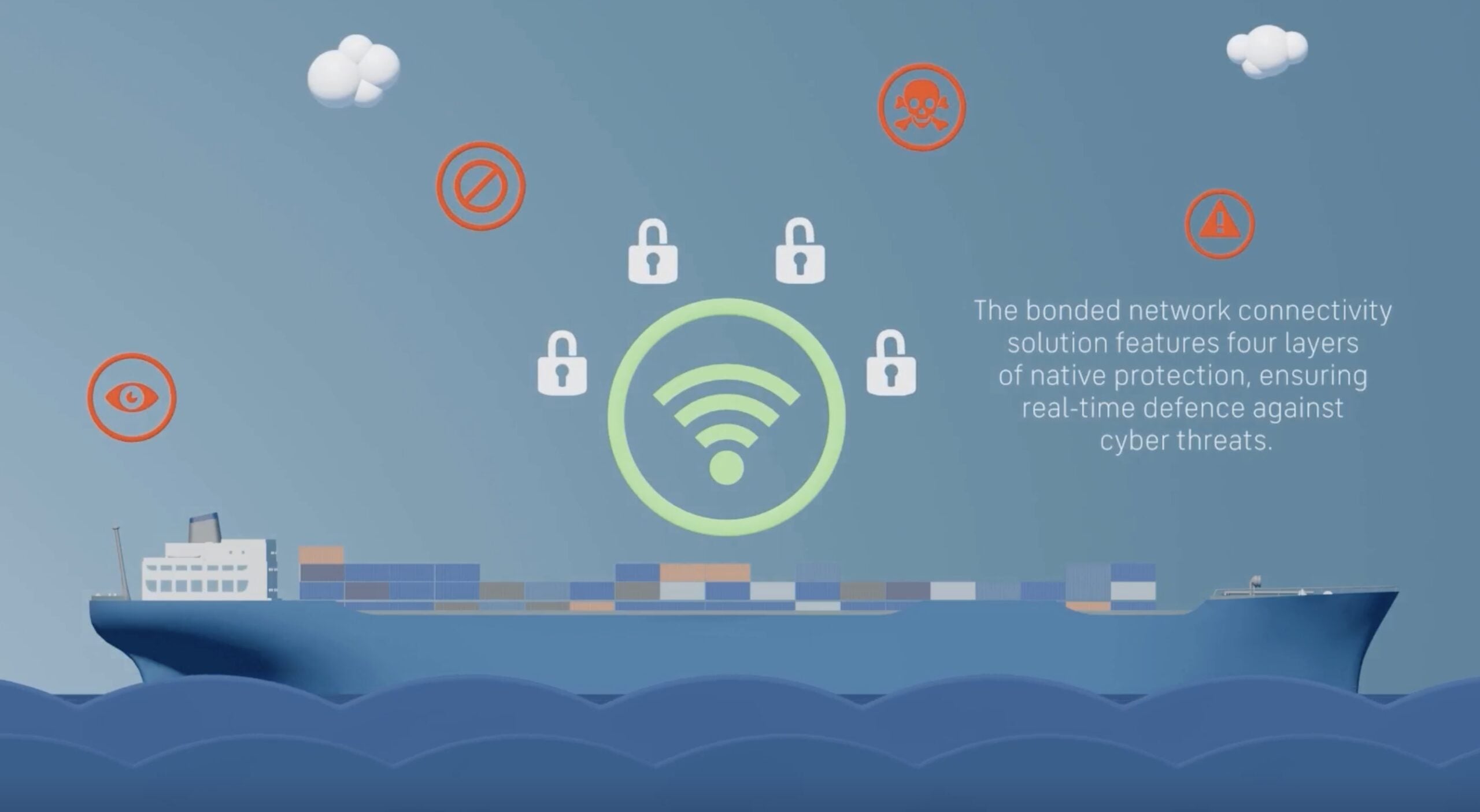
“As we connect more systems on the vessel, we’re of course creating a substantially bigger attack surface,” Briest acknowledged, adding that the company is “pushing between 100 and 200 patches to every vessel every week” to address this issue. Cybersecurity, he said, “cannot be an afterthought anymore” – instead, it should be “secure by design and [built] from the ground up”.
At the same time, Hapag-Lloyd is taking care to ensure digitalisation strengthens rather than weakens the judgement, resilience, and practical competency of its seafarers. “Digitalisation can help a lot, but there’s an inherent [seafaring] culture, capability and skillset that we also need to preserve,” said Briest.
These considerations become increasingly important as Hapag-Lloyd’s digitalisation strategy progresses. As more decisions, systems, applications, and interactions come to depend on the ship–shore connection, and the vessel is further integrated into the broader digital operating environment, connectivity itself becomes strategic infrastructure.
Inmarsat Maritime’s NexusWave is a key enabler of Hapag-Lloyd’s digitalisation strategy. The fully managed, bonded multi-network connectivity solution delivers the consistent high speeds, global reliability, and secure-by-design infrastructure the company needs to continue its transformation and pursue its operational ambitions with confidence.
Digitalisation, Briest summarised, is helping Hapag-Lloyd to manage its workload, make better decisions, and work more effectively as a team – both onboard the vessel and between ship and shore. While he stressed that connectivity needs to be managed responsibly to preserve cybersecurity and crew autonomy, he was in no doubt about the direction of travel: “The future of shipping is connected,” he concluded.

 Join The Club