At SNA, the CNO Talked Ships, Lasers — and Finally Answered the Merchant Marine Question
By John Konrad (gCaptain)
WASHINGTON, D.C. — The Surface Navy Association conference is usually where the U.S. Navy talks to itself: destroyers, readiness charts, acquisition slides, and a lot of reassurance that everything is hard but under control. This is a conference for surface ship warriors, but increasingly their job is becoming difficult because of a lack of investment in auxiliary ships and a critical shortage of U.S. merchant mariners to man them.
This year, gCaptain was invited to the closed-door media breakfast with members of the old Pentagon Press Corps to meet with the Chief of Naval Operations, Admiral Daryl Caudle.
Yes, there was talk of shipbuilding, foreign yards, lasers, readiness, and budgets. But for the first time in a long while, the Navy’s top officer directly engaged — on the record — with the question the maritime industry has been asking for decades:
Who protects the ships that make naval power possible? And why are the people who crew them still treated like an afterthought? Is the Jones Act safe, or is the Navy pushing for changes to the hundred-year-old law?
Foreign Shipyards and a Quiet Re-Examination of the Jones Act
The morning opened with questions from Sam LaGrone of USNI News about shipbuilding capacity and the possibility of using foreign yards as a stopgap. Caudle did not hedge.
He said bluntly that the United States cannot simply “push a button” and produce ships at scale, and that increasing capacity takes years, not budget cycles. In that context, he described foreign shipyards not as a replacement for U.S. industry, but as a “bridging strategy” while American capacity is rebuilt.
More striking was his willingness to question long-standing assumptions behind U.S. maritime law.
Caudle said legislation like the Jones Act was passed for specific reasons, at a specific time, and under specific assumptions he suggested may no longer fully apply given today’s threat environment and industrial base realities. He said those assumptions deserve a fresh look.
He further said the Navy is looking at buying Military Sealift Command (MSC) auxiliary and logistics ships straight from overseas, adding that the Navy is even exploring importing sections of warships from allies like South Korea.
That is not language you typically hear from a sitting CNO, who have historically tip-toed around the topic of the Jones Act and the slow, painful drawdown of specialty MSC ships like salvage ships, submarine tenders, fireboats, floating drydocks, and command ships.
Golden Fleet: Not an “Or,” but Only If the Navy Changes How It Builds
On the administration’s “Golden Fleet” vision, Caudle pushed back on the idea that it is merely aspirational. But he was equally clear that it cannot be achieved using the Navy’s existing business model.
The core problem, he argued, is not just funding — it is process.
He pointed to modular construction as the clearest path forward, citing submarine modules already being built in Gulf Coast yards and shipped north for final assembly. In his view, shipyards must evolve from bespoke, end-to-end builders into networked production nodes that share workload.
Without that shift, he warned, Golden Fleet becomes a slogan rather than a fleet.
“We are not replacing the current Navy with the Golden Fleet,” he said in his keynote address to SNA later in the day. “The Golden Fleet is an “and” initiative, not an “or” wish list.”
Carrier Extensions: “I’m a Big Non-Fan”
When asked about extending aircraft carrier deployments — specifically whether USS Gerald R. Ford could be sent back toward the Middle East — Caudle delivered one of the most candid answers of the morning.
“I am a big non-fan of extensions,” he said.
His reasons were not rhetorical. He walked through the cascading damage: disrupted families, broken maintenance schedules, blown-up shipyard contracts, budget chaos, and degraded readiness when ships are run harder and longer than planned.
He emphasized that extensions hurt sailors first, but they also undermine the very readiness the Navy claims to protect.
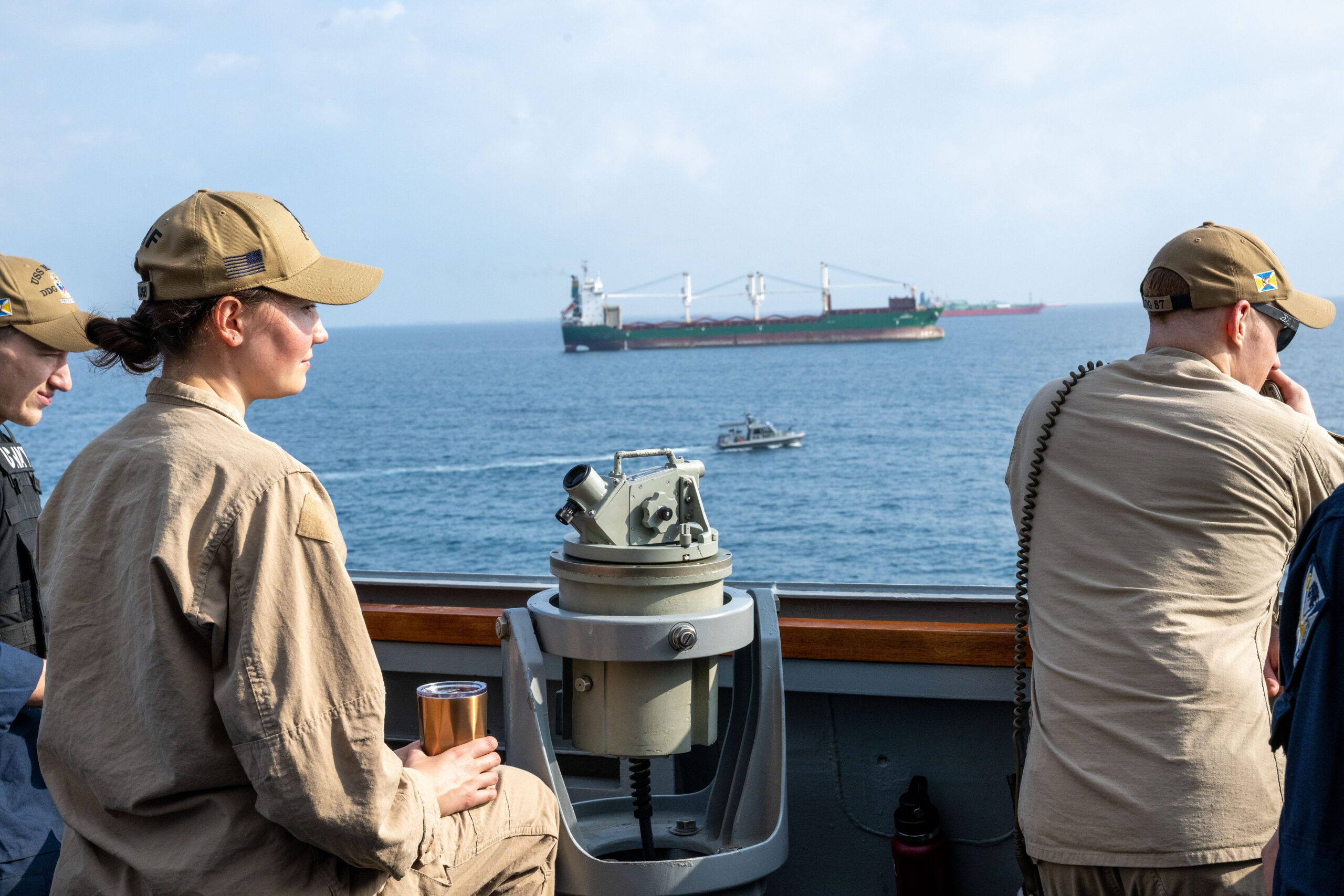
The question was about warships, but Caudle also addressed the challenges U.S. merchant mariners face finding relief crews aboard MSC ships. He noted it is especially hard to retain senior ship officers with families who can earn more money working far from bullets and missile attacks in places like the Red Sea.
He discussed the quality of life aboard cruise ships and said he has instructed the Supply Corps to learn from mega-cruise ships, the largest of which carry nearly twice as many people — passengers and crew — as an aircraft carrier.
My Question: Recognition and Protection of the Merchant Marine
When it was my turn, I introduced myself plainly: a U.S. Merchant Marine captain first, a reporter second.
I laid out what gCaptain readers already know.
Military Sealift Command operates the largest fleet under Navy control, yet it is routinely sidelined — organizationally, rhetorically, and culturally. Merchant mariners sail into combat zones aboard oilers and logistics ships, yet are still labeled “civilian mariners,” which causes cultural division rather than using our proper title, “Merchant Mariners.”
I noted that a significant percentage of the Navy workforce — from ordinary seamen working on MSC oilers to naval architects working on the latest battleship designs — are Merchant Mariners, but our contribution has been omitted from speeches and inconsistently recognized for combat service.
Then I asked the harder question.
Logistics ships will be targeted in the next war. Today, many have limited defensive capability, minimal port protection, and little organic salvage or fireboat support if attacked. So how does the Navy plan to protect them when the shooting starts? Senior officers may be willing to take extreme risks — as they did last year replenishing carriers in the Red Sea — but against a stronger navy like China’s, a simple resupply run could become a suicide mission. How many fathers and husbands will sign up for that duty during wartime?
Caudle’s Answer: “We Don’t Highlight This Enough”
To his credit, Caudle did not deflect.
He acknowledged that the Navy does a poor job messaging the importance of its logistics fleet and the Merchant Marine. He instinctively called us “Civilian Mariners” in his answer but quickly corrected himself.
The admiral conceded that many outside, and even inside, the service do not fully understand how critical the Merchant Marine is to the Navy’s core functions.
He spoke openly about the shortage of licensed mariners — masters, chief mates, and chief engineers — and admitted that competition from commercial shipping makes retention increasingly difficult. He even said, candidly, that when he looks at commercial pay and working conditions, he is “surprised” MSC retains as many mariners as it does.
Then came the most significant admission of the morning.
Caudle said he believes it was a mistake to reduce Military Sealift Command, which is the largest fleet in the Navy, to a two-star command and that he is actively working to fix it.
He described MSC as simultaneously a type commander, systems command, and operational commander for the Navy’s largest fleet, and said that level of responsibility demands commensurate rank and authority. He said he intends to brief the Secretary of the Navy on corrective options.
For the Merchant Marine, that was not a throwaway line. It was a structural acknowledgment long overdue.
He said — and I agree — that MSC has been commanded by excellent admirals (Mark Buzby and Phil Sobeck, for example), and that the current commanding officer, Ben Nicholson, a graduate of the U.S. Merchant Marine Academy, is solid. The problem is not the quality of MSC’s uniformed leaders; it is the weight additional stars could give a command that desperately needs more attention in the Pentagon and Congress.
Protection: Not Just Guns, but Targeting
On ship defense, Caudle acknowledged that logistics vessels carry small arms and embarked security teams and that more protective measures can be dispatched depending on need, but said protection must be viewed more holistically.
The real fight, he argued, is against the adversary’s targeting complex — deception, obfuscation, maneuver, and information control — rather than simply adding more steel and guns to hulls that can still be found and fixed.
That answer will not satisfy everyone, but it does clarify the Navy’s thinking: logistics ships are being folded into the same counter-targeting framework as combatants, whether or not that framework has yet been proven at scale.
He also noted that upgrading outdated communications equipment to modern, secure command-and-control systems is a priority. MSC ships must understand the battlespace and communicate effectively with warships — even when the enemy attempts electronic countermeasures. He added that blinding the enemy and preventing them from firing on logistics ships is a top priority he cannot discuss in an unclassified setting.
Caudle did not address the fireboats, salvage ships, and support crews that will be needed if ships are damaged in war.
Lasers, Battleships, and Payload Reality
Later in the session, Caudle was asked about directed energy and the Navy’s apparent embrace of laser-armed surface combatants — including future “battleship” concepts.
His response was unequivocal: laser power is not the problem; engineering, integration, and maritime targeting are.
He said megawatt-class lasers are well within reach and argued that directed energy must become the default for point defense because it frees payload space for offensive weapons. In his words, payload volume is everything — and lasers change the math.
He said some of these systems might be installed in auxiliary ships in the future.
After his speech, he was asked, given the electric demands, why the battleships are not nuclear powered. He said they did explore that option, but it would have delayed delivery of the first-in-class ships.
In a recent trip with the Secretary of Defense, a senior Pentagon official told me on background that while the first two ships in the Trump class will be gas turbines with diesel auxiliary engines, nuclear options are being explored for subsequent vessels. Caudle was not asked and did not comment on this.
The Bigger Budget — and the Bigger Problem
He was asked about President Trump’s comment that defense spending will be raised by almost 50% to $1.5 trillion a year and how much of that new money will go to the Navy.
On funding, Caudle argued for locking in a new normal above 4% of GDP, warning that every post-war “peace dividend” has historically ended the same way: with surprise conflict and unready forces.
He was unapologetic about the cost, calling defense spending an investment in industrial jobs, national security, and long-term prosperity.
But even he acknowledged the tension: readiness requirements are stacking on top of shipbuilding bills, with nothing dropping off the list.
What This Breakfast Actually Revealed
The Surface Navy Association breakfast with the Navy’s top admiral did not produce a single headline-ready announcement. What it produced was something rarer: clarity.
The CNO publicly acknowledged that:
- The Navy cannot surge what it cannot build.
- It cannot build faster without changing how it builds.
- It cannot fight without logistics.
- It must do a better job respecting the efforts of Merchant Mariners.
- And it has undervalued the people who provide them.
Those are not small admissions.
The next war will not be won by destroyers alone. It will be won — or lost — by fuel, ammunition, spare parts, ports, salvage, and the merchant mariners who deliver all of it under fire.
For the first time in a long time, the Navy’s top officer seemed willing to say that out loud.
Now the question is whether the institution will follow where his words just went.
And if there was one headline from the entire event, it was Admiral Caudle saying publicly to the audience, “Battleships are badass,” and admitting privately to me that Merchant Mariners are badass too.
Editorial Standards · Corrections · About gCaptain

 Join The Club