By Renju Jose and Helen Clark
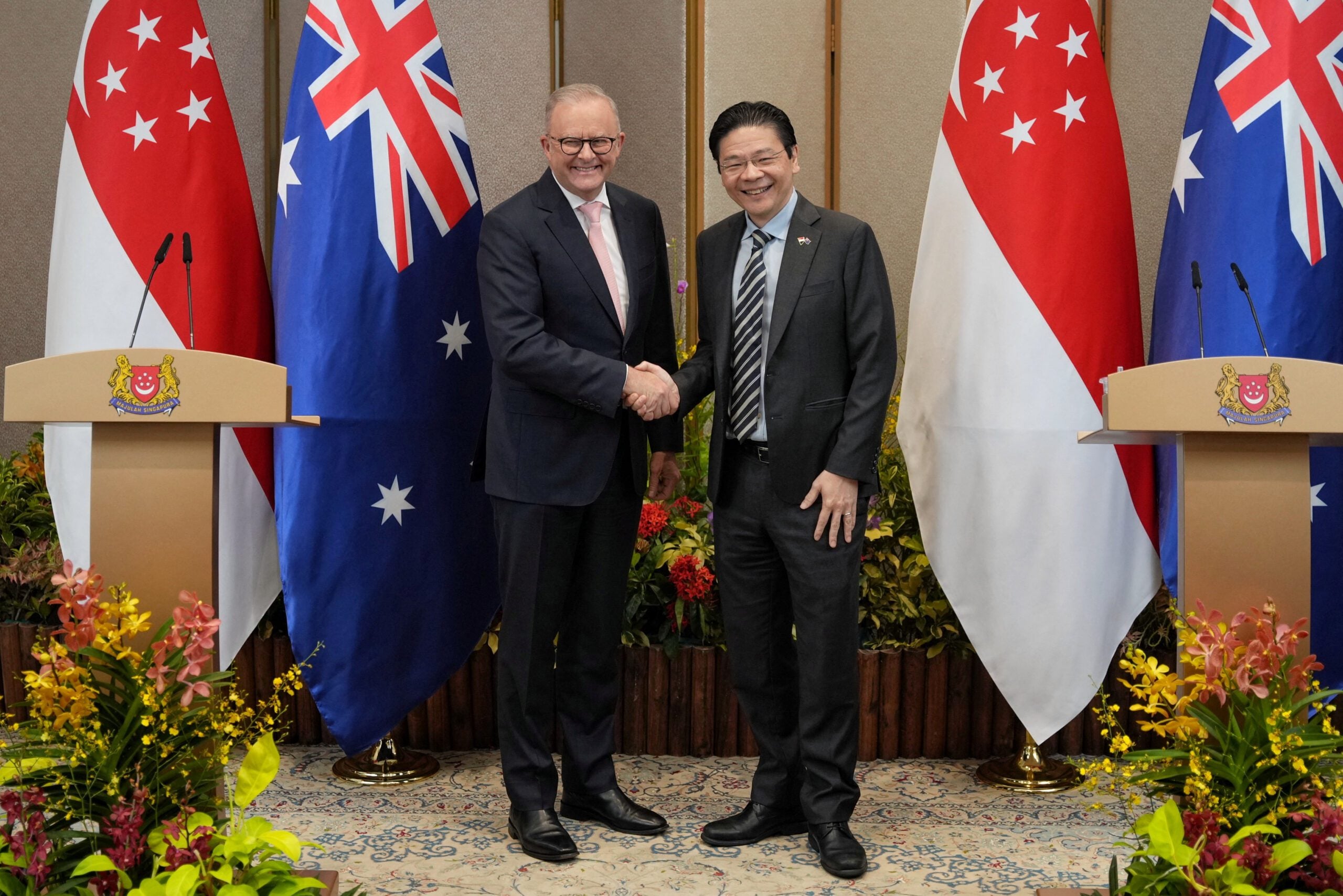
SYDNEY/PERTH, April 10 (Reuters) – Australian Prime Minister Anthony Albanese will meet his counterpart Lawrence Wong in Singapore on Friday as Canberra looks to secure fuel supplies from regional allies amid disruptions due to the Middle East conflict.
Singapore, Asia’s oil trading hub, is Australia’s largest supplier of petrol and a major supplier of its diesel and jet fuel.
“This is an important relationship at a time when fuel security is on the agenda, right around the globe due to the conflict in the Middle East,” Albanese told reporters in Singapore after his arrival late on Thursday.
Tight domestic diesel supplies due to limited stockpiles and far-flung distribution networks are rattling Australia’s farming and mining sectors, the main users of the transport fuel. Panic buying also left several petrol stations dry across the vast country.
Albanese said Australia supplies about one-third of Singapore’s liquefied natural gas imports, while getting about 26% of its refined fuel from the city-state.
“Australia and Singapore are strategically aligned. We share values and we share a relationship of trust between each other. And that is why it’s so important that at difficult times in the world we can rely upon each other,” Albanese said.
Australia is one of a number of Asian countries concerned about fuel supplies after Iran closed the Strait of Hormuz, where about a fifth of the world’s oil had transited before its war with the U.S. and Israel.
Ship traffic along the Strait remains at a near standstill despite a fragile peace deal between the U.S. and Iran.
Australia uses roughly 1 million barrels of oil per day and last year imported 84% of its petroleum product demand. The country has two refineries, down from eight in 2005.
Singapore is a major refining center in Asia and has three refineries with a combined capacity of about 1.2 million barrels per day, although refineries have cut output after their crude supply was disrupted by Iran’s closure of the Strait of Hormuz.
Statistics released by road insurer NRMA in late March found Singapore accounted for 54.7% of Australia’s petrol imports or close to 6 billion liters. South Korea was second at 22.5% and India third at 11.5% or 1.25 billion liters.
Albanese and Foreign Minister Penny Wong have been in discussions with their Asian counterparts about fuel supplies since early March.
The Australian government has said it has held talks with Japan, South Korea, Indonesia, Malaysia, Brunei, China and others.
(Reporting by Renju Jose in Sydney and Helen Clark in Perth; Additional reporting by Xinghui Kok in Singapore; Writing by Praveen Menon; Editing by Jamie Freed)
(c) Copyright Thomson Reuters 2026.

 Join The Club