Dockworkers across 113 ports in 22 countries staged coordinated strikes and protests Friday, disrupting cargo operations and ferry services as part of a global campaign opposing arms shipments to Israel and the use of commercial ports for military logistics.
The October 30 action, organized under the banner “Dockworkers Don’t Work for War,” involves more than 25 unions across five continents, with 24-hour strikes, shorter work stoppages and demonstrations at ports throughout Europe, the Mediterranean and beyond.
Organizers describe the mobilization as the largest coordinated port action of its kind, estimating that approximately 52,000 containers carrying $2.8 billion worth of cargo could be delayed. The group puts the direct economic cost at $57 million, although those figures have not been independently verified.
The largest disruptions are concentrated in France, Italy, Greece and Türkiye, where unions called 24-hour strikes. Additional work stoppages and demonstrations are taking place in Morocco, Cyprus and other countries, while Italy is also holding a general strike.
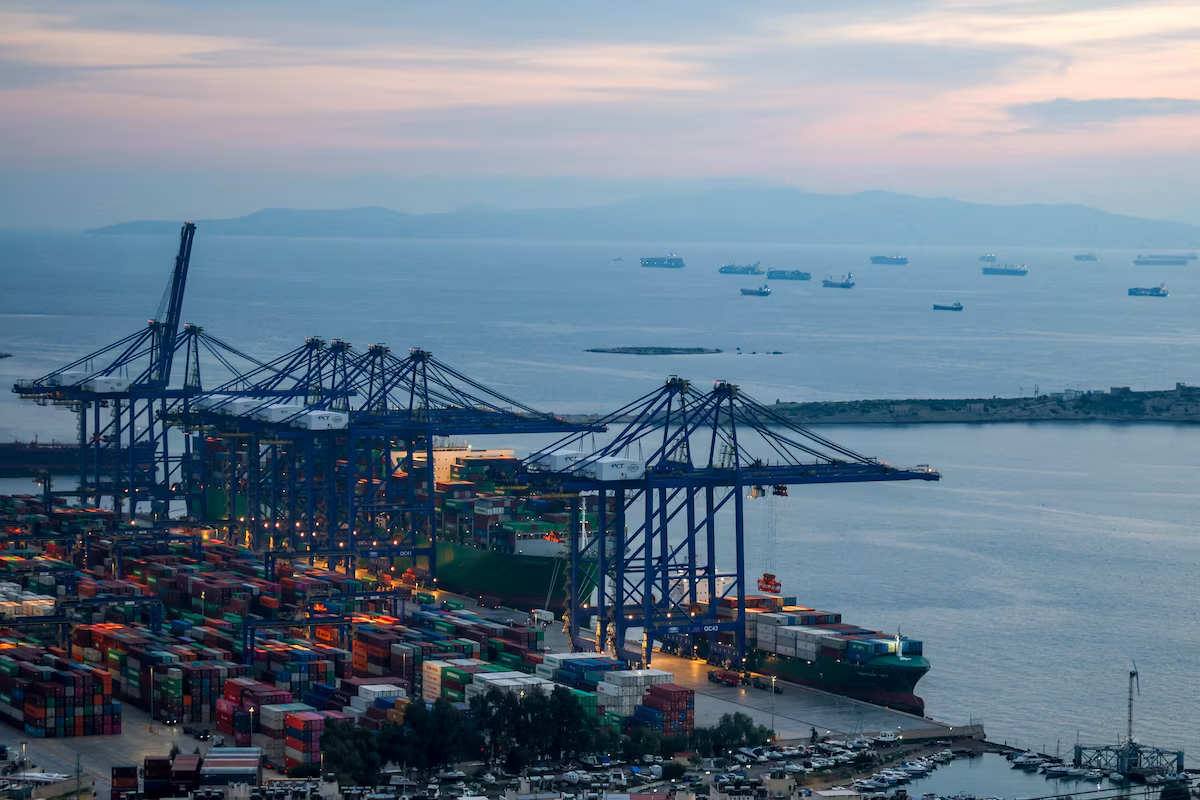
In Greece, approximately 3,000 workers joined a walkout at the Port of Piraeus, disrupting cargo operations and ferry services, according to Reuters.
The movement has also expanded beyond its traditional European and Mediterranean base, with actions in India, Australia, Brazil, Mexico, Uruguay and the United States.
On the U.S. West Coast, International Longshore and Warehouse Union (ILWU) Local 10 is participating in actions in Oakland and San Francisco. Other participating unions include Germany’s ver.di, Sweden’s Svenska Hamnarbetarförbundet, Denmark’s 3F and the Maritime Union of Australia.
Organizers have published an interactive map and list of participating ports, including major shipping hubs such as Valencia, Algeciras, Barcelona, Hamburg, Piraeus, Genoa and Tangier Med.
Participation varies by location, ranging from full-day strikes to brief stoppages and solidarity demonstrations outside port gates. Not all participating ports are experiencing cargo disruptions.
The campaign follows an earlier international day of action on February 6 involving 20 ports in seven countries, marking a significant expansion of coordinated labor opposition to the movement of military cargo through commercial shipping networks.
ITF Backs Dockworkers’ Action
The International Transport Workers’ Federation (ITF) has thrown its support behind the campaign, calling on governments and employers to respect workers’ rights to refuse military cargo without retaliation.
“Governments must stop the flow of arms used to violate international humanitarian law,” said ITF General Secretary Stephen Cotton. “Governments and employers must respect the voice and rights of these workers.”
The ITF said the protests are intended to challenge the movement of military equipment through civilian ports while also drawing attention to workers’ demands for better wages, improved working conditions and protections against increasing automation.
ITF President Paddy Crumlin criticized governments for increasing military spending while workers face growing economic pressure.
“Governments find billions for weapons while telling working people to accept insecure jobs, squeezed wages and increasing automation – dockers have every right to challenge this anti-worker agenda,” Crumlin said.
The federation’s support builds on resolutions adopted at its 2024 Congress in Marrakech, where affiliated unions committed to calling for a permanent ceasefire in Gaza and measures to stop arms transfers contributing to violations of international humanitarian law.
The campaign’s demands were further formalized in the Istanbul Declaration in May 2026, when unions representing more than 35 ports agreed to oppose the movement of weapons, ammunition, military equipment and troops through civilian port facilities.
Military Cargo in the Spotlight
The protests are being supported by No Harbour for Genocide, an activist research organization that tracks military supply chains moving through commercial ports.
According to the group, its research identified 315 shipments of components for Israeli defense manufacturer Elbit Systems passing through 56 commercial ports in 29 countries between August 2025 and September 2026.
The organization also says it tracked approximately 3,400 shipments supplying U.S. military bases through 67 ports in 42 countries between December 2025 and September 2026.
Organizers argue that coordinated action across multiple ports makes it more difficult for shipping companies to avoid disruptions by rerouting military cargo through alternative terminals.
Previous dockworker actions have targeted individual shipments in Greece, France, Italy and Morocco, including efforts to block weapons and military components destined for Israel.
The latest campaign seeks to expand those actions into a broader international movement opposing what participating unions describe as the militarization of civilian port infrastructure.
Maritime Workers Raise Concerns Over War-Zone Safety
The protests also come amid growing concerns about the safety of commercial seafarers operating in conflict zones.
At Piraeus, Greek maritime unions linked the action to mounting casualties among merchant mariners in the Persian Gulf and Black Sea, where commercial vessels have faced missile, drone and other attacks.
“We will not work for their wars, and we will not become food for their cannons,” Apostolos Kypraios, head of the Greek union of merchant marine engineers, told Reuters during Friday’s demonstration.
Greek unions cited 28 attacks on vessels in the Gulf during the first 21 days of October and 570 confirmed attacks in the Black Sea this year, which they said have killed 40 seafarers.
Indian union representatives also raised concerns about casualties during the Iran war, saying approximately 15 Indian seafarers have died and others remain stranded by disruptions to maritime trade.
Participating workers are demanding stronger safety protections, including access to medical personnel aboard vessels transiting war zones.
The labor action comes as the shipping industry continues to grapple with attacks on vessels around the Strait of Hormuz, growing insecurity in the Black Sea and wider geopolitical disruptions affecting major trade routes.
Impact on Global Trade Uncertain
Despite the scale of the mobilization, the actual impact on global shipping remains difficult to assess.
Organizers say the participating ports collectively handle approximately 13.5% of global shipping activity and 63% of Mediterranean container activity. Those figures, however, reflect the ports’ overall share of trade rather than the volume of cargo directly affected by Friday’s actions.
The estimated $2.8 billion in delayed cargo also represents goods potentially held up by the stoppages, rather than cargo lost or permanently removed from trade.
For the participating unions, the objective extends beyond Friday’s operational disruptions.
Organizers say further coordinated actions are planned as the international dockworkers’ movement continues to expand.

 Join The Club