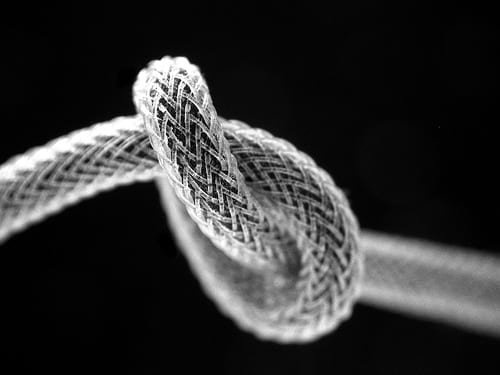
Photo by AMagill
We all know the basics of knots. They rely on friction to cinch against themselves or an object, they reduce the breaking strength of a line and a good one is easy to remove but what about randomly created knots? Doug Smith, a physics professor at the University of California set to find out. The New York Times tells us:
 Working with his research assistant Dorian Raymer, he took some string — about the thickness of a computer-mouse cord — and dropped it into a small square plastic box. They spun the box around for 10 seconds, then opened it up. Sure enough, they found “this really monster, complex knot,” Smith says. Then they repeated the experiment a dizzying 3,415 more times, using strings of different lengths and boxes of larger sizes, to see whether there were any rules that governed how badly the string knotted.In the end, one law emerged: The longer the string, the more likely it is to form a knot. String that was 1.5 feet or shorter never got tangled up. But “as the string gets longer, the probability of a knot forming goes up and up,” Smith says, at least to 18 feet. Flexibility matters, too. The more pliable the string, the more likely it is to knot spontaneously.
Trying to figure out how to tie a knot? Try Grog’s Animated Knots.
Updated: February 5, 2026 (Originally published October 23, 2008)
Editorial Standards · Corrections · About gCaptain

 Join The Club