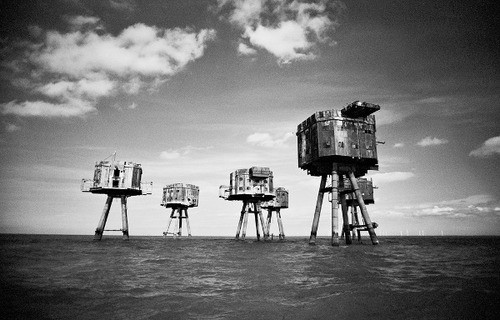
An armada of sea forts were built during World War II specifically designed to repel smaller aircraft flying in to attack Great Britain. Each fort consisted of a cluster of smaller units arrayed in a group. Each group had one spotlight tower and the rest of the units had guns mounted all around to give maximum coverage. Each fort was connected by bridges to the others in the cluster but was also structurally autonomous – presumably in case one was to be successfully targeted and destroyed. Since being decommissioned in the 1950’s, a number of these forts have been used for pirate radio broadcasting stations, while others been converted into a luxury resorts.
Converted Sea Fortress
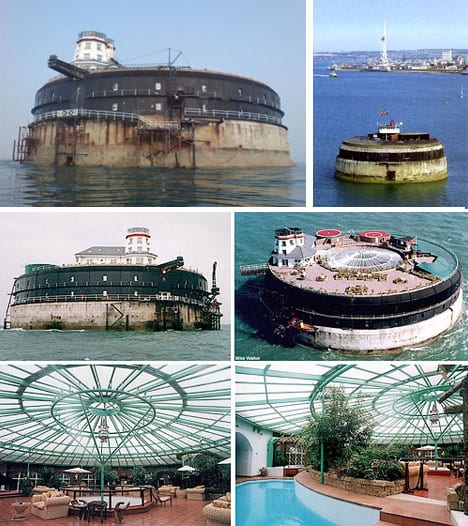
Horse Sands, Spitbank, St. Helens and No Man’s Land Forts were created in the mid-1800s as defensive sea forts around Portsmouth. Some are now abandoned or under private ownership but No Man’s Land Fort has actually been converted into a luxury resort and Spitbank has been transformed into a museum, hotel and events space. St. Helen’s Fort can actually be reached on foot during low tides at certain times of year. At one point, a failed businessman barricaded himself in No Man’s Land Fort to escape his creditors.
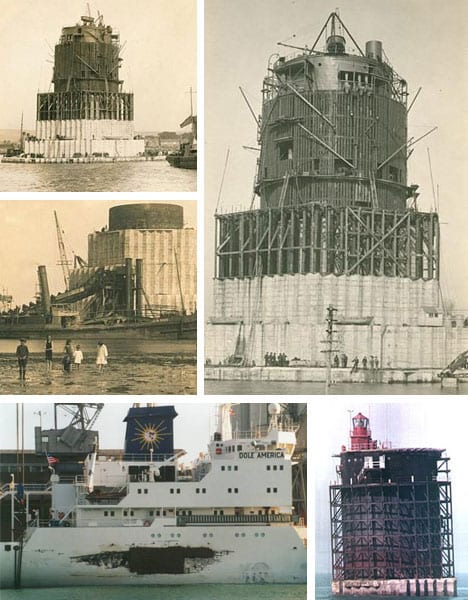
Military Guard Tower and Lighthouse
The Nab Tower, now a lighthouse, was created in 1918 near Southampton in order to protect merchant vessels from attacks by German submarines. At 40 feet wide, 90 feet tall and a cost of over a million dollars a piece, eight such towers were to be created and linked with steel nets to keep out U-boats. In the end, only this tower was constructed and installed – one other was scrapped after being partly built. The tower was built on a concrete base towed out to sea then filled with water so it would sink to the bottom. However, in the sinking process the structure tilted slightly and remains at a 3 degree angle. In 1999, the commercial (Dole) ship shown above allided with the tower.
We went to London to tell the story of pirate radio secret urban studios that transmit music from concrete tower blocks to the city, and met with DJs, and station managers, rappers and MCs. We met with DJ Scratcha from RINSE FM, MC Flirt from old school KOOL FM, J2k, Jammer, and Logan Sama. We uncovered how they stay underground and away from the authorities, while still setting the new music standard across London. We sailed to the source, where it all started massive concrete and steel forts that sit at the mouth of the Thames River. We met the people who pioneered the spirit of pirate, and played the music that London wanted to hear. They set the standard, and when the authorities shut them down, pirate sounds went into the urban underground.
___________________________
This post was written by Richard Rodriguez, Rescue Tug Captain, and US Coast Guard approved instructor for License Training. You can read more of his articles at the BitterEnd of the net.
RTX Corp. secured a multi-year Pentagon deal to dramatically increase production of Tomahawk Anti-Ship cruise missiles and SM-6 interceptors, weeks after President Trump criticized the defense contractor as "least responsive" to military needs.
The U.S. government is once again under fire for a long-standing shipbuilding habit: starting construction before designs are fully baked. The practice has repeatedly led to cost overruns, delays, and technical setbacks across several major maritime programs, the Government Accountability Office (GAO) has repeatedly pointed out in its reports.
After months of delay, the Pentagon will select as soon as this week the defense company to design and build the Navy's next stealth fighter, a U.S. official and two people familiar with the decision said, it will be a multibillion-dollar effort for a jet seen as central to U.S. efforts to counter China.
October 7, 2025
Total Views: 2907
Get The Industry’s Go-To News
Subscribe to gCaptain Daily and stay informed with the latest global maritime and offshore news
— just like 104,783 professionals
Secure Your Spot
on the gCaptain Crew
Stay informed with the latest maritime and offshore news, delivered daily straight to your inbox
— trusted by our 104,783 members
Your Gateway to the Maritime World!
Essential news coupled with the finest maritime content sourced from across the globe.

 Join The Club






 This post was written by Richard Rodriguez, Rescue Tug Captain, and US Coast Guard approved instructor for License Training. You can read more of his articles at the