On Monday, Alaskan state officials announced that the owners and operators of the bulk freighter, M/V Selendang Ayu, that sank off the north shore of Unalaska Island in the Bering Sea in 2004 have agreed to pay the state of Alaska nearly $850,000 to settle oil spill, wreck removal and lost fish tax claims.
The settlement with the vessels operator IMC Shipping Co. Pte. Ltd. (IMC) of Singapore and owner Ayu Navigation of Port Klang, Malaysia, brings the total amount of clean-up costs and fees to more than $112 million for the December 2004 sinking. The accident resulted in the a spill of approximately 336,000 gallons of fuel oil and diesel fuel.
With the exception of the Exxon Valdez, the penalty collected is the largest civil oil spill penalty ever recovered by the state of Alaska.
Flashback to December 2004
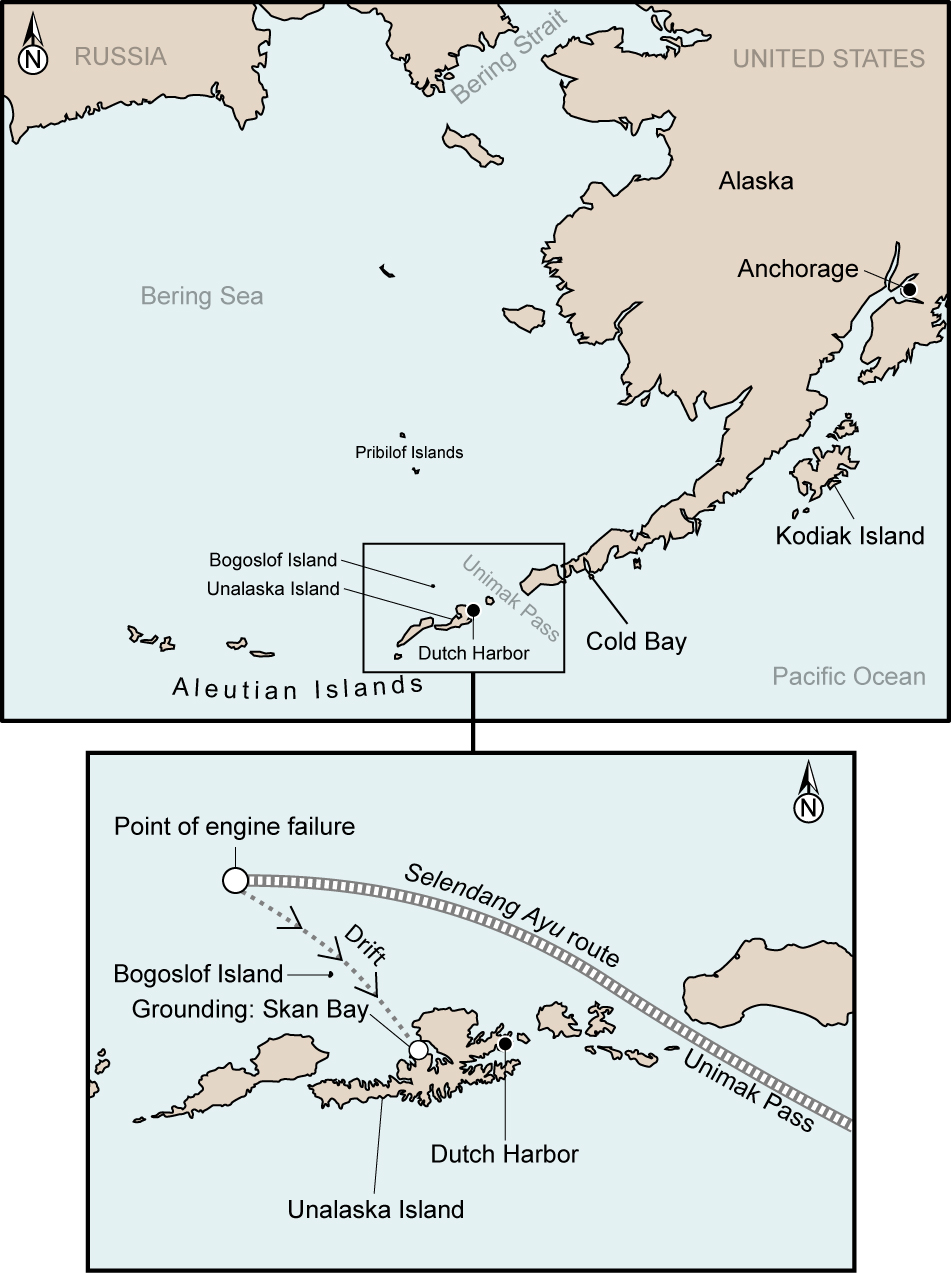
The Malaysian-registered bulk carrier M/V Seledang Ayu was on it’s was to China from Seattle, Washington with a crew of 26 and 60,200 metric tons soybeans. On December 6, as the vessel transitted through the Unimak Pass in the Aleutian Islands, she encountered heavy weather. Shortly after, the vessels engine failed from a crack in the liner of the main engines No. 3 cylinder and the freighter went adrift.
On the night of December 6, approximately 11 hrs after the engines initial failure and subsequent usuccessful attempts to restart it, the master made his first attempt to contact the harbormaster at Dutch Harbor over VHF channel 16. At a distance of 90 miles from Dutch Harbor, the Selendang Ayu was well out of VHF range and received no response. After a few more hours, the master finally contacted Dutch Harbor via the ship’s satellite phone and the USCG Cutter Alex Haley was dispatched to the vessels position.
On December 7, the cutter arrived on the scene along with the oceangoing tug Sidney Foss. Despite 25-foot waves and 45- to 55-knot winds, the Sidney Foss was able to maneauver around the vessel and begin to tow freighter.
Later, in the early morning hours of December 8, the harbor tug James Dunlap arrived to assist with the tow which was being hampered by the continuing strong winds and high seas that restricted the freighter’s bow from turning into the wind.Because of the sea state and the darkness, the masters of the Sidney Foss and the James Dunlap decided to wait until daylight before attempting to swing the bow of the Selendang Ayu around by putting a line on the stern. At 0732, the towline broke.
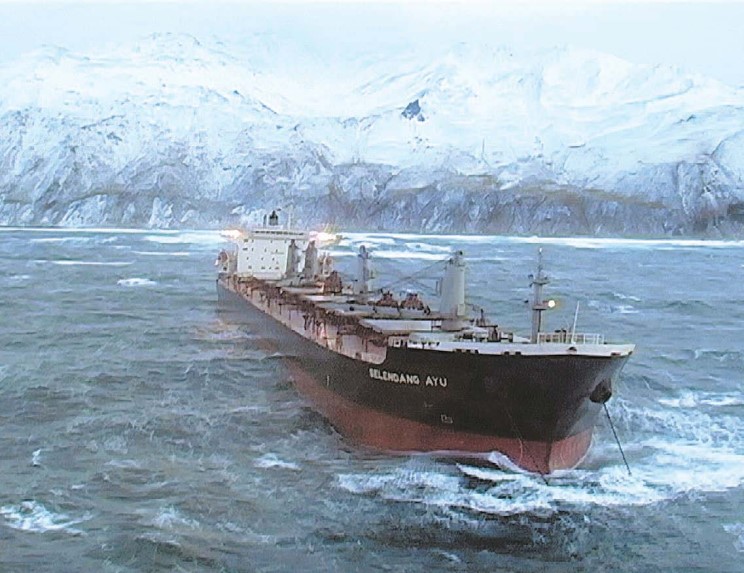
The Selendang Ayu, which was quickly closing in on the Unalaska Island coast, began to take precautionary measures to reduce the danger of a spill if the ship grounded and, upon recommendation of the Alex Haley, the Selendang Ayu dropped its port anchor.
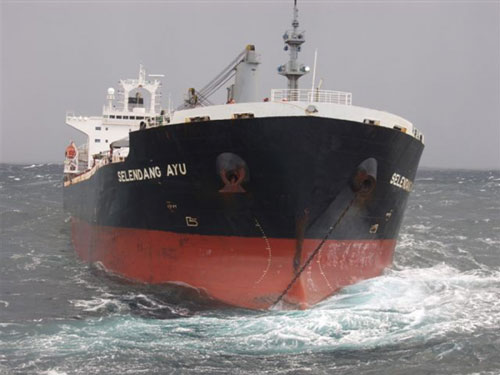
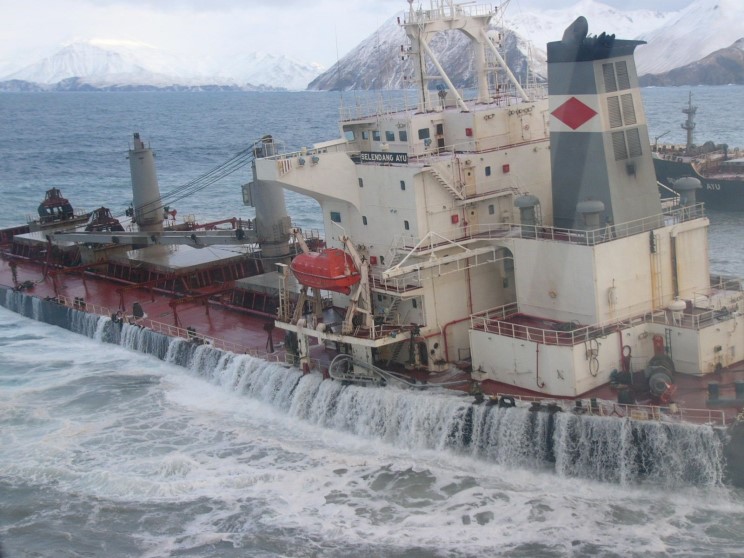
At first it appeared the the anchor was going to hold, but after only a short period it began to drag and the vessel again began to drift towards the shore. Requests to drop its starboard anchor were denied by the master, as the port’s chain was wrapped tight around the vessels stem (shown above). Last minute efforts by the Alex Haley to tow the drifting freighter were unsuccessful and attention was turned to evacuation of the crew.
About 1400, the Coast Guard began hoisting the first group of nine Selendang Ayu crewmembers from the deck of the freighter intothe first HH-60 helicopter that had arrived from nearby Cold Bay.At 1430, the second HH-60 helicopter arrived on scene.
The Selendang Ayu master lowered his starboard anchor. The Alex Haley‘s deck log reports that at 1450, the vessel was about 1 mile from the beach, holding to two anchors with 10 shots of chain on each.
At 1450, the first HH-60 helicopter completed its hoist and flew the nine Selendang Ayu crewmembers to the Alex Haley.Hovering above the cutter’s deck, the helicopter lowered the crewmembers one at a time in a basket.
Beginning at 1455, the second HH-60 helicopter hoisted on board the other group of nine crewmembers, all wearing lifejackets, and flew directly to a rendezvous point on Unalaska Island. Nine Selendang Ayu crewmembers were still on board the Alex Haley. Eight crewmembers remained on board the Selendang Ayu in an attempt to finish with the engine repairs.
With both anchors dragging, the master order the remaining crew to be evacuated, and the Selendang Ayu ran aground. The master noted the time of the grounding as 1705 on December 8.
When the vessel ran aground, the master ordered for immediate helicopter evacuation. With one of the two Jayhawk helicopters 30 min. away in Dutch Harbor, a smaller, medical helicopter which had been aboard the Alex Haley stepped into assist. The remaining HH-60 Jayhawk lowered a rescue swimmer to help the crewmembers into the basket that would hoist them into the helicopter. After the seventh crewmember had been hoisted on board the helicopter and while the Selendang Ayu master and the Coast Guard rescue swimmer waited on the freighter’s exposed bow, a wave larger than any yet encountered, according to witnesses, struck the bow of the freighter, sprayed up, and engulfed the HH‑60.
The HH-65 Dolphin helicopter from the Alex Haley had been hovering nearby observing the rescue effort when it witnessed the wave and the crash of the HH-60 Jayhawk and it immediately went into rescue mode. By 1836, the HH‑65 had recovered all three of the Jayhawk’s crew from the water but only one of the Selendang Ayu‘s seven crewmembers.
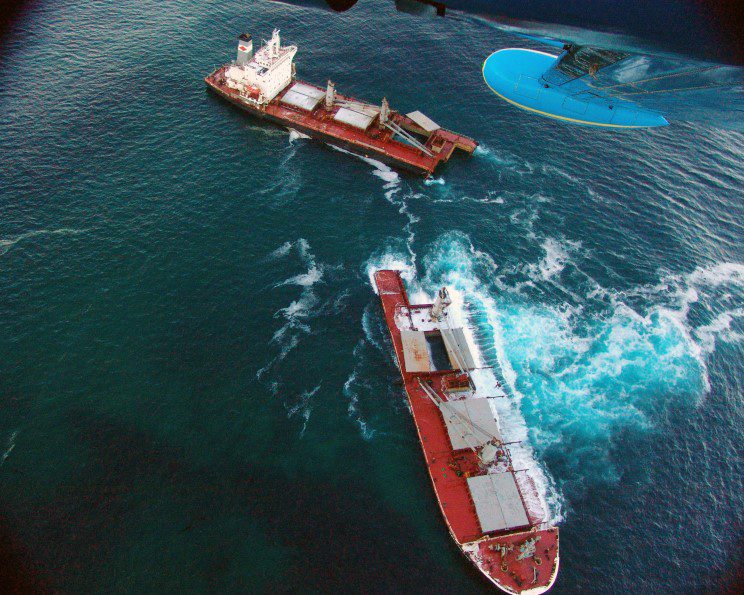
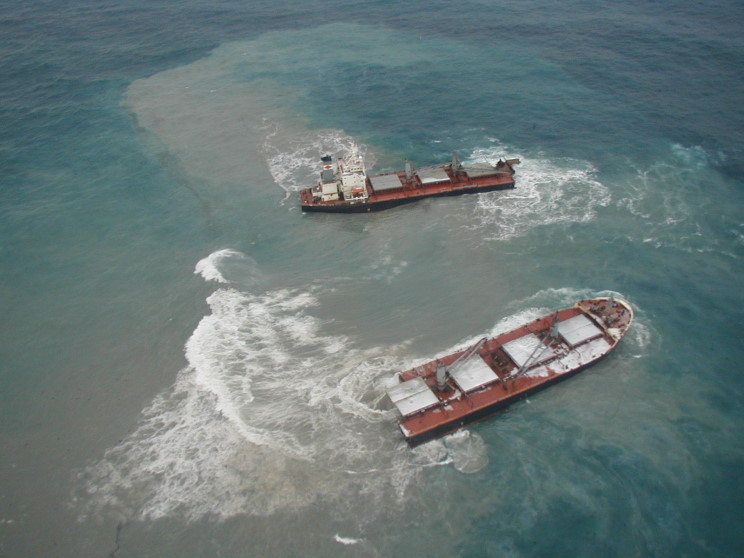
Finally, at 1913, with the master of the Selendang Ayu and Coast Guard rescue swimmer still awaiting rescue, the freighter broke in half on the rocks.
The chief engineer of the Selendang Ayu, the second engineer, the chief electrician, the chief mate, the third officer, and the bosun died in the accident. None of their bodies was recovered and they are presumed drowned.27 The accident resulted in a spill of approximately 336,000 gallons of fuel oil and diesel fuel that led to an environmental cleanup lasting until June 2006
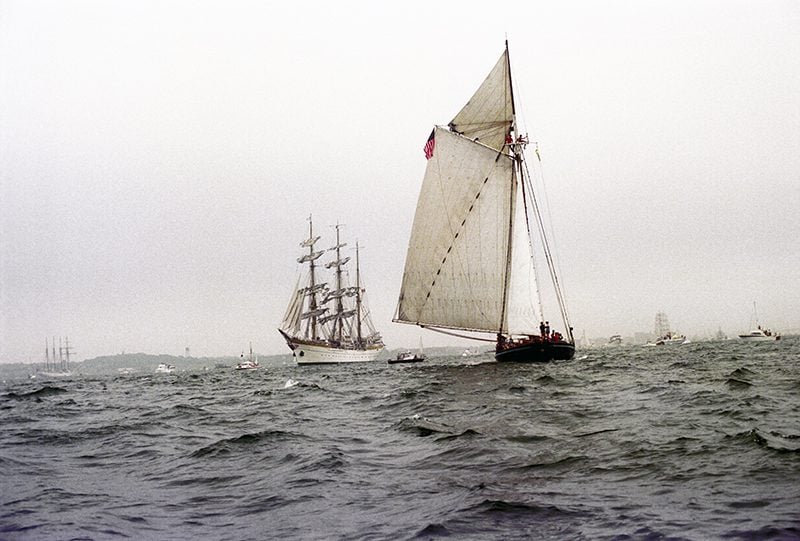
By Nicole Jao NEW YORK, July 4 (Reuters) – The U.S. Coast Guard said “politically charged” messages led to the removal of an environmental group’s vessel from a fleet of sailing ships gathered in...
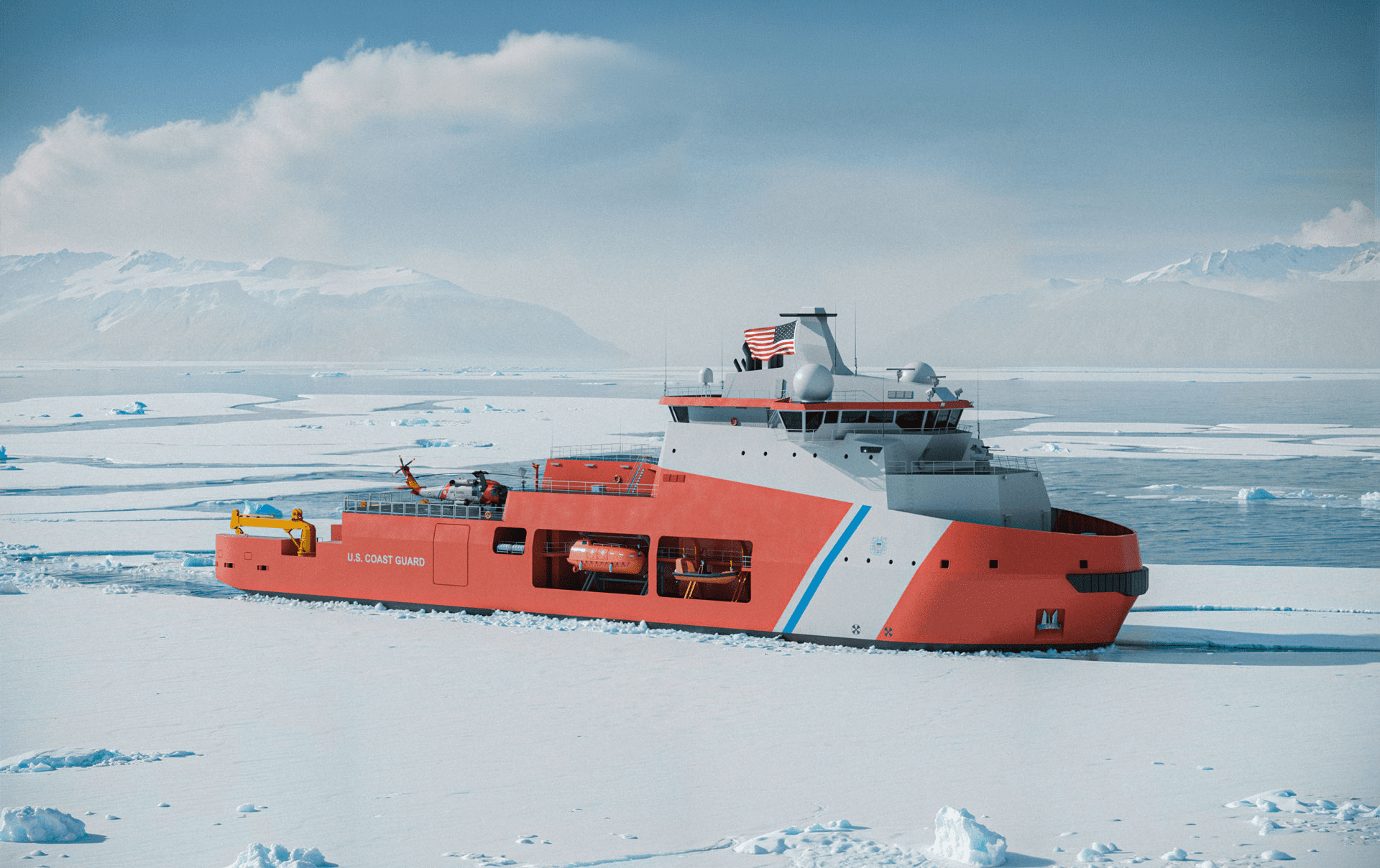
The United States has finalized contracts worth $3.3 billion for six new Arctic Security Cutters (ASCs), completing the procurement of the Coast Guard’s first major new medium icebreaker fleet in decades as one of the shipbuilders revealed construction on the lead vessel quietly began in April.
Construction of the first Arctic Security Cutter (ASC) for the U.S. Coast Guard began on Tuesday at Sata Shipbuilding’s yard in Pori, Finland, marking the start of a shipbuilding program that could ultimately transform the service into one of the world’s most capable Arctic maritime forces.
June 23, 2026
Total Views: 6839
Get The Industry’s Go-To News
Subscribe to gCaptain Daily and stay informed with the latest global maritime and offshore news
— just like 104,711 professionals
Secure Your Spot
on the gCaptain Crew
Stay informed with the latest maritime and offshore news, delivered daily straight to your inbox
— trusted by our 104,711 members
Your Gateway to the Maritime World!
Essential news coupled with the finest maritime content sourced from across the globe.

 Join The Club