Some of you may remember a cartoon which appeared during World War I, a drawing showing an inquisitive stranger talking with the gateman at a railway crossing. The gate was painted with the usual black and white stripes, and lying on the river beyond the tracks was a steamer painted with similar markings. The stranger asked, “Why do they paint the stripes on the gate?” And the gateman answered, “Oh, that’s to make them more visible.”
And then the stranger asked, “Well, why do they paint the stripes on the vessel out there?” And the gateman replied, “Oh, that’s to make the ship less visible.”
-Everett Warner [paraphrased from his lecture notes]
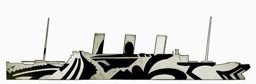
A ships in costume, gCaptain brings you Razzle Dazzle; history’s most unusually painted ship. What is Razzle Dazzle? GoTouring.com tells us;
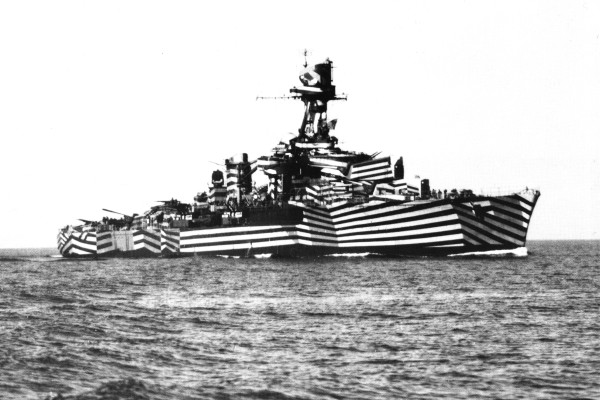
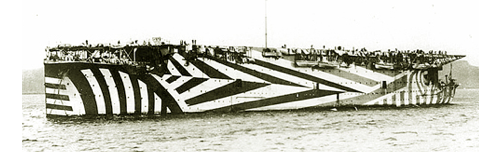
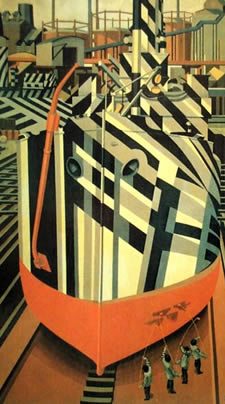
During World War I, the British and Americans faced a serious threat from German U-boats. All attempts to camouflage ships at sea had failed, as the appearance of the sea and sky are always changing. Any color scheme that was concealing in one situation was conspicuous in others. A British artist and naval officer, Norman Wilkinson, promoted a new camouflage scheme that was derived from the artistic fashions of the time, particularly cubism. Instead of trying to conceal the ship, it simply broke up its lines and made it more difficult for the U-boat captain to determine the ship’s course. The British called this camouflage scheme “Dazzle Painting.” The Americans called it “Razzle Dazzle.”
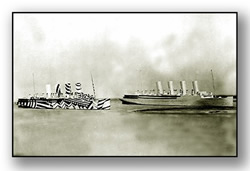
Artists were enlisted to draw up the camouflage designs. Early in the war, designs were drawn for individual ships, with each ship having its own distinctive pattern. As the war progressed, standard patterns were devised and applied to large numbers of ships. Even the great passenger liners were camouflaged for the duration of the War.
It is unfortunate that there are no color photographs of these WWI ships. People who witnessed convoys of dazzle painted ships reported that the scene was quite dramatic. Imagine sailing across the North Atlantic surrounded by dozens of brightly painted ships, each in different colors and patterns. If you compare the colored drawing with the black and white photograph of the ship “War Clover”, you can get an idea of how much we are missing. Read More…
.
The problem confronting a submarine, once his prey has been sighted, resolves itself solely into estimating course and speed of the target, in order to determine how the approach to torpedo fire position should be made. The “dazzle” system of painting is based on this one consideration and that is, of rendering the problem confronting a submarine more difficult, confusing him as to how his approach shall be made and thereby adding in some degree to the safety of the vessel attacked.
U.S. Admiral William S. Sims (1917)
Camopedia has this amazing information on the World War I design team assigned to the project;
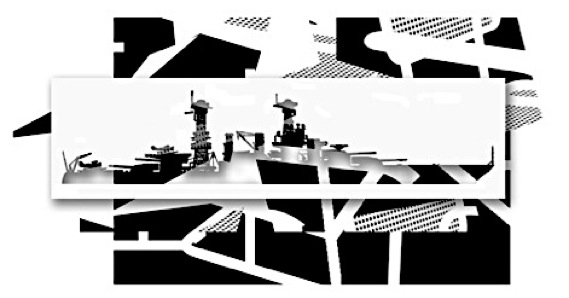
ONE METHOD camoufleurs might have used (but did not, apparently) to generate a large number of unique dazzle schemes is the stencil method.
It is indebted to American artist Abbott Handerson Thayer (1849-1921), sometimes called “the father of camouflage,” who (circa 1909) devised a clever, easy way for individuals to design their own camouflage, using cut-out silhouettes.
Whatever the surrounding, said Thayer, a person “has only to cut out a stencil of the soldier, ship, cannon or whatever figure he wishes to conceal, and look through this stencil from the viewpoint under consideration, to learn just what costume from that viewpoint would most tend to conceal this figure.” However, the purpose of dazzle camouflage was confusion, not concealment, so, in the examples below, we have used the silhouette as a mask with which to “find” valuable dazzle designs in an abstract, geometric plan. In studies of human vision, Gestalt psychologists and others have investigated embedded figures or “puzzle pictures” (Wolfgang Köhler called them “camouflaged figures”) in which a simple shape has been adroitly hidden within a larger, more complex surrounding.
In pre-computer days, one could make arbitrary compositions in art by overlapping “systems” on layers of tracing paper, viewed on a light table. Today, it is ever so easy to do the same thing (and much more) by using the “layers” function in software such as Adobe Photoshop. This could have been useful as a way to generate dazzle designs, had all that been available in World War I.
By Maha El Dahan (Reuters) – Iran’s Revolutionary Guards seized an Israeli-linked cargo ship in the Strait of Hormuz on Saturday, days after Tehran said it could close the crucial...
By Kit Rees (Bloomberg) UK Prime Minister Rishi Sunak is committing hundreds of millions of pounds to Britain’s nuclear deterrent and energy infrastructure as part of a “critical national endeavour”...
By Nafisa Eltahir (Reuters) – The only effective and efficient way to deliver heavy goods to meet Gaza’s humanitarian needs is by road and includes an exponential increase in commercial deliveries, U.N....
March 25, 2024
Total Views: 2351
Why Join the gCaptain Club?
Access exclusive insights, engage in vibrant discussions, and gain perspectives from our CEO.
This website uses cookies to improve your experience while you navigate through the website. Out of these, the cookies that are categorized as necessary are stored on your browser as they are essential for the working of basic functionalities of the website. We also use third-party cookies that help us analyze and understand how you use this website. These cookies will be stored in your browser only with your consent. You also have the option to opt-out of these cookies. But opting out of some of these cookies may affect your browsing experience.
Necessary cookies are absolutely essential for the website to function properly. This category only includes cookies that ensures basic functionalities and security features of the website. These cookies do not store any personal information.
Any cookies that may not be particularly necessary for the website to function and is used specifically to collect user personal data via analytics, ads, other embedded contents are termed as non-necessary cookies. It is mandatory to procure user consent prior to running these cookies on your website.

 Join The Club





 “find” valuable dazzle designs in an abstract, geometric plan. In studies of human vision, Gestalt psychologists and others have investigated embedded figures or “puzzle pictures” (Wolfgang Köhler called them “camouflaged figures”) in which a simple shape has been adroitly hidden within a larger, more complex surrounding.